The Mohs Scale
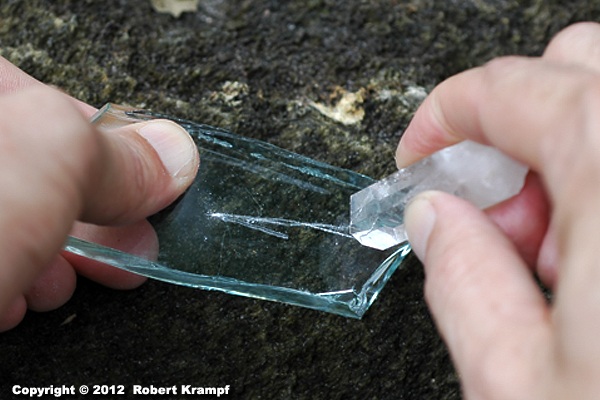
The property of hardness has historically been measured according to the Mohs scale, which was created in 1824 by the Austrian mineralogist Friedrich Mohs. Mohs based his system for measuring and describing the hardness of a sample upon the definition of hardness as resistance to scratching. Mohs' method thus relies upon a scratch test in order to relate the hardness of a mineral specimen to a number from the Mohs scale.
In order to define his scale, Mohs assembled a set of common reference minerals of varying hardnesses and labled these in order of increasing hardness from 1 to 10. The reference minerals of the Mohs scale are as follows:
- Talc
- Gypsum
- Calcite
- Fluorite
- Apatite
- Orthoclase
- Quartz
- Topaz
- Corundum
- Diamond
Each reference mineral will scratch a test specimen with a Mohs hardness less than or equal to its own. Each reference mineral can be scratched by a specimen with a hardness equal to or greater than its own. If a reference mineral both scratches and can be scratched by a certain test specimen, then the specimen is assumed to possess a hardness equal to that of the reference mineral in question.
The set of reference minerals of the Mohs' scale can be supplemented by a few common household items. A fingernail has a Mohs hardness of 221; a copper penny 3, window glass 521, and a knife blade approximately 6.
The hardness of an unknown sample can be determined to within 21 increment by using the scratch test. Mineral hardnesses determined by the scratch test should never be given in decimal form, because the Mohs scale does not provide measurements of such precision.
The hardness of a mineral may vary with direction and crystallographic plane. This effect is usually small. However, species exist in which the variance in the hardness along different axes is notable. For example, the mineral kyanite (Al2OSiO4) typically forms elongated crystals. The Mohs hardness parallel to the length of a kyanite crystal is 5, whereas the Mohs hardness perpendicular to the length of such a crystal is 7. A second example is provided by the mineral halite, which is softer parallel to its cleavage planes than it is at a 45° angle to the cleavage planes.