促动因素:二次方程式的因子定理

Illustrated · 1 min

Factor Theorem

The word "factor" is thrown around a lot in algebra. We most commonly see it when dealing with quadratics. Think about how many problems have had you simplify something like x2+4x+3x^2+4x+3 into (x+1)(x+3)(x+1)(x+3). We use this process when we solve quadratics because of the factor theorem which states:

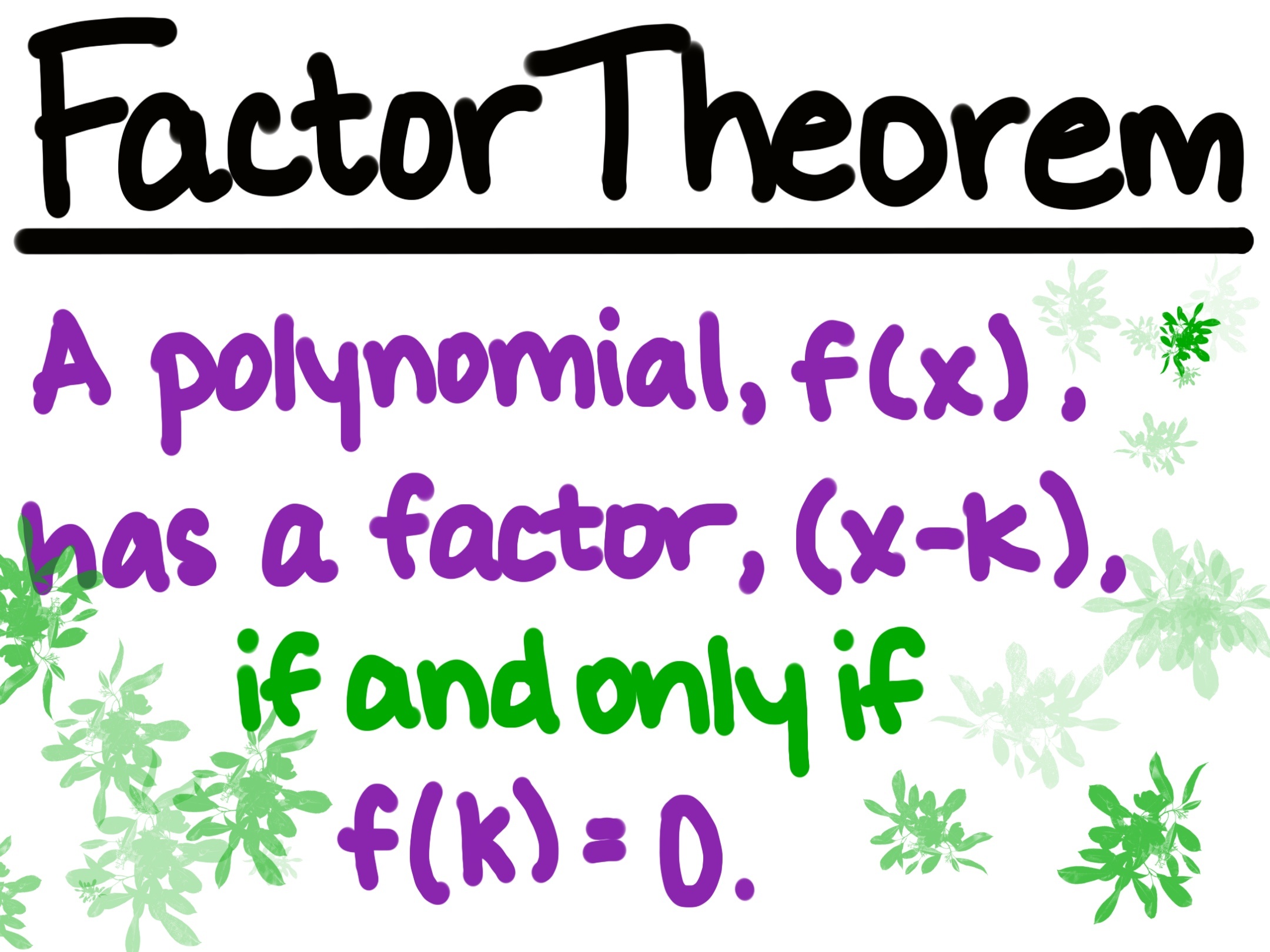
"A polynomial, f(x)f(x), has a factor, (x−k)(x-k), if and only if f(k)=0f(k)=0".

Let's look at the phrase "if and only if". This is something that is seen in many mathematical theorems and can be thought of as "event aa can only happen if event bb happens". For this theorem, it means that factors in polynomials will only be valid in the the form of (x−k)=0(x-k)=0.

Keep in mind, this kind of functions as the alternative to polynomial long division or synthetic division, where we divide a polynomial by a factor.

Factor Theorem and Standard Form

Let's look at the equation x2+4x+3=0x^2+4x+3=0 again. This is a polynomial of degree 22. We know that this factors out to (x+1)(x+3)=0(x+1)(x+3)=0. Through this factorization we also know that the solutions to this equation are x=−1x=-1 and x=−3x=-3. This process works because we are setting them equal to 00. We could've also used the quadratic formula.

Let's say that we were instead looking at x2+4x+3=8x^2+4x+3=8. We could factor the left side of the equation in the same way, but the resulting answers won't be the roots of the function. x2+4x+3=8(x+3)(x+1)=8x+3=8x=5x+1=8x=7\begin{align}x^2+4x+3&=8\\ (x+3)(x+1)&=8\\ x+3&=8\\ x&=5\\ \\ x+1&=8\\ x&=7\end{align}

We need to put the equation into standard form so we can solve for xx values when y=0y=0. x2+4x+3=8x2+4x−5=0(x+5)(x−1)=0x=−5,1\begin{align}x^2+4x+3&=8\\ x^2+4x-5&=0\\ (x+5)(x-1)&=0\\ x&=-5,1 \end{align} The true roots of this quadratic are x=−5x=-5 and x=1x=1. We can check this by looking at the graph of y=x2+4x+3y=x^2+4x+3.

The roots of this quadratic are at the points (-5,0) and (1,0)

Made with Desmos

When we graph the equation, we think of it as y=x2+4x+3y=x^2+4x+3, and the roots occur on the graph at (−5,0)(-5,0) and (1,0)(1,0). We solve the quadratic while it is set to 00 because we are trying to find the xx-values when y=0y=0.

Video

(Video) Factor Theorem

by Brian McLogan

In this video by Brian McLogan, you'll learn about the factor theorem and how to use it.

Summary

The Factor Theorem says that a function f(x)f(x) only has a factor (x−k)(x-k) if and only if f(k)=0f(k)=0.

Let's consider the factors of 1212.

2⋅612⋅14⋅3−2⋅−6−12⋅−1−4⋅−3\begin{align} 2 \cdot 6 \\ 12 \cdot 1 \\ 4 \cdot 3 \\ -2 \cdot -6 \\ -12 \cdot -1 \\ -4 \cdot -3 \\ \end{align}

All of these factors evenly divide into the original number, 1212. That means there will be no remainders! We will use the same logic when considering the Factor Theorem. If the polynomial equation f(x)f(x) has a factor of (x−k)(x-k), then that means that the factor (x−k)(x-k) must evenly divide into this polynomial.

One way you can tell that the remainder will be 00 is by using synthetic or long division. However, you can use the Remainder Theorem by plugging in the zero into the polynomial to see if we get a solution of 00. Then, we can prove that because there is a remainder of 00, the factor is indeed a factor of our polynomial.

Illustrated · 1 min

Factor Theorem

The Factor Theorem is a tool we use in algebra to help us figure out if a number is a factor of a polynomial.

Factor Theorem: A polynomial, f(x), has a factor, (x-k), if and only if f(k)=0.

Image source: by Anusha Rahman

The Factor Theorem says that if you have a polynomial f(x)f(x) and you substitute a number kk into the equation and get zero, then x−kx-k is a factor of that polynomial. In other words, if f(k)=0f(k)=0, then x−kx-k is a factor of the polynomial f(x)f(x).

This theorem is useful because once you find a factor, you can divide the polynomial by it to simplify the problem and find other factors. This method is especially helpful when you’re solving quadratic equations, which are polynomials with degree 22.

####Example

Let's say that we have the polynomial f(x)=x2−5x+6f(x)=x^2 - 5x +6. To check if x−2x-2 is a factor, we substitute x=2x=2 into the polynomial.

f(2)=22−5(2)+6=4−10+6=−6+6=0\begin{align} f(2) &= 2^2 - 5(2) +6 \\ &= 4 - 10 + 6 \\ &= -6 + 6 \\ &= 0 \\ \end{align}

Since f(2)=0f(2)=0, the Factor Theorem tells us that x−2x-2 is a factor of the polynomial.

The Factor Theorem also leads us into imaginary numbers when we find that a polynomial has no real solutions but has imaginary ones instead. This is a key idea in understanding quadratic functions and how they behave. In future lessons, we’ll explore how to solve quadratics using the Factor Theorem and how imaginary numbers come into play when the solutions aren't real numbers.

Looking Further

In the next lesson, you will learn about completing the square, which will help you to convert between different forms of quadratics. After you've conquered that, you will learn how to find a quadratic from three points.

Type a concept, like “slope” or “photosynthesis”.

↑ ↓ to choose · Enter to openSearch explanations and problems