In this video by Nancy Pi it is explained how to find the vertex of a parabola.
There are two forms a parabola can come in: standard form, and vertex form.
Standard Form
A parabola in standard form has the general equation:
y=ax2+bx+c
An example of this is y=−2x2+4x+1.
To find the x-coordinate for the vertex, you first need to calculate:
−2ab
Using our example, this is:
−2ab=−2(−2)4=1
Thus, our vertex point is at (1,?).
To find the y-coordinate, we just plug our x value back into the equation.
yyyy=−2x2+4x+1=−2(1)2+4(1)+1=−2+4+1=3
So the vertex of this parabola is at the point (1,3).
Vertex Form
A parabola in vertex form has the general equation:
y=a(x−h)2+k
An example of this is y=2(x−1)2+3.
This form gives us the vertex automatically. The vertex is (h,k). Looking at our given equation, the vertex is (1,3).
Be careful with this form. We want to make sure the h is being subtracted: (x−h)2.
So if we were given the equation y=2(x+3)2+4, we would want to rewrite this as:
y=2(x−(−3))2+4
This tells us the vertex is at (−3,4).
Find the vertex of the parabola.
y=2(x+1)2−4
Find your level
The problems run from approachable to very hard, and each is rated by how often real students solve it, so you can pick your next step. These are real problems from the AMC 12 and AIME, the national math competitions for middle and high school students, each with a worked solution on LIVE by Po-Shen Loh.
For this lesson, we want to go from standard from to an equation with a perfect square trinomial.
That means, we are trying to go from this:
ax2+bx+c=0
...to this form of the equation:
a(x+d)2+e=0
This second, transformed, equation is the vertex form of a quadratic function. We also use completing the square when deriving the quadratic formula.
This transformation is calling completing the square. We will manipulate terms, add and subtract, multiply and divide terms.
Completing the Square: Background
To understand how to complete the square, we have to go back to the formula for the square of a binomial.
Remember that when we square a binomial, we use the form:
(x+a)2=x2+2ax+a2
But not all quadratic equations will be of that form with the constant term being a perfect square, so we use completing the square to transform the quadratic. Let's consider the following quadratic:
x2+6x+12
, where we know that 2ax=6x→a=3. So, the perfect square trinomial will look like: x2+6x+9. However, that's not the quadratic that we are solving.
In order to complete the square, your quadratic equation must first be in standard form, ax2+bx+c=0. That means all of the terms must be on the left hand side.
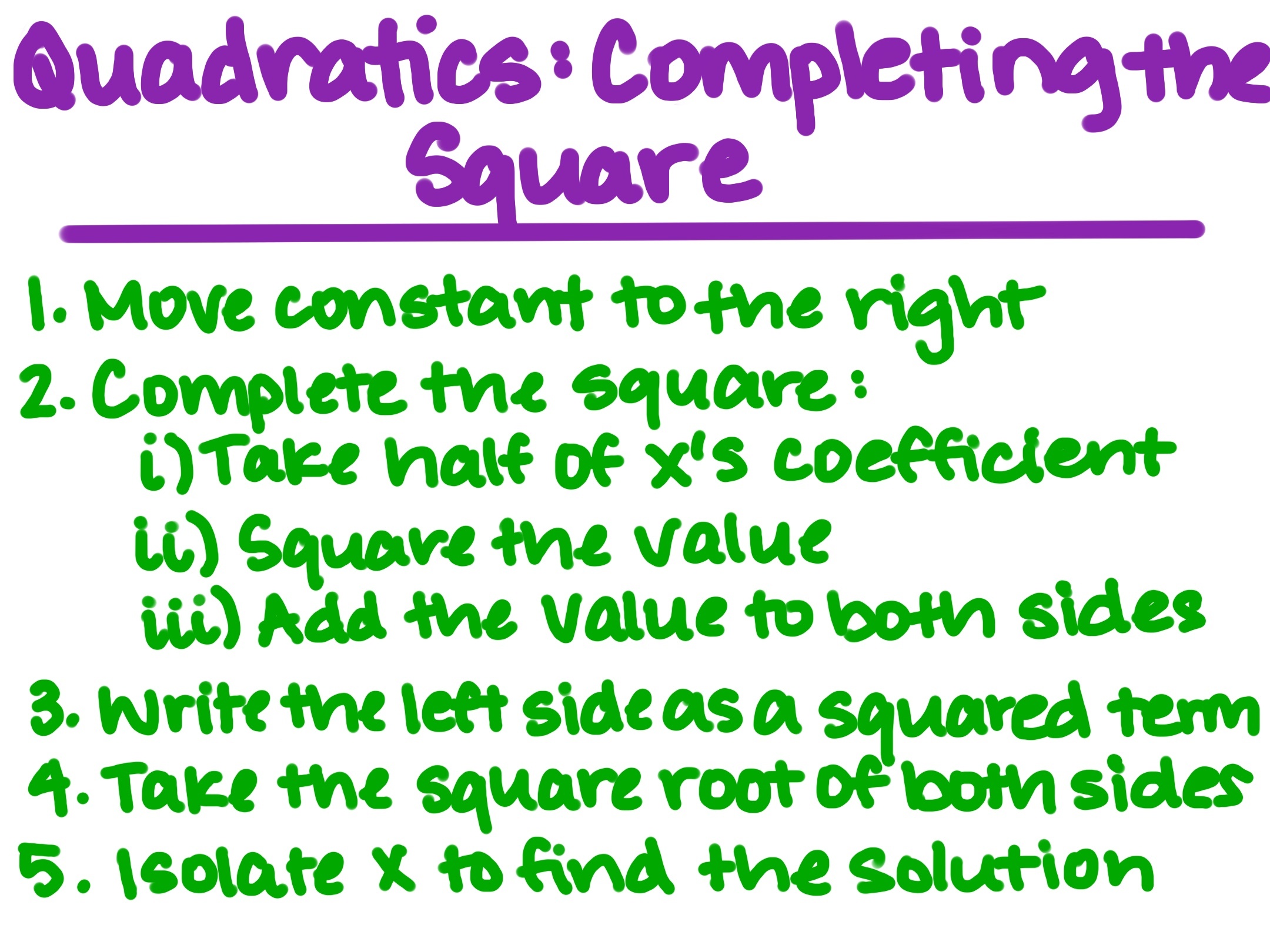
There are five steps to completing the square:
Divide all terms by a, in order for a=1.
Move the constant term to the right side of the equation.
Complete the square by adding (2b)2 to both sides, and simplify. This is your vertex form.
Take the square root of both sides.
Simplify and solve for x.
Example
Solve x2+4x+3=0 by completing the square.
Divide all terms by a, in order for a=1.
In this case, a=1
Move the constant term to the right side.
x2+4x=−3
Complete the square by adding (2b)2 to both sides, and simplify.
x2+4x+(24)2x2+4x+4(x+2)2=−3+(24)2=−3+4=1
Take the square root of both sides.
(x+2)2(x+2)=1=±1
Simplify and solve for x.
x+2xORx+2x=1=−1=−1=−3
Test your knowledge: try this example on your own!
Solve this quadratic by completing the square: x2+10x+15=0
(Video) Find the Turning Point of Quadratic Graphs
by HEGARTYMATHS
Here's a video by HEGARTYMATHS showing you how to use the method of completing the square to find the turning point or vertex. Previously when completing the square, we turned the problem into the form (x+21b)2−(21b)2+c. From here we can easily find out what the vertex of the graph is. The vertex will always be the opposite of the number inside the parenthesis and the exact number outside the parenthesis. So the vertex will be (−21b,c−(21b)2).
Test Yourself: Find the vertex of x2−4x−3 by completing the square.
In this lesson, we will learn how to complete the square to solve quadratic equations. You might remember that quadratic equations can look like this: ax2+bx+c=0. We've also learned how to find the roots (or solutions) of these equations.
Now, we'll focus on a new method to solve them: completing the square.
Image source: by Anusha Rahman
The idea behind completing the square is to turn the quadratic equation into a perfect square trinomial, which is an expression that looks like (x+p)2, where p is some number. The trick is to adjust the equation so that the left side is a perfect square.
Let's walk through an example.
x2+6x−7x2+6xx2+6x+9(x+3)2x+3x=1 or x=−7=0=7=7+9=16=±4
Completing the square works every time, and it's a great way to solve quadratic functions that don't easily factor. A good tool for your toolbox!