Read · 1 min
Suppose that we have a tank of static incompressible fluid. Most liquids are close to incompressible, so this is fairly realistic. This means that we may assume that the liquid has a uniform density .
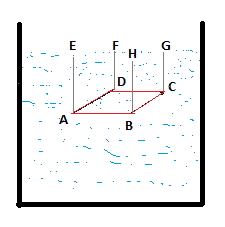
Suppose that we have a thin plate of area at a depth . The thickness of the plate doesn't matter.
The pressure on all of the vertical walls of the plate cancels out; thus, we only need to consider the pressure on the top and the bottom. Also, the pressure on the plate on the top and bottom due to Pascal's Principle also cancel out. Thus, the only remaining force is the weight of the fluid on top of it. The pressure on the surface results only from the weight of this fluid.
The weight of the fluid above it is: where is the volume of the fluid.
Calculating the pressure,
Thus, we have that the pressure at a depth is the product of the depth, the density of the fluid, and the gravitational acceleration.
This also means that the pressure difference between two points is directly proportional to the height difference: Notice that this derivation is only so simple because the fluid is incompressible and gravity is roughly constant. In a gaseous medium, or in an experiment with more variability in gravitational strength, an accurate calculation of the pressure would require the following integration: However, in virtually all cases, the approximations are good enough for us to work with and get accurate results.