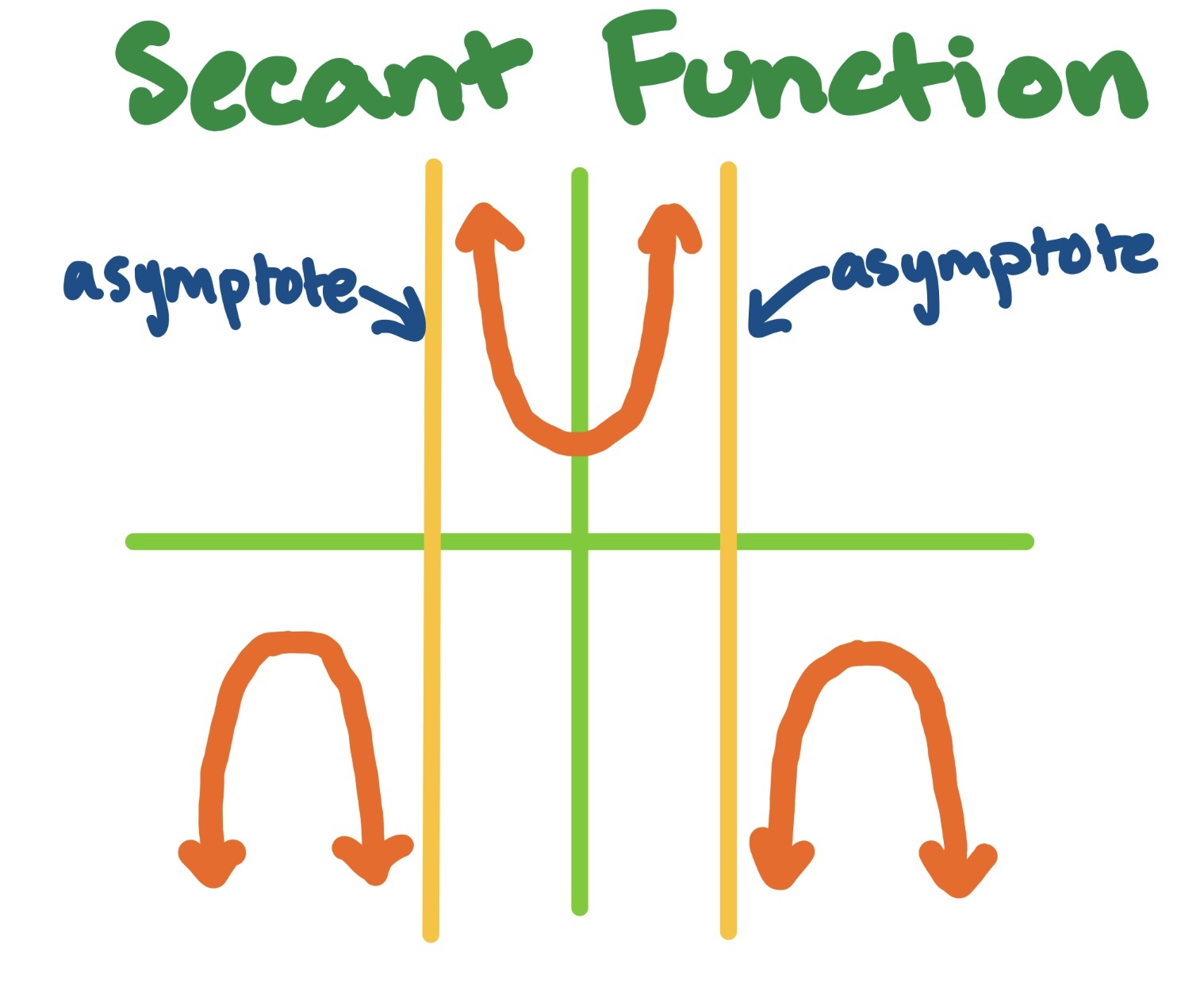
In this video by Brian McLogan, you will learn what the domain, range, and vertical asymptotes of the secant function are.
Summary
Let's start with the domain and range of the secant function. To do that, we will first graph the cosine function. The cosine function looks like:
From here, we know that every x-intercept becomes a vertical asymptote on the secant function. From here, we know that our secant graph approaches our vertical asymptotes. So, our secant graph looks like:
This function is going to repeat in both the positive and negative directions. To get the domain, we need to find all of the x values that are part of this function. Because the function goes on forever in both directions, it is easier to first look at which values of x the secant function cannot be, which is where the vertical asymptotes come into play!
We can see that there are vertical asymptotes at 2π, −2π, 23π, and −23π. This pattern goes on forever in both directions.
So, we know that our domain is all real numbers, except for those asymptotes. We know that the distance between each asymptote is π. So we can represent the domain as: x=2π+πn.
Next, we will look at the range of the function, which is all possible y values. There are no horizontal asymptotes, so we have to think through this a little differently. If we look at our graph, we notice that our range is: (−∞,−1] and [1,∞).