绘制反三角函数图像

Before this, know反三角函数:求值

Illustrated · 2 min

We have learned to graph a variety of trig functions, like sine and cosine, but now let's learn how to graph the reciprocal functions: secant, cosecant, and cotangent.

##Graph the Secant Function

To graph any of the reciprocal trig functions, start off with the parent function of the corresponding sine, cosine, or tangent graph.

Let's start off with graphing secant. The reciprocal of secant is cosine, and we have already learned how to graph cosine.

Graph of cosine with the points (0, 1), (pi/2, 0), (pi, -1), (3pi/2, 0), and (2pi, 1) labeled.

Made using Desmos

We know that sec⁡(θ)=1cos⁡(θ)\sec(\theta) = \frac{1}{\cos(\theta)}. Therefore, we know secant is undefined when cosine is 0. In other words, there will be a vertical asymptote wherever cosine is 0. Looking at the parent graph of cos⁡(θ)\cos(\theta) above, we can see that there will be vertical asymptotes in the graph of secant when x=π2±πx = \frac{\pi}{2} \pm \pi.

We know that the reciprocal of one is one, so the wherever cos⁡(θ)=1\cos(\theta)=1 or −1-1 on the graph will be the same point on the secant graph.

Once we have these points written on our graph, we can look at the direction the cosine graph goes, then do the opposite for the secant graph. In other words, when we look at the point where cos⁡(θ)=1\cos(\theta) = 1, the graph immediately decreases before and after that point. Therefore, in the secant function, the function will increase before and after the same point.

Using all this information we have gained from the cosine graph, we can now graph secant!

Graph of secant with the points (0,1) and (pi, -1) labeled. Asymptotes x = pi/2 and x = 3pi/2 labeled.

Made using Desmos

In this graph, we can see that the points (0,1)(0,1) and (π,−1)(\pi, -1) are the same in both the cosine and secant graphs. We can also see the asymptotes at x=π2±πx = \frac{\pi}{2} \pm \pi

##Graph the Cosecant Function

We can follow a similar process that we did to graph the secant function. We can look at the graph of the reciprocal function of cosecant, which is sine, and look at the xx-intercepts, points where sin⁡(θ)=1\sin(\theta) = 1 and −1-1, and the end behavior relative to the known points.

Let's look at the graph of sin⁡(θ)\sin(\theta).

Graph of sine function with the points (0, 0), (pi/2, 1), (pi, 0), (3pi/2, -1), and (2pi, 0) labeled.

Made using Desmos

Looking at this graph, we can see that there are xx-intercepts at (0,0)(0,0), (π,0)(\pi, 0), and (2π,0)(2\pi, 0). Therefore in the cosecant graph, we know there will be vertical asymptotes at x=0±πx = 0 \pm \pi.

We also know that the points (π2,1)(\frac{\pi}{2}, 1) and (3π2,−1)(\frac{3\pi}{2}, -1) will be the same in the cosecant graph.

Using these two points as a reference point, we can determine the end behavior of the graph. For example, at the point (π2,1)(\frac{\pi}{2}, 1), in the sine function the graph decreases before and after the point. Therefore, in the cosecant graph, the graph will increase before and after this point.

Now, let's graph cosecant!
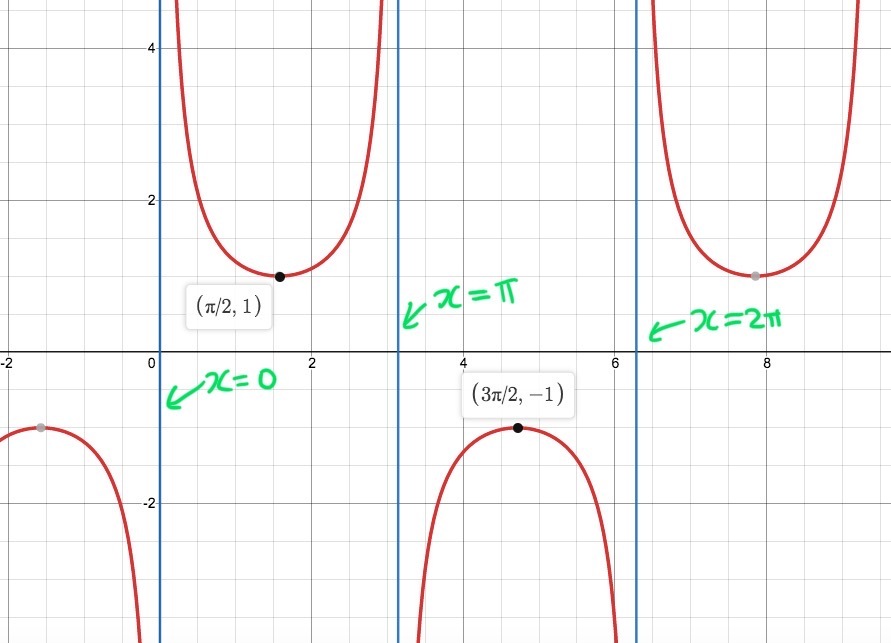
Graph of cosecant with points (pi/2, 1) and (3pi/2, -1) labeled. The asymptotes x = 0, x = pi, and x = 2pi are labeled.

Made using Desmos

On the graph, we can see the points (π2,1)(\frac{\pi}{2}, 1) and (3π2,−1)(\frac{3\pi}{2}, -1) labeled along with the asymptotes x=0,x=πx = 0, x = \pi, and x=2πx = 2\pi.

##Lastly, Graph Cotangent

By now, you've gotten the hang of it!

Let's check out the graph of tan⁡(θ)\tan(\theta).

Graph of tangent function with points (0,0), (pi/4, 1), (pi, 0), (5pi/4, 1), (2pi, 0), and (9pi/4, 1).

Made using Desmos

Using the method we learned above, we can graph cotangent:
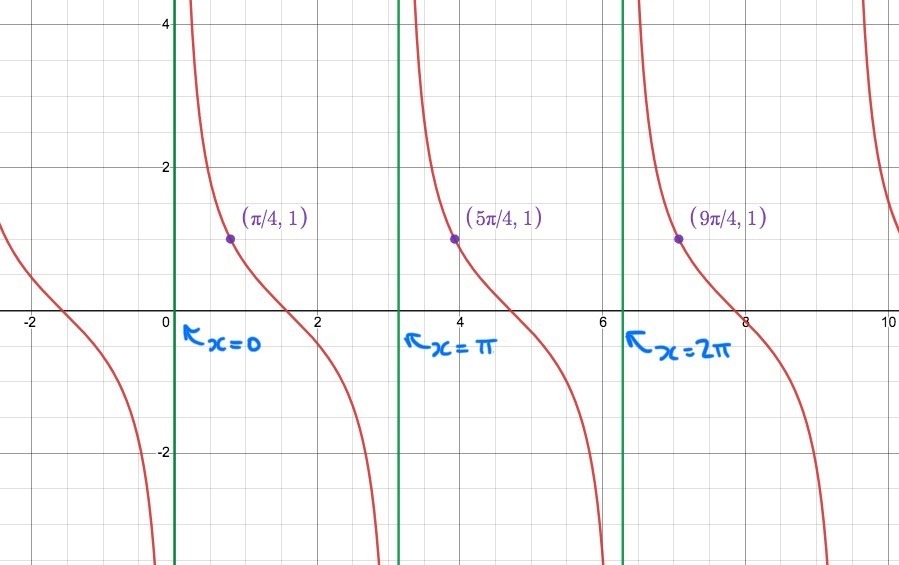
Graph of cotanget with the points (pi/4, 1), (5pi/4, 1), and (9pi/4, 1) labeled. Asymptotes x=0, x=pi, and x=2pi labeled.

Made using Desmos

We can see that the xx-intercepts in the tangent graph are the vertical asymptotes in the cotangent graph. We can also see that the points (π4±π,1)(\frac{\pi}{4} \pm \pi, 1) are the same in both graphs. The end behavior relative to these points is also opposing.

Video

(Video) Graphing Reciprocal Functions: Secant and Cosecant

by Mario's Math Tutoring

In this video by Mario's Math Tutoring, you will learn about graphing two reciprocal trig functions, specifically secant and cosecant.

Video

(Video) Graphing Reciprocal Trig Functions

by Anusha Rahman

In this video by Anusha Rahman, you will learn about the reciprocal trig functions and how to graph them.

Summary

To graph reciprocal trig functions:

  • Identify asymptotes based on the reciprocal of the corresponding primary trigonometric function (i.e., cosecant and sine)
  • Find the amplitude and period of the function
  • Plot key points, including intercepts
  • Sketch the curve by connecting points and beware of the asymptotes!

Illustrated · 1 min

Graphing Reciprocal Trig Functions

In this lesson, we will learn about reciprocal trig functions. You already know the three main trig functions: sine, cosine, and tangent. Each of these has a reciprocal function - the flipped version.

Reciprocal Trig Functions
The graph in purple is y=sin(x).

The reciprocal trig function of sine is cosecant.

The graph in green is y=csc(x).

The graph in purple is y=cos(x).

The graph in purple is y=tan(x).

The reciprocal trig function of tangent is cotangent.

The graph in green is y=cot(x).

The reciprocal trig function of cosine is secant.

The graph in green is y=sec(x).

Image source: by Anusha Rahman

Let's take a step back and think about what reciprocal means. If you have the number 22, the reciprocal is 12\frac12. So, if we apply that to trig: if sin(θ)\text{sin}(\theta), then csc=10.5=2\text{csc} = \frac{1}{0.5} = 2. We can do the same thing for both cosine and tangent.

The reciprocal of sine is cosecant (csc). The reciprocal of cosine is secant (sec). The reciprocal of tangent is cotangent (cot).

An important thing to note: you can't divide by zero! So, reciprocal trig functions don't exist when the original functions are zero. So, if sine is 00, then cosecant doesn't exist.

Type a concept, like “slope” or “photosynthesis”.

↑ ↓ to choose · Enter to openSearch explanations and problems
