
Illustrated · 3 min
Plucked instruments
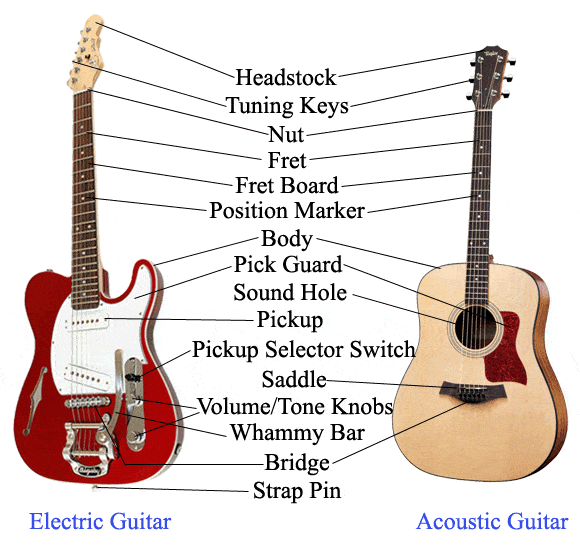
Both acoustic and electric guitars rely on the same mechanisms to produce sound, although they rely on different processes to amplify sound.
All plucked string instruments share some components, or have some equivalent component that operates similarly. Plucked string instruments contain one or more strings that are plucked with the fingers or a pick in order to produce sound. The player usually plucks the strings with one hand and presses down on the strings at specific points with the other hand in order produce distinct pitches and in turn, music.
Tension is applied to the strings through the use of tuning keys or similar structures that can be rotated to adjust the tension of each string. As the tension on each string is increased, the frequency at which the string vibrates at when plucked increases, resulting in a higher-pitched note.
Constantly adjusting the pitch produced through the strings through the tuning keys alone would be quite tiring and limit the speed at which notes could be played. Hence, most plucked instruments also include a fretboard or other flat surface against which the strings can be pressed against. By reducing the portion of the strings that are able to vibrate when plucked, the frequency of the strings' vibrations are also increased. By quickly manipulating the locations where strings are pressed against the fretboard, notes can be played much more quickly and much more accurately than with the tuning keys alone.
The vibrations produced through the plucked strings then travel down along the string to the bridge, which carries the vibrations from the strings into the hollow body of the instrument in acoustic instruments. In electric instruments, the vibrations are instead captured by an electronic pickup, which converts the vibrations into electric signals.
In acoustic instruments, the vibrations enter the hollow body of the instrument and are amplified within the cavity before exiting through the sound hole or other opening in the body. The sound waves exit the instrument and then enter the ear, where they are interpreted by the brain as music.
In electric instruments, the process is similar. However, the task of amplifying the signal is instead handled by an electric amp. The electric signal transmitted from the electric instrument is carried through wires to an amp, where the electric signal is converted back into sound waves and played back.
Bowed instruments
With bowed instruments, the process for creating sound is very similar. However, a bow is used to create vibrations in the string instead of using the fingers or a pick. The bow hair is sometimes coated in rosin or other substances in order to produce more sound when pulled across the strings.
Like with plucked instruments, the other hand is used to press the strings against a fingerboard or other flat surface in order to produce distinct pitches. Tuning pegs or other similar mechanisms also exist on most bowed instruments.
The vibrations are then carried through the strings to a bridge, where they enter a hollow cavity to be amplified. Electric bowed instruments usually lack a cavity, and instead rely on a pickup to capture the vibrations and require a speaker or amp to produce sound, just like electric plucked instruments.
Keyboard instruments
Some keyboard instruments also rely on strings to produce sound. Pianos and harpsichords produce sound by using small wooden hammers to hit strings. Unlike plucked and bowed instruments, the length of the strings is not altered to produce sound; instead, a separate string exists for each possible note.