不等式:绝对值表达式

Video · + 2 min read

(Video) Matching Number Lines with Absolute Value Inequalities

by PatrickJMT
This video by Patrick JMT Hows how to turn absolute value inequalities into compound inequalities.

Summary\large{\text{Summary}}

He starts out by graphing the absolute value inequality: ∣x∣>9|x|>9.

The absolute value symbol makes negative numbers positive.

Let's start by looking at what positive numbers (and zero) satisfy the inequality. We can see that 00 through 88 won't work since they're all less than 99. And, 99 won't work either since the inequality is strictly greater than. But 1010 would work since it's greater than 99. So we can graph:

An open circle on 9 with the line and arrow going to the right.

Image source: Ben Ferrara

Let's look at the negative numbers: −1-1 through −8-8 would simplify to 11 through 88 respectively. We know those won't work. We also know we are looking for numbers strictly greater than 99. The absolute value of −9-9 is 99, so −9-9 won't work. But −10-10 would simplify to 1010 and that works. So everything below −9-9 would be made positive and be greater than 99. Therefore, we can graph:

An open circle on -9  with a line and arrow going to the left.

Image source: by Ben Ferrara

Therefore, we turned the absolute value inequality into a compound inequality: x<−9orx>9x<-9\quad\text{or}\quad x>9

Next up, Patrick looks at the inequality: ∣x∣≤6|x|\le 6

To turn this absolute value inequality into a compound inequality, again, we start with the positive numbers (and zero). We include 00 through 55 since they're all less than 66. We also include 66 since we have a less than or equal to sign. We do not include 77 since it's bigger than 66.

A closed circle on 6 with a line extending to 0.

Image source: by Ben Ferrara

Next, look at the negative numbers. Notice that −1-1 through −5-5 simplify to 11 through 55 respectively. These are all less than 66. Likewise, −6-6 simplifies to 66, which we include since the sign is less than or equal to. Finally, −7-7 simplifies to 77, which we don't include since it's greater than 66. We can graph:

Closed circle on -6 and 6 with a line connecting them.

Image source: by Ben Ferrara

So, we turned the absolute value inequality into a compound inequailty: −6≤x≤6-6\le x\le6

Closed circles on -3 and 3 with a line connecting them.

Image source: by Ben Ferrara

What inequality is being represented above?

Choose one answer

Read · 4 min

Turning Absolute Value Inequalities Into Compound Inequalities

Translate absolute value inequalities into compound inequalities to solve. If the absolute value is greater than a number, use an OR inequality. If it's less, use an AND inequality.

Remember absolute value? As a quick review, when you take the absolute value of a number, the result is the non-negative version of the number. For example,

∣−5∣=5∣5∣=5, since 5 is already non-negative∣0∣=0, since 0 is already non-negative|-5| = 5\\ |5| = 5, \text{ since } 5 \text{ is already non-negative}\\ |0| = 0, \text{ since } 0 \text{ is already non-negative}

An absolute value inequality is an inequality involving an absolute value. We can split these inequalities into compound inequalities.

Let's look at some examples of solving the inequality.

Turning Absolute Value Inequalities into AND Compound Inequalities\textbf{Turning Absolute Value Inequalities into AND Compound Inequalities}

Consider the following absolute value inequality:

∣x∣<6|x| < 6

Say xx is a non-negative number. Since the absolute value sign does not affect non-negative numbers, let's look at the inequality without it.

x<6\boxed{x < 6}

This is the first part of our compound inequality! Easy! But what happens if xx is a negative number?

If xx is negative number, we can't just drop the absolute value sign and be done with it! Let's investigate further what happens when xx is negative.

Say x=−1x = -1. Then, ∣x∣=∣−1∣=1|x| = |-1| = 1. Indeed, 1<61<6.

Say x=−2x = -2. Then, ∣x∣=∣−2∣=2|x| = |-2| = 2. Indeed, 2<62<6.

Say x=−3x = -3. Then, ∣x∣=∣−3∣=3|x| = |-3| = 3. Indeed, 3<63<6.

Say x=−4x = -4. Then, ∣x∣=∣−4∣=4|x| = |-4| = 4. Indeed, 4<64<6.

Say x=−5x = -5. Then, ∣x∣=∣−5∣=5|x| = |-5| = 5. Indeed, 5<65<6.

Say x=−6x = -6. Then, ∣x∣=∣−6∣=6|x| = |-6| = 6. But 66 is not less than 66.

Say x=−7x = -7. Then, ∣x∣=∣−7∣=7|x| = |-7| = 7. But 77 is not less than 66.

And so on.

When xx is negative, the only values of xx that satisfy the inequality are ones that are greater than −6-6.

x>−6\boxed{x > -6}

Otherwise, when we take the absolute value of x,x, the inequality is not upheld!

Now, let's put our two discoveries together. We know when xx is non-negative, then x<6\boxed{x < 6}, and when xx is negative, then x>−6\boxed{x > -6}. If we make this into a compound inequality, we get:

−6<x<6-6 < x < 6

This is an AND compound inequality. Whenever you have an absolute value inequality of the form

∣x∣<a|x| < a

where aa is a non-negative constant, you can make it into an AND compound inequality that looks like this:

−a<x<a-a < x < a

This works for ≤\leq inequalities too!

Turning Absolute Value Inequalities into OR Compound Inequalities\textbf{Turning Absolute Value Inequalities into OR Compound Inequalities}

Consider the following absolute value inequality:

∣x∣>7|x| > 7

If xx is a non-negative number, the absolute value sign does not affect it, so we have: x>7\boxed{x > 7}

This is the first part of our compound inequality.

Now let's say xx is negative number. Let's plug some numbers in for xx and see what happens.

Say x=−1x = -1. Then, ∣x∣=∣−1∣=1|x| = |-1| = 1. But 11 is not greater than 77.

Say x=−2x = -2. Then, ∣x∣=∣−2∣=2|x| = |-2| = 2. But 22 is not greater than 77.

Say x=−3x = -3. Then, ∣x∣=∣−3∣=3|x| = |-3| = 3. But 33 is not greater than 77.

Say x=−4x = -4. Then, ∣x∣=∣−4∣=4|x| = |-4| = 4. But 44 is not greater than 77.

Say x=−5x = -5. Then, ∣x∣=∣−5∣=5|x| = |-5| = 5. But 55 is not greater than 77.

Say x=−6x = -6. Then, ∣x∣=∣−6∣=6|x| = |-6| = 6. But 66 is not greater than 77.

Say x=−7x = -7. Then, ∣x∣=∣−7∣=7|x| = |-7| = 7. But 77 is not greater than 77.

Wait, last time we had valid inequalities by now! Why isn't it working this time?

For this example, we need to go past −7-7 in order to get a valid inequality.

Say x=−8x = -8. Then, ∣x∣=∣−8∣=8|x| = |-8| = 8. Indeed, 8>78>7.

Say x=−9x = -9. Then, ∣x∣=∣−9∣=9|x| = |-9| = 9. Indeed, 9>79>7.

Say x=−10x = -10. Then, ∣x∣=∣−10∣=10|x| = |-10| = 10. Indeed, 10>710>7.

And so on.

When xx is negative, the only values of xx that satisfy the inequality are ones that are less then than −7-7.

x<−7\boxed{x < -7}

Now, let's put our two inequalities together. We know when xx is non-negative, then x>7\boxed{x > 7}, and when xx is negative, then x<−7\boxed{x < -7}. If we make this into a compound inequality, we get:

x<−7 OR x>7x < -7 \text{ OR } x>7

This is an OR compound inequality! For future reference, whenever you have an absolute value inequality of the form

∣x∣>a|x| > a

where aa is a non-negative constant, you can make it into an OR compound inequality that looks like this:

x<−a OR x>ax < -a \text{ OR } x>a So, in summary:\textbf{So, in summary:}

Whenever you have an absolute value inequality of the form:

∣x∣<a|x| < a

where aa is a non-negative constant, you can make it into an AND compound inequality that looks like this:

−a<x<a-a < x < a

Whenever you have an absolute value inequality of the form:

∣x∣>a|x| > a

where aa is a non-negative constant, you can make it into an OR compound inequality that looks like this:

x<−a OR x>ax < -a \text{ OR } x>a

If you get a longer expression within the absolute value signs, you can follow the same steps, but also consider the steps to solve compound inequalities!

Illustrated · 1 min

The patterns of "and" and "or" inequalities

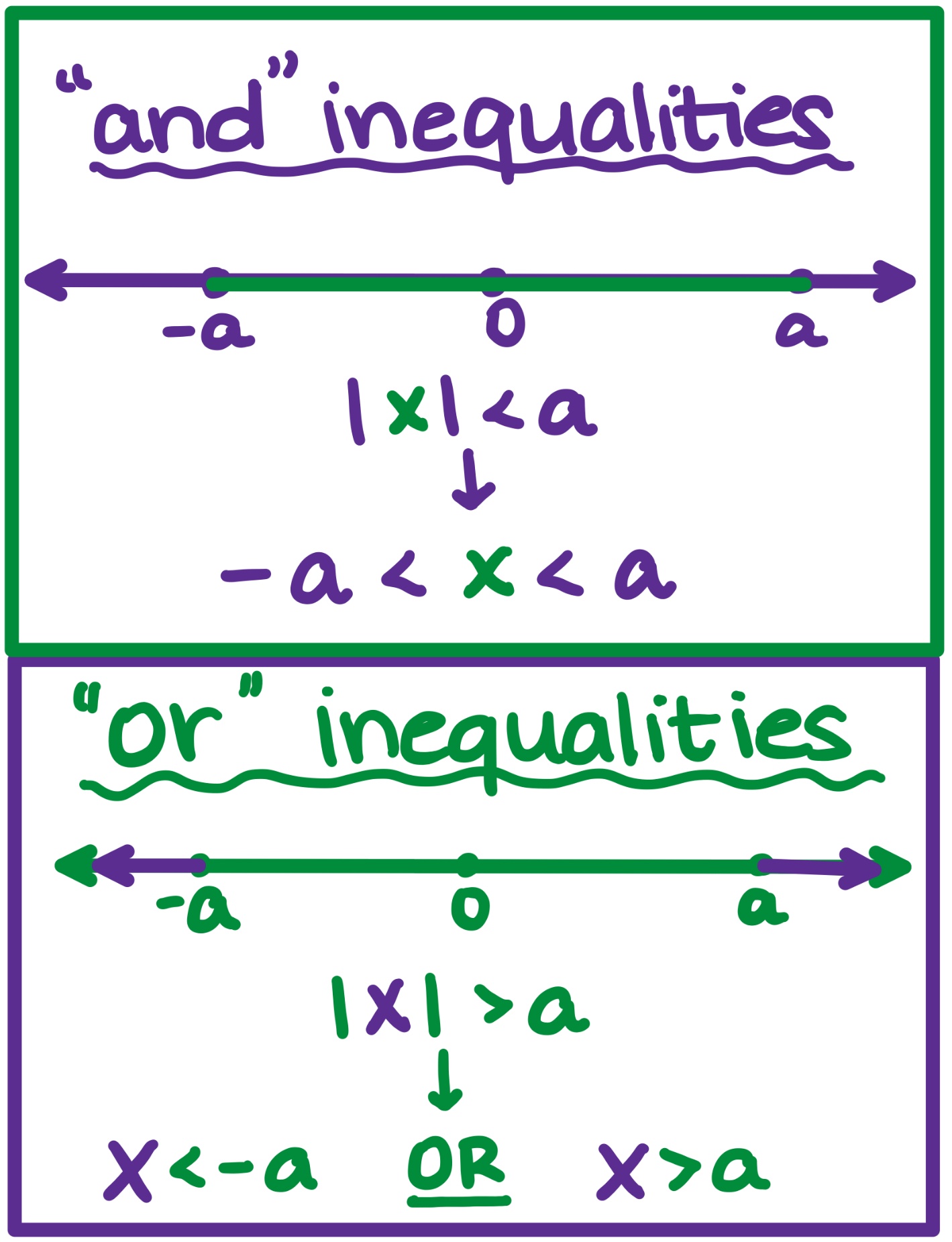
When we're faced with absolute value inequalities, it can feel daunting at first to figure out how to solve the problem. The good news is that there are two main patterns for when we're solving these types of problems!

"and" inequalities
Number line from $-a$ to $a$, with a line connecting the two points.
$|x|<a --> -a<x<a$

"or" inequalities
Number line from $-a$ to $a$, with an arrow going out from each point.
$|x| > a --> x<-a OR x>a$

Image source: by Anusha Rahman

You may face problems that are a little more difficult that this basic structure, but this pattern will stay relatively the same when tackling absolute value inequalities.

Type a concept, like “slope” or “photosynthesis”.

↑ ↓ to choose · Enter to openSearch explanations and problems