Here's a video by patrickJMT showing you how to solve a quadratic inequality. In this example he factors but you solve it the same way if you choose to use the quadratic formula instead.
Our next lesson in the series of solving systems of nonlinear inequalities is about solving nonlinear inequalities using the quadratic formula! Previously, we've seen how to solve these via graphing and via substitution, and those methods will still work with these type of nonlinear inequalities. However, remember that the quadratic formula is in your arsenal!
Quadratic Inequalities
The most obvious requirement for these types of problems is that the inequality must be a quadratic. An example of a nonlinear inequality with a quadratic is:
x2+4x<3
These types of inequalities are called quadratic inequalities because there is a quadratic within the inequality. These inequalities are quadratic because they meet the requirement of having a power of 2, i.e., having the x2 term.
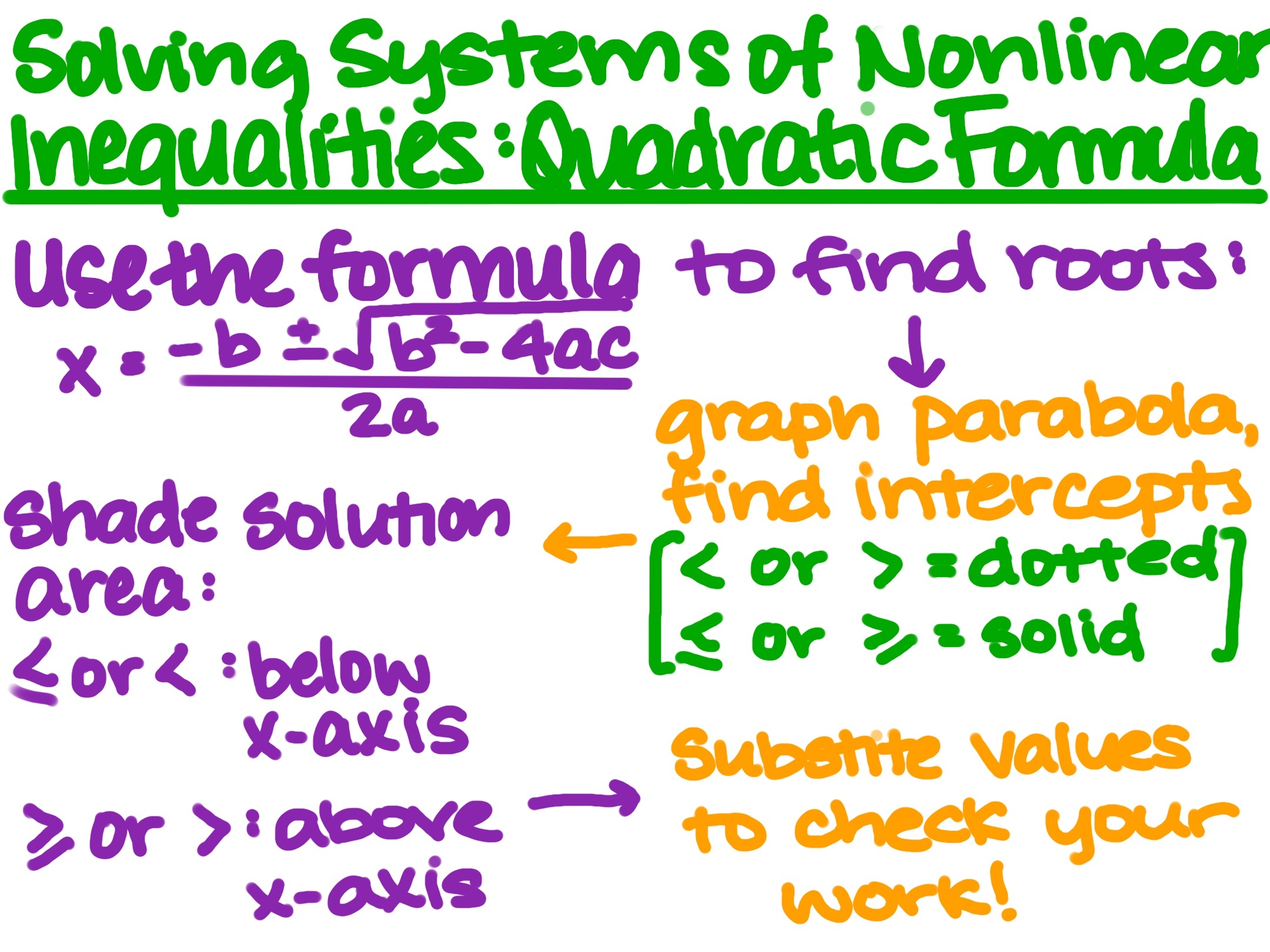
As a review, to solve quadratic inequalities, you first want to find the zeroes, which are the points where the function crosses the x-axis, just like with quadratic equations. The biggest difference is that we are looking for an interval of solutions, as this is an inequality. Once we find the zeroes, we need to test values to see what the interval is. We pick a value between the zeroes, and then plug in that value to see if it's true or not. That's how we find the region that represents our solution! These steps are similar to how we've previously solved systems of inequalities.
Systems of Quadratic Inequalities
Now that you understand the basics, we can spice this up a little bit by considering systems of quadratic inequalities. Our work is going to look very similar to factoring, except we will now use the quadratic formula to find the zeroes instead.
Remember, the quadratic formula is:
x=2a−b±b2−4ac
So, to solve systems of quadratic inequalities, we will use the quadratic formula to find the zeroes. Then we will find the interval on which the inequality is true.
Let's walk through an example!
Example
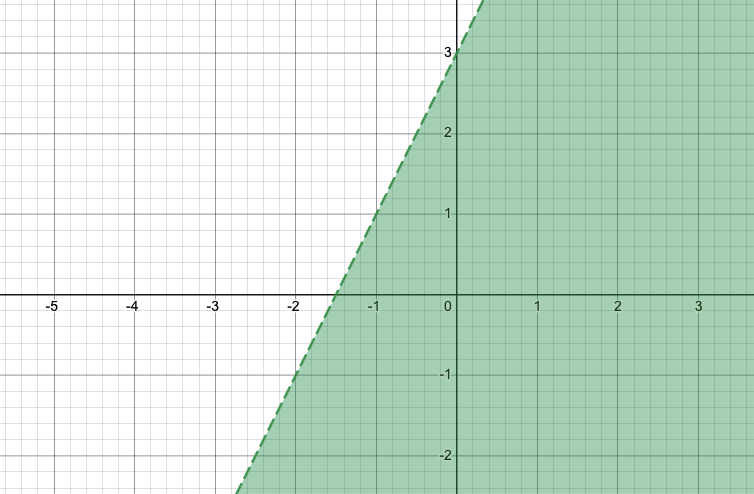
{y>x2+2x−1y<2x+3
Solution
We can see that this system of inequalities has one quadratic component and one linear component. We will first tackle the quadratic component. Previously, we've seen factoring as our method of solving the quadratic, but now we'll use the quadratic formula.
From our quadratic equation, we have determined that the roots to the quadratic are: 2−2±8. The vertex can be found at (−1,−2). If we were to graph this associated equation, y=x2+2x−1, it would look like:
We know our line should be dotted, since the inequality is >.
Our next step is to figure out the shaded regions. We can use the zeroes, 2−2±8, as boundaries to figure out which areas are shaded. Let's first test a value between the two zeroes.
For x=−1,
0>x2+2x−10>(−1)2+2(−1)−10>1−2−10>−2
Because this statement is true, we know the region containing the point is shaded.
Let's test a point outside of the boundaries of the zeroes, just to double check our work.
For x=2,
0>x2+2x−10>(2)2+2(2)−10>4+4−10>7
This statement is false, so the regions outside of the boundaries of our zeroes is not shaded. We could have inferred this from our previous determination, but it's always a good idea to double check!
Systems of Nonlinear Inequalities: Using the Quadratic Formula
We've used the quadratic formula a lot before, and we're about to learn a new application for it!
Image by: Anusha Rahman
We can now solve a quadratic nonlinear inequality using the quadratic formula! When given a system of nonlinear inequalities, we can first find the roots. After applying the quadratic formula, we can find the solutions. The overlapping shaded region is the solution area.
Some systems are better solved using elimination, especially when variables can be removed algebraically.