什么是函数?

Video

(Video) Introduction to Functions

by mathman1024

In this video, mathman1024 explains the basics of functions.

Summary\large{\text{Summary}}

Here's an example of a relation: {(2,3),(4,1),(0,1),(2,−2),(−1,5)}\{(2,3),(4,1),(0,1),(2,-2),(-1,5)\}

Sometimes when we put a bunch of ordered pairs together, we get a pattern that creates a graph.

A graph of sin x.

Made using Desmos

Definition of a function

Now let's learn about functions. A function is a relation where each xx is paired with no more than one yy. Note that the same yy can be paired with different xx's, but not the reverse. All linear equations, with the exception of vertical and horizontal lines, are functions.

Is {(2,3),(4,1),(0,1),(2,−2),(−1,5)}\{(2,3),(4,1),(0,1),(2,-2),(-1,5)\} a set of values that could come out of a function?

Choose one answer

Interactive · 4 questions

Functions - What are Those?!

In math, think of a function like a little machine. We give it an input, like putting a penny into a gumball machine. The job of the function is to produce an output for each input we give it.

If the input is like a penny into a gumball machine, then the output is like the gumball. The function is the gumball machine itself—the thing changing the input to the output.

Input: penny
Function: gumball machine
Output: gumball

Image source: by Hannah Bonville

So, we obviously can't draw a gumball machine every time we want to write down a function in math. Instead, functions are written down like this: f(x)f\left(x\right)

No matter how we write our function, you can still think of it as out little gumball machine, giving an output for each input.

Let's look at an example of a simple function.

f(x) = 2x
Input: f(x)
Output: 2x

Image source: by Hannah Bonville

Note also that we don't have to use xx when we write our functions. You can use any letter you want.

The function above (in pink) says that "for each xx we put in, we get 2x2x out."

Input (x) // Output (2x)
1 // 2(1) = 2
2 // 2(2) = 4
3 // 2(3) = 6
4 // 2(4) = 8
5 // 2(5) = 10

Image source: by Hannah Bonville

Let's use the same function:

f(x)=2xf(x) = 2x

What is the value of f(x)f(x) if x=12x=12?

Choose one answer

Video · + 1 min read

(Video) Functions and Relations

by Eddie Woo

Here's a video by Eddie Woo where he briefly goes over the fundamentals of functions.

Summary\large{\text{Summary}}

What are Functions?

A function is a kind of rule that, for one input, it gives you one output.

1 input into some rule gives 1 output

Image source: by Alex Federspiel

An example of this would be y=x2y=x^2. If you put in anything for xx, you get one output for yy. We would say that yy is a function of xx since xx is the input value.

(Video) Function Notation

by Eddie Woo

Function Notation

The way to denote a function is by using the letter ff. We then have parentheses that contain our input. Usually, we see an xx here. Then we set the function equal to something which is our output, or yy. f(x)=yName(Input)=Outputf(x)=y\\ \text{Name}(\text{Input})=\text{Output}

Note that these do not need to be f,x,f,x, or yy. For example: A(r)=πr2A(r)=\pi r^2 AA is what we're naming this function, because it stands for area. More specifically, area of a circle. This is a function because if we put in an input, there's only one output. We say AA is a function of rr. Our input in this example is rr, or the radius. The output is πr2\pi r^2, or what the actual area is.

How function notation works is whatever number you see as the input, you substitute that into the equation for the respective variable. A(5)=π(5)2A(5)=25π\begin{align} A(5)&=\pi({\color{#8925AE}{5}})^2\\ A(5)&=25\pi \end{align}

You can also have functions that have multiple inputs. V(r,h)=πr2hV(r,h)=\pi r^2h This is a function for the volume of a cylinder and its inputs are radius and height. We would say here that VV is a function of rr and hh.

Read · 1 min

We can think of functions as a machine. We can plug in a value, and our machine will do something to it, and it will output a result. For example, f(x)=2x+3f(x)=2x+3 is basically plugging in any number, which our machine will double and add 33 to, yielding a result.

The (x)(x) that follows the ff means that we are putting xx into the function ff. The xx is really a dummy variable, because it is just a placeholder. When we input a specific value, we replace xx with that value. For example, f(5)f(5) using the function we set above would turn out to be 2(5)+3=132(5)+3=13 When we read f(x)f(x) we say "f of x."

The domain of a function is all the values that can be put into the machine and result in an output. The range of a function is all the possible outputs.

Do you want to try an example?

Consider the function f(x)=2x2−5f(x)=2x^2-5.

What is the domain of this function? Try to figure this out yourself before continuing!

All real values will work for xx, our function will always produce a result equal to 2x2−52x^2-5. Therefore, our domain is R\mathbb{R}!

Now, this is a bit trickier, but you will be able to do it :):)

What is the range of ff? Remember, the range is all the outputs of the function. Try to reason through it.

We know that 2x22x^2 must be positive. Thus, 2x2−5≥−52x^2-5 \geq -5. This means ff cannot output numbers smaller than −5-5. We can check that all the other values greater than or equal to −5-5 work, and when it all checks out, we know that the range is [−5,∞)[-5,\infty).

Video · + 1 min read

(Video) What are Functions?

by Math Antics

In this video, mathantics explains what a function is.

Summary\large{\text{Summary}}

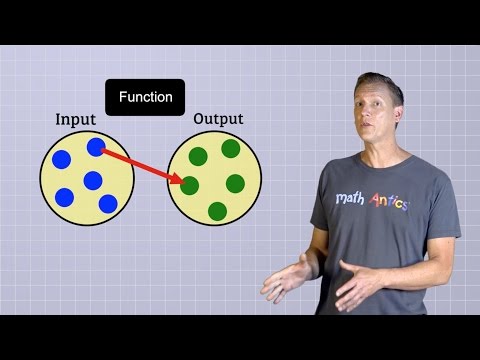
Function: Something that relates or connects one set to another set in a particular way.

Set: A group or collection of things. The notation for a set is {1,2,3...}\{1, 2, 3...\}, where the elements of a set are placed inside those brackets.

The two sets that are related in a function are called the input set and output set. The function takes each member of the input set and relates it or maps it to a value in the output set. The input set is usually called the domain and the output set is called the range.

Function notation

Functions are usually written as f(x)=3xf(x)=3x instead of y=3xy=3x. Here, the f(x)f(x) does not mean f×xf\times x. Instead, it just refers to the equation being a function. If we look at the function above, we would say, "ff of xx equals three xx."

If a number is placed where the xx is, that number is your input. For example: f(x)=3xf(4)=3xf(4)=3(4)f(4)=12\begin{align} f(x) &= 3x\\ f(4) &= 3x\\ f(4) &= 3({\color{Red}{4}})\\ f(4) &= 12 \end{align}

Type a concept, like “slope” or “photosynthesis”.

↑ ↓ to choose · Enter to openSearch explanations and problems