
Read · 1 min

Permutation

Let's start with an example scenario to provide some intuition:

The license plate of my mom's car contains seven characters: 4, 5, 7, 9, E, H, and U. From that information, think about whether you can deduce her license plate!

The answer is: no! I didn't tell you the arrangement of the characters.

From what I told you, there are 50405040 possible license plate numbers. I don't think you care to see the entire list of possibilities, but here are a few: 4579EHU, 4579EUH, 4579HEU, 4579HUE, 4579UEH, 4579UHE, etc.

These possibilities are called permutations of the seven characters I listed at the top of this explanation.

It turns out that my mom's license plate number is 4UHE795. However, if I just switched around the 9 and the 5, I'd get 4UHE759. That license plate number would correspond to an entirely different car. In other words, rearrangements of the characters on license plates refer to entirely different cars.

That's an important characteristic about permutations. Order matters.

###Order Matters

Order matters in permutations. Each permutation, or rearrangement, refers to a different entity.

Order matters in permutations. Each permutation, or rearrangement, refers to a different entity.

Order matters in permutations. Each permutation, or rearrangement, refers to a different entity.

I can't emphasize that point enough. There's the core of this explanation, condensed into two sentences.

Let's part with the formal definition of a permutation. With all the previous stuff in this explanation down pat, let's go!

A permutation, also called an "arrangement number" or "order," is a rearrangement of the elements of an ordered list into a one-to-one correspondence with itself.

Awesome. You now know about permutations. Now off with you into the world with this new enlightenment!

Learn a clever approach

Every problem comes with a worked solution, so even one you cannot crack shows you a new way to think. These are real problems from the AMC 8, AMC 10, AMC 12 and AIME, the national math competitions for middle and high school students, each with a worked solution on LIVE by Po-Shen Loh.

Video · + 1 min read

(Video) Introduction to Permutations (Ordered Selections)

by Eddie Woo

In this video by Eddie Woo, you will learn more about permutations.

As Eddie says, permutations are another way of looking at probability. Specifically looking at how many ways exist to select a certain option when order matters.

Let's look at the example Eddie uses in his video.

How many permutations exist in a 4-digit PIN number?

We know there are 10 options for each digit in a PIN number. In other words, the numbers 0-9 can all exist in each of the 4 placeholders.

Therefore, to find the probability we can solve 10×10×10×1010 \times 10 \times 10 \times 10, which means there at 10410^4 different combinations (where order doesn't matter).

But now let's say we can't repeat numbers in the PIN number.

For the first placeholder, we have 10 options. But for the next placeholder, we have 9 options, then 8 options for the next one, then 7 options for the final placeholder.

To find the probability, we can solve 10×9×8×710 \times 9 \times 8 \times 7, but there's an easier way! We can use factorials:

10!(10−4)!\frac{10!}{(10-4)!}

A general formula for permutations is:

n!(n−k)!\frac{n!}{(n-k)!}

where...

n = number of objects

k = number of positions available

Illustrated · 1 min

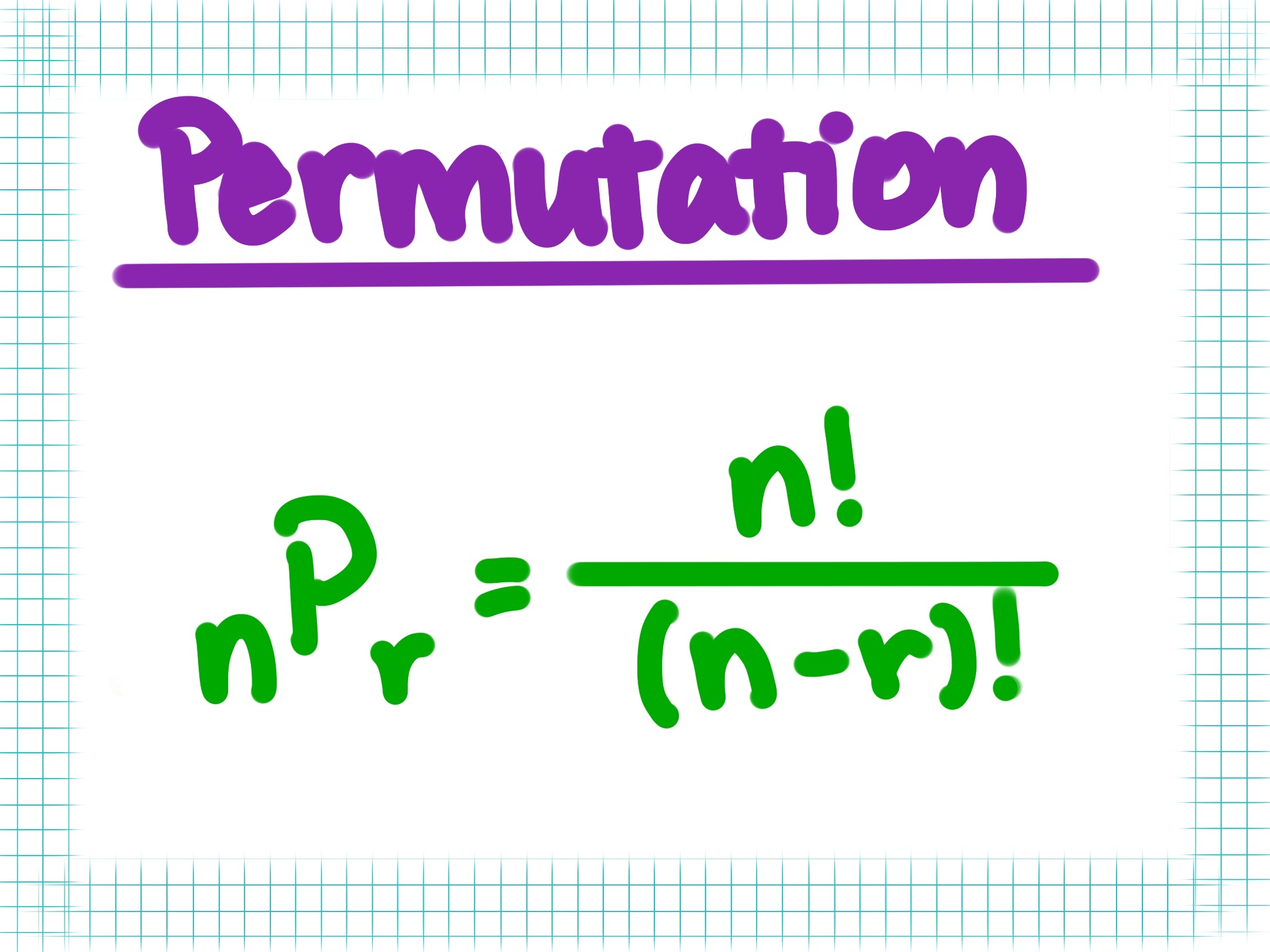
Permutation

Permutations and combinations are both mathematical ways to count the number of ways to arrange or select items from a given set. A permutation is a type of probability where the order matters.

Permutation

Image source: by Anusha Rahman

The number of permutations of a set of nn distinct objects taken rr at a time is given by the permutation formula.

nPr=n!(n−r)!_nP_r = \frac{n!}{(n-r)!}

Here, nn represents the total number of elements in the set and rr represents the number of elements you are selecting. Make sure you calculate the factorial correctly!

Permutations with repetition occur when items can be repeated in the arrangement. The formula for permutations with repetition, when there are nn objects and rr places, is nrn^r.

In the next lesson, we will dive into the Fundamental Counting Principle.

Type a concept, like “slope” or “photosynthesis”.

↑ ↓ to choose · Enter to openSearch explanations and problems
