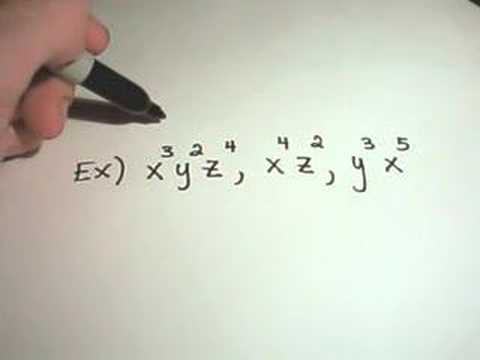
Here are a couple of videos by HEGARTYMATHS that show you how to factor polynomials by pulling out greatest common factors. Over the course of both videos, our instructor walks us through plenty of examples, ensuring that you get a good amount of practice with this particular method of factoring.
A polynomial's greatest common factor is exactly what it sounds like: it's the largest term that divides evenly into all of a polynomial's terms. For instance, a polynomial that consists of the terms 12x and 30 would have a greatest common factor of 6, as that is the largest term that divides evenly into both 12x and 30.
In order to find a polynomial's GCF, you must first find the numerical portion of that polynomial's GCF. You can do this by following these three steps:
- Break down the coefficient of each of your polynomial's terms into its prime factorization.
- Select all the numbers that appear in each coefficient's prime factorization.
- Multiply those selected numbers together; this is the numerical portion of your polynomial's GCF.
What's more, if all of your polynomial's terms have any variables in common (e.g. all of your polynomial's terms contain x variables, all of your polynomial's terms contain an x variable and a y variable, et cetera), then your polynomial's GCF will also contain those variables.
If this is not the case, then the numerical portion of your polynomial's GCF is your polynomial's GCF. However, if all of your polynomial's terms do have at least one variable in common, you can use the following method to find the variable portion of your polynomial's GCF:
- List all of the variables that your polynomial's terms have in common.
- Take one of the variables that you just listed and look at the exponent that is attached to each of that variable's instances in your polynomial. Then, take the lowest of those exponents and attach it to your listed variable.
- Repeat the previous step for all other variables that you listed in step 1.
- Multiply all of your listed variables (complete with their newly attached exponents) together; this is the variable portion of your polynomial's GCF (note: you must multiply this result by the numerical portion of your polynomial's GCF in order to determine the complete version of your polynomial's GCF).