
Illustrated · 1 min
+1 contributors

A transversal is any line that crosses at least two other lines. The following are all transversals:

The red lines are transversals.
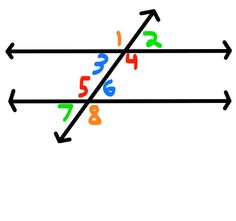
Transversals are usually used in when they cross two parallel lines, as they have some pretty useful properties when this happens. Let's use the following figure for a reference:

Vertical angles are equal
Vertical angle are on the opposite sides of an intersection of two lines. Some examples of vertical angle pairs in the above figure are ; ; ; and . Vertical angles are always equal, and are usually pretty easy to spot, so they're great to keep in mind.
Corresponding angles are equal
Corresponding angles are the angle pairs which are in the same position relative to the transversal. Some examples of corresponding angle pairs in the above figure are ; ; ; and . Corresponding angle pairs are always equal.
Alternate interior angles are equal
Alternate interior angles are angles that are on different sides of the transversal, and on opposite parallels, but within the middle of the parallel. The pairs of alternate interior angles in the above figure are and . They are always equal.
Alternate exterior angles are equal
Alternate exterior angles are angles that are on different sides of the transversal, and on opposite parallels, but on the outsides of the parallels. The pairs of alternate interior angles in the above figure are and . They are always equal.

Same-side interior angles are supplementary
Same-side interior angles are the angles which are within the parallels, and on the same side of the transversal. They are supplementary, which mean that add to or the straight angle.
This is not all of the relationships we can make from a transversal over two parallels. However, these relationships should be enough, when used in conjunction with one another, to derive any other relationship.

