
Interactive · 1 question
+1 contributors

Interior vs Exterior angles Let's begin by asking the question, "What is an angle?" An angle is the space between two intersecting lines or shapes and it is usually measured in degrees. Now lets consider interior and exterior angles. Any angle that is on the inside of a shape is called an interior angle. Any angle that is on the outside of a shape is called an exterior angle. An exterior angle is made by extending one of the lines of the shape beyond the intersection point. The image below shows an interior and an exterior angle.

Notice that the two angles make a straight line. This is important because we know that a straight line measures , which means we can always find the measure of a missing angle when given the measurement of the other. For example, the rhombus below has only given us the measurement of an exterior angle.

Knowing what we have learned about interior and exterior angles, find the measure of x
When solving for missing angle measurements it is helpful to remember the following facts: The sum of the interior angles of a triangle is always The sum of the interior angles of any regular polygon can be found using the following formula: Where x is the number of sides of the polygon The sum of any interior angle and its complementary exterior angle is always because it creates a straight line
Interior and Exterior angles are not limited to shapes, they also exist in lines. Take a look at the parallel lines and the line bisecting the two. Can the angles created by the bisector be categorized as interior or exterior?
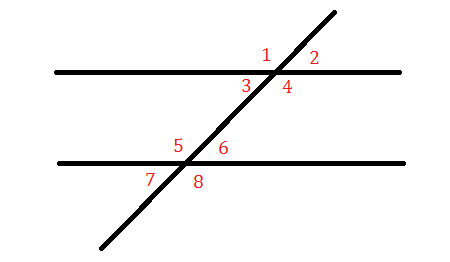
Just like the interior angles of a polygon are inside the shape, the interior angles in this case are the angles inside the parallel lines. So angles 3,4,5, and 6 are interior angles while angles 1,2,7, and 8 are exterior angles.