Interactive · 4 questions
+2 contributors


Types of Sampling
In statistics, we gather (hopefully) large amounts of data on subjects, so we can make inferences about the populations or groups they come from.
These subjects are often people, but they don't have to be.
The subjects in your study (i.e., the things you're collecting data on) could be neighborhoods, mice, apples, brains, other studies, languages, ponds...basically anything. If you can collect information on it, it can be a subject in a study.
One thing to avoid when picking a study population (the larger group that your subjects will represent) is bias.
Wendy conducted a study on how many servings of fruit kindergarteners eat each week.
What are the subjects in Wendy's study?
Marcella is trying to figure out which neighborhood in Washington, D.C. has the most chimneys per square mile.
What are the subjects in Marcella's study?
So, how do we select the subjects for our studies?
There are many approaches, but let's talk about three:
- Random sampling
- Systematic sampling
- Stratified sampling
Random Sampling
Random sampling is exactly what it sounds like—the subjects for a study are selected randomly from a larger group or population.
Each individual subject is selected entirely by chance, and each member of the larger population has an equal chance of being selected.
Which of these methods allows subjects to be RANDOMLY sampled from a larger population? (Check off all that apply)

Think of random sampling as drawing names out of a hat. There are many different examples, but in each one, every individual in a given group has an equal chance of being selected. Image by Clker-Free-Vector-Images via Pixabay (License)
Systematic Sampling
In systematic sampling, we arrange all of the possible subjects, and then select from that group at regular intervals.
For example, let's say I want to do a study of buildings on 5th Avenue in New York City. (For reference, th Avenue is miles long, so that's a lot of buildings!)
The buildings are already arranged for us—they are all numbered with addresses. To do systematic sampling, I might decide to select every th building on the street. This will give me the sample of buildings that will be the subjects in my study.
Which of these approaches can be considered systematic sampling? (Check off all that apply)
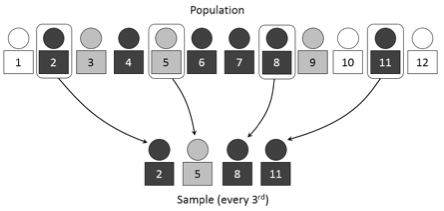
Image source: By Dan Kernler CC BY 2.0, via Wikimedia Commons(Image from Wikimedia Commons)
Stratified Sampling
In stratified sampling, we divide up our whole target population (of people, banana trees, or whatever else) into groups that do not overlap. These groups are called strata. Then, we select our subjects from each stratum.
Think of stratified sampling as a two-step process. First, we have to stratify (make our groups, or strata). Second, we select our subjects from each stratum.
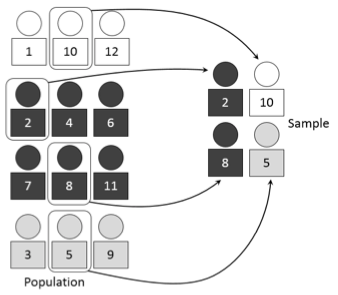
Image source: By Dan Kernkler CC BY 2.0, via Wikimedia Commons
Here, we have 3 strata: white, dark, and gray. Then, we select individuals from each stratum. In this case, we picked individuals 2 and 8 from the dark group, individual 10 from the white group, and individual 5 from the gray group.
Notice, as shown in the image above, strata do NOT need to be the same size.