Sampling: Random, Systematic, and Stratified

Interactive · 4 questions

Types of Sampling

In statistics, we gather (hopefully) large amounts of data on subjects, so we can make inferences about the populations or groups they come from.

These subjects are often people, but they don't have to be.

The subjects in your study (i.e., the things you're collecting data on) could be neighborhoods, mice, apples, brains, other studies, languages, ponds...basically anything. If you can collect information on it, it can be a subject in a study.

One thing to avoid when picking a study population (the larger group that your subjects will represent) is bias.

Wendy conducted a study on how many servings of fruit 2525 kindergarteners eat each week.

What are the subjects in Wendy's study?

Choose one answer

Video · + 3 min read

(Video) Simple Random, Convenience, Systematic, Cluster, and Stratified

by Statistics Learning Centre

Statistics Learning Centre has a great video describing the different types of Sampling methods and gives pros and cons of each.

Summary\large{\text{Summary}}

They start out by defining what a sample is. A sample is a smaller selection of an entire population. Their example is picking a few apples out of all of the apples in one area to find out their normal size.

All samples are meant to be unbiased meaning that they will not favor one outcome over the other and will have an equal chance at any outcome.

The method that is used to sample depends on the population being studied as well as the amount of time and money researches have. Samples should also try to match the characteristics of the population.

Going back to the apples example, if the population of apples is 13\frac{1}{3} green and 23\frac{2}{3} red, the sample should be close to those same proportions.

There is always going to be a little bit of discrepancy when sampling called sampling error. This is because even when you have the best possible sample, you are only looking at a fragment of the population rather than the whole.

The video explains 55 different types of sampling. There are 33 that you should focus on: Simple Random, Systematic, and Stratified. The other two, Convenience and Cluster are still good to know.

Simple Random

Simple random sampling is when you take the entire population and randomly select subjects. An easy way to think of this is by drawing names out of a hat. Each subject is present within the hat, and each one has an equal chance of being selected. This is the most ideal form of sampling but can be very expensive and time consuming when you are trying to study large or spread out populations.

Convenience

Convenience sampling is when you take your sample in a manner that is easiest at the time. For example, someone taking a survey in a mall would be asking everyone who walked by them and was willing to respond rather than randomly sampling everybody that uses that mall. This is often biased because of the lack of randomness in the selection of subjects but can still be useful as a cheap and quick way to get information.

Systematic

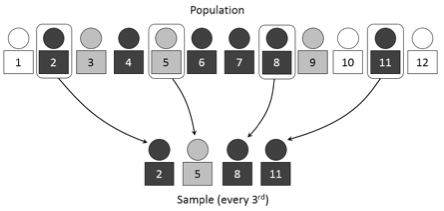
Systematic sampling is a two step process. First you order your population, then you select subjects that are a certain number apart. This will be unbiased as long as the starting point is randomized. When a systematic sample is done well it can closely resemble a Simple Random sample while being easier to perform and less time consuming. However, patterns in the population can sometimes yield results that aren't entirely true.

Cluster

Cluster sampling is when you first break your data into clusters such as departments of an office that are then chosen at random. The entirety of each cluster is then part of the sample. This is generally easier to perform than Simple Random sampling, but if the clusters are too different from each other it can lead to biased and inaccurate data.

Stratified

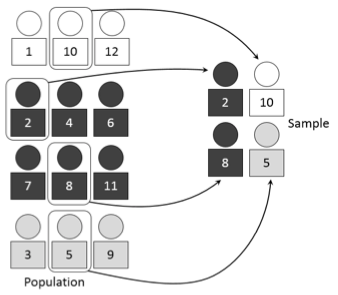
Stratified sampling is similar to cluster but the groups are specifically separated into the categories that you are studying, then a random sample is taken within that group. Sometimes this sample is proportional to the size of the group. In the apple example, this would be first splitting the apples into groups of the same color, then randomly selecting apples from each group. This can give you very good data but requires lots of information about the population, and it can be difficult to split the population into strata, or groups, that make sense.

Interactive · 3 questions

Sampling\text{Sampling}

In statistics we conduct surveys or studies on many different topics in order to learn something about the population we are studying. Often times the population we want to study is too large and it is impractical or not possible to survey or study its entirety.

In situations like this, we choose a sample population. Sampling allows us to learn about a population without having to study each individual member of that population.

When conducting surveys it is important to choose the sample population and subjects of the survey in a way that avoids bias. Now, how does one avoid a bias sample? Well there are several ways to choose a sample population to avoid any bias, but we're going to focus on three:

  • random sampling
  • systematic sampling
  • stratified sampling

Random Sampling

Random sampling is conducted exactly how it sounds. Each subject in the study/survey is chosen completely at random. The subjects are not chosen systematically and every member of the larger population being studied has an equal opportunity of being chosen.

Systematic Sampling

Systematic sampling is a two step method of choosing subjects.

The first step is organizing all of the possible subjects. For example, let's say we want to learn about the sports preferences of the seniors at a high school. The first step of this study would be to organize every member of the senior class in a specific order i.e alphabetical order, by homeroom, etc.

The second step of this method of sampling is to then choose subjects from the organized group at regular intervals. For example, if every member of the senior class is lined up alphabetically, surveying every 5th person in line would be a systematic way to sample the population being studied.

Stratified Sampling

Stratified sampling is similar to systematic in the sense that it is also a two step method. The first step is to divide the population into smaller groups called strata. The smaller groups are made up of individuals/things that share some attributes. The subjects for the survey are then selected from the smaller groups (stratum). The subjects can then be chosen randomly or systematically from the stratum.

For example: Let's say we are interested in learning about social media usage among different age groups. First, we divide the population into groups by age. Next, we can choose subjects from the groups randomly.

Let's review!

Which of the following is an example of random sampling?

Choose one answer

Read · 1 min

Random, Systematic, and Stratified Sampling

There are different ways to gather data for a presentation or a study. These are just 33 of the different ways to do so!

Random

A random sample is a group of individual points that are chosen randomly. A random sample has individuals that have the same probability of being chosen for the sample as a large total. This is an unbiased sampling technique. This is usually seen as the simplest of the sampling techniques, since you can basically go out on the street or send out a survey to gather data.

Systematic

Although random sampling is the simplest of the sampling techniques, it can also be very inefficient and time consuming. However, systematic sampling is more linear and defined. In systematic sampling, the individuals being sampled are selected from a random starting point, and from then on are selected according to a fixed, periodic interval. This interval is called the sampling interval, and it it calculated by: population sizesample size\frac{\text{population size}}{\text{sample size}} Eventhough you are choosing the sample size before performing the sampling, systematic sampling is still considered a "random" sampling if the starting point is random.

Stratified

Stratified sampling is sampling where the researcher divides the initial population into separate groups, which is called strata. From the strata, a random sample is drawn from each group. We can use this when we want to scale down our data sets, but still get representative, and more precise, results.

Type a concept, like “slope” or “photosynthesis”.

↑ ↓ to choose · Enter to openSearch explanations and problems