Interactive · 2 questions

Dependent vs Independent Events

Independent events and dependent events are simple, but essential to solving complex probability problems. Independent Events

Suppose I flip a fair coin. Intuitively, the probability, or chance, of it landing on heads is 12\frac{1}{2}.

Now, suppose it does land on heads. What is the probability of it landing on heads the next flip?

Choose one answer

Math as a puzzle

Many contest problems feel more like puzzles than homework. They are a good way to find out how much fun math can be. These are real problems from the AMC 12 and AIME, the national math competitions for middle and high school students, each with a worked solution on LIVE by Po-Shen Loh.

Read · 1 min

Independent and Dependent Events

Independent: Two events are considered independent if the result of the first event does not affect the second event whatsoever. For example:

Let's say I have a standard deck of cards (52 cards, 13 cards of each suit, 4 suits). I pick a card from the deck, replace it, then pick a second card. What is the probability I pick two queens?

P(Q)=P(1)×P(2)P(Q) = P(1) \times P(2)

There are 44 queens in the deck, which means I have a 452\frac{4}{52} chance of picking the first one. Since I am replacing the first card, there is the same probability of picking a second queen (452\frac{4}{52}). Therefore, we multiply them together to get: P(Q)=452×452=162704P(Q) = \frac{4}{52} \times \frac{4}{52} = \frac{16}{2704}

Dependent: Two events are considered dependent if the result of the first event does affect the second event. For example:

Let's say we have the same deck of cards as above. I pick a card from the deck, then immediately pick a second card. There is NO replacement. What is the probability I pick a queen, then a jack?

There are 44 queens in the deck, which means I have a 452\frac{4}{52} chance of picking the first one. Since we are not replacing the first card, we then have a probability of 451\frac{4}{51} for picking the jack, since we now only have 5151 cards to pick from. This will give us: P(Z)=452×451=162652P(Z) = \frac{4}{52} \times \frac{4}{51} = \frac{16}{2652}

The fact that we do not replace the card after the first pulling is what makes this dependent. Since we start with 5252 cards, removing 11 will affect the outcome of the second pull.

Illustrated · 1 min

Independent and Dependent Events

In probability, there are two types of events: independent and dependent events.

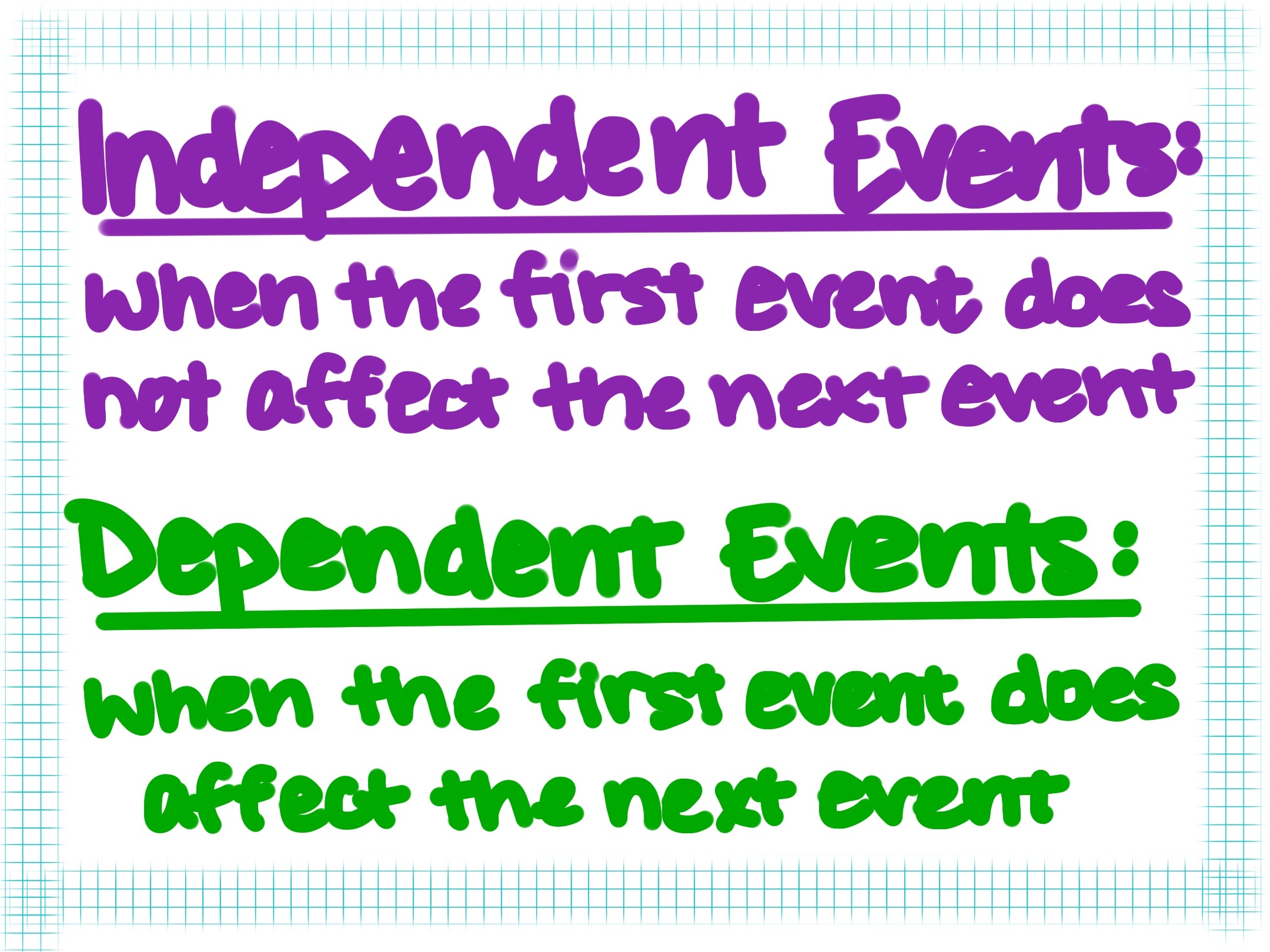
Independent events: when the first event does not affect the next event
Dependent events: when the first event does affect the next event

Image source: by Anusha Rahman

In both independent and dependent events, we are calculating the probability that an event occurs within the sample space. With independent events, the occurrence of one event does not affect the occurrence of a second event. With dependent events, they do.

Think of the example of rolling a die. The chance of rolling a 66 on one roll does not affect the chance of rolling a 66 (or any other number!) on the second roll. We can say the same thing for tossing a coin. These events are mutually exclusive. Independent events can also happen at the same time.

Now let's think of dependent events. Say we have a big bag with a bunch of marbles. There are red and blue marbles in the bag, and we want to know the likelihood of randomly selecting a red marble. Once we take a marble out of the bag, and we don't replace it, the events are dependent on each other.

We'll dive deeper into finding the probability of dependent events and the probability of independent events.

Video · + 1 min read

(Video) Independent and Dependent Events

by the Organic Chemistry Tutor

In this video by The Organic Chemistry Tutor explains the difference between independent and dependent events, while also giving examples. It provides good probability word problems to practice with.

Independent events do not depend on each other, while dependent events do depend on each other.

Following along with the first example in the video, there are 8 red marbles, 7 blue marbles, 6 green marbles, and 4 yellow marbles. There are a total of 25 marbles.

The probability of selecting the red marble is 8/258/25 which is 0.32 or 32%.

The probability of selecting a blue marble then green marble is 7/25∗6/257/25 * 6/25 which equals 42/625=0.067242/625 = 0.0672 or 6.726.72%. Note that this is an independent event because choosing a blue marble has no effect on choosing a green marble.

However if we want to find the probability of selecting a yellow marble then a red marble without replacing the yellow marble, we would calculate 4/25∗8/244/25 * 8/24 which equals 4/75=5.34/75 = 5.3%. Notice how the denominator is one less when we calculate the probability of the red marble? That is because we have removed the yellow marble, so there is one less marble to chose from, reducing our denominator. This is an example of a dependent event since the probability of selecting the red marble depends on selecting the yellow marble first.

Try the next two examples!

Type a concept, like “slope” or “photosynthesis”.

↑ ↓ to choose · Enter to openSearch explanations and problems