Interactive · 3 questions

Two events, AA and BB, are dependent if the fact that AA occurs affects the probability of BB occurring. An example of dependent events would be randomly selecting marbles out of a bag, without replacement.

Suppose there are two red and three blue marbles in a bag, and you want to know the probability that you pick a blue marble on two different attempts, without replacing the first marble.

The first time you pick a marble out of the bag, the probability that you pick a blue marble is 35\frac{3}{5} because there are three blue marbles and five total marbles. This is the probability of occurrence of one event. The second time you pick a marble out of the bag, the probability that you pick a blue marble depends on the outcome of the first selection because the first event affects the outcome of the second attempt.

If the first marble you picked was blue, then there are two red and two blue marbles left in the bag. Now, the probability that you pick another blue marble is 24\frac{2}{4}, or 12\frac{1}{2}.

If the first marble you picked was red, then there are one red and three blue marbles left in the bag. Now, the probability that you pick a blue marble is 34\frac{3}{4}.

If the first marble you picked was blue, what is the probability that the second marble you pick is red?

Choose one answer

Check what you really know

If you can solve a contest problem with this idea, you know it well. If not, you know exactly what to review. These are real problems from the AMC 8, AMC 10, AMC 12 and AIME, the national math competitions for middle and high school students, each with a worked solution on LIVE by Po-Shen Loh.

Read · 1 min

Two events are considered dependent if the result of the first event does affect the second event. For example:

Let's say I have a standard deck of cards (52 cards, 13 cards of each suit, 4 suits). I pick a card from the deck, then immediately pick a second card. There is NO replacement. What is the probability I pick a queen, then a jack?

There are 44 queens in the deck, which means I have a 452\frac{4}{52} chance of picking the first one. Since we are not replacing the first card, we then have a probability of 451\frac{4}{51} for picking the jack, since we now only have 5151 cards to pick from. This will give us: P(Z)=452×451=162652P(Z) = \frac{4}{52} \times \frac{4}{51} = \frac{16}{2652}

The fact that we do not replace the card after the first pulling is what makes this dependent. Since we start with 5252 cards, removing 11 will affect the outcome of the second pull.

Video

(Video) Probability of Dependent Events

by Mathispower4u

In this video by Mathispower4u, you will see of an example of how to find the probability of dependent events.

Remember that dependent events depend on each other.

In the example in the video about the bag of cookies, we want to calculate the probability of selecting an oatmeal cookie, eating it, then selecting a peanut butter cookie. To do so, we multiply the probability of selecting an oatmeal cookie by the probability of selecting a peanut butter cookie that accounts for one less cookie.

In this example, we have 26 total cookies, 7 oatmeal cookies, and 5 peanut butter cookies. Therefore, we calculate: 7/26∗5/25=0.0538=5.387/26 * 5/25 = 0.0538 = 5.38%. Note that we subtract one from the denominator when calculating the probability of eating the peanut butter cookie as there is one less total cookie since we already ate an oatmeal cookie.

Illustrated · 1 min

Dependent Events

We've already learned the difference between independent and dependent events. Now, we'll dive deeper into dependent events.

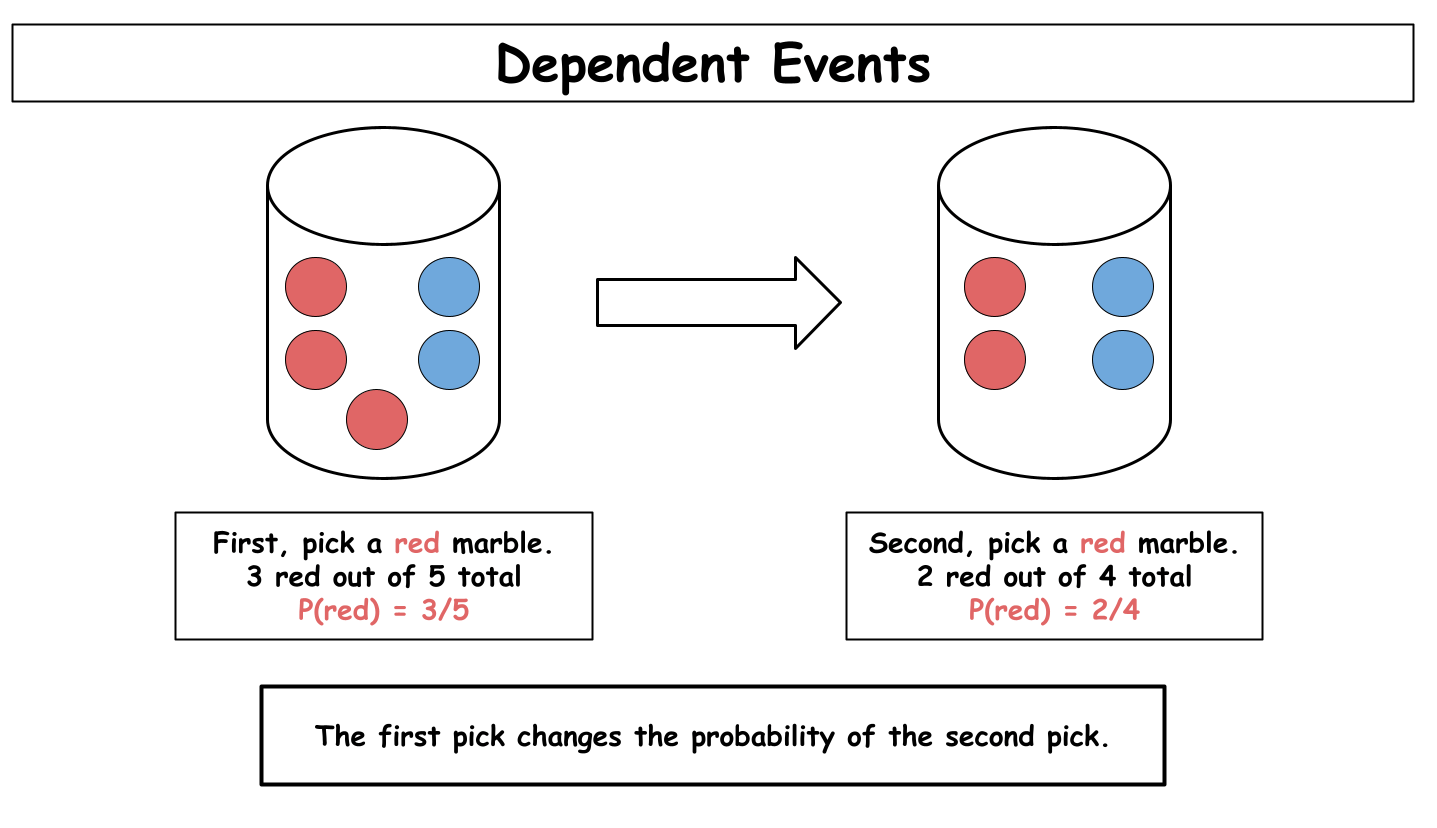
Dependent events are events where the result of one event changes the probability of another event.

The first pick changes the probability of the second pick.

Image source: by Anusha Rahman

Imagine a bag containing three red marbles and two blue marbles. At first, the probability of picking a red marble is 35\frac{3}{5}.

Suppose you pick a red marble and do not put it back in the bag. Now there are only four marbles left, and only two of them are red. This means the probability of picking another red marble has changed to 24\frac{2}{4}.

The two events are dependent because the first pick affects what can happen on the second pick. This often happens when objects are chosen without replacement. If the first marble were placed back in the bag, the probabilities would stay the same. A tree diagram for number of outcomes is also useful when one event affects what can happen next. The branches can change to reflect the possible outcomes after each event.

When working with dependent events, always pay attention to how the first event changes the possible outcomes. Updating the numbers after each event will help you find the correct probabilities.

Next up, we'll learn about independent events.

Type a concept, like “slope” or “photosynthesis”.

↑ ↓ to choose · Enter to openSearch explanations and problems