Interactive · 3 questions

Remember, two events, AA and BB, are independent if the fact that AA occurs does not affect the probability of BB occurring. An example of an independent event is the rolling of a die. Whether I roll an odd or even number one time does not affect the parity (oddness or evenness) of the number I roll the next time.

Let's use a real-life example to calculate the probability of independent events:

In fourth grade, I was repeatedly rolling a die in order to experimentally demonstrate that the theoretical probability of rolling an odd is 12\frac{1}{2}. This is because the die has six sides (1,2,3,4,5,6)(1, 2, 3, 4, 5, 6): 33 odd and 33 even.

3 odd6 total=12.\frac{3\text{ odd}}{6\text{ total}} = \frac{1}{2}.

Same for the evens.

I record the outcomes of my rollings each time: Odd, Even, Odd, Even, Odd, Odd, Odd, Odd, … Odd, Odd, Odd, … Odd, another Odd, and finally an Even.

I rolled twenty-two Odds in a row.

Now, what's the probability that I roll 2222 odds in a row? I haven't been able to achieve such a feat ever since. Note that none of the odds I rolled depended on any other odd.

What's the probability that I rolled the first odd? Please answer with a fraction.

Stretch your creativity

Contest problems rarely look like the examples you studied. Solving one means finding your own way in. These are real problems from the AMC 12 and AIME, the national math competitions for middle and high school students, each with a worked solution on LIVE by Po-Shen Loh.

Read · 1 min

Independent Events

Two events are said to be independent of each other if and only if the probability of AA happening does not affect the probability of BB occurring. We can write this as P(A∩B)=P(A)×P(B)P(A \cap B) = P(A) \times P(B), meaning that the joint probability of AA and BB equals the product of their individual probabilities. This shows the occurrence of AA does not affect the probability of BB, and vice versa. This is also known as the multiplication rule, which states that the probability of the intersection of two independent events is equal to the product of their individual probabilities. Typically, when events occur in sequence, and they're independent, the probability of the sequence of events is also the product of their individual probabilities.

A sample space is the set of all possible outcomes of a random experiences. For example, when you toss a fair coin, the sample space consists of two outcomes: heads and tails. Mutually exclusive events are events that cannot occur at the same time. We might think of a standard six-sided die, where the events "rolling a 3" and "rolling a 4" cannot happen at the same time, so they're mutually exclusive.

When something is randomly selected, we are talking about selecting something without any bias or pattern.

Example of an Independent Event

For example, let's say that you have 33 pairs of socks in a box, a green pair, a yellow pair, and a blue pair. You pick one pair from the box, replace it, then pick another pair. What is the probability of picking the green pair of socks both times?

Since you are replacing the first pair of socks you picked up, the choices for your second picking are the same as the first. In other words, there is a 13\frac{1}{3} chance of picking a green pair of socks originally. Then, once you put them back, there is a 13\frac{1}{3} chance of picking them again. Therefore, your total probability is 13×13=19\frac{1}{3} \times \frac{1}{3} = \frac{1}{9}

Read · 1 min

Two events are considered independent if the result of the first event does not affect the second event whatsoever. For example:

Let's say I have a standard deck of cards (52 cards, 13 cards of each suit, 4 suits). I pick a card from the deck, replace it, then pick a second card. What is the probability I pick two queens?

P(Q)=P(1)×P(2)P(Q) = P(1) \times P(2)

There are 44 queens in the deck, which means I have a 452\frac{4}{52} chance of picking the first one. Since I am replacing the first card, there is the same probability of picking a second queen (452\frac{4}{52}). Therefore, we multiply them together to get: P(Q)=452×452=162704P(Q) = \frac{4}{52} \times \frac{4}{52} = \frac{16}{2704}

Video

(Video) Example of Probability of Independent Events

by Don't Memorise

In this video by Don't Memorise, you will see an example of how to find the probability of independent events.

Remember that the outcomes of independent events do not effect each other.

Following along with the example in the video, an example of an independent event is choosing a red marble, putting it back, then choosing a red marble again. There are a total of 6 marbles, 3 red and 3 blue.

To calculate this probability: 3/6∗3/6=0.253/6 * 3/6 = 0.25 or 2525%.

Notice how since these are independent events, the probability of choosing the red marble a second time is not different from choosing the first red marble. However, if these were dependent events (if we did not replace the first marble), the second probability would be different.

Illustrated · 1 min

Independent Events

Now that we've covered dependent events, let's dive deeper into independent events!

Independent events are events where the result of one event does not change the probability of another event. Imagine flipping a fair coin and then rolling a six-sided die. The probability of flipping heads is 12\frac{1}{2}.

Suppose the coin lands on heads. This result does not change the possible outcomes when you roll the die. The probability of rolling a 44 is still 16\frac{1}{6}.

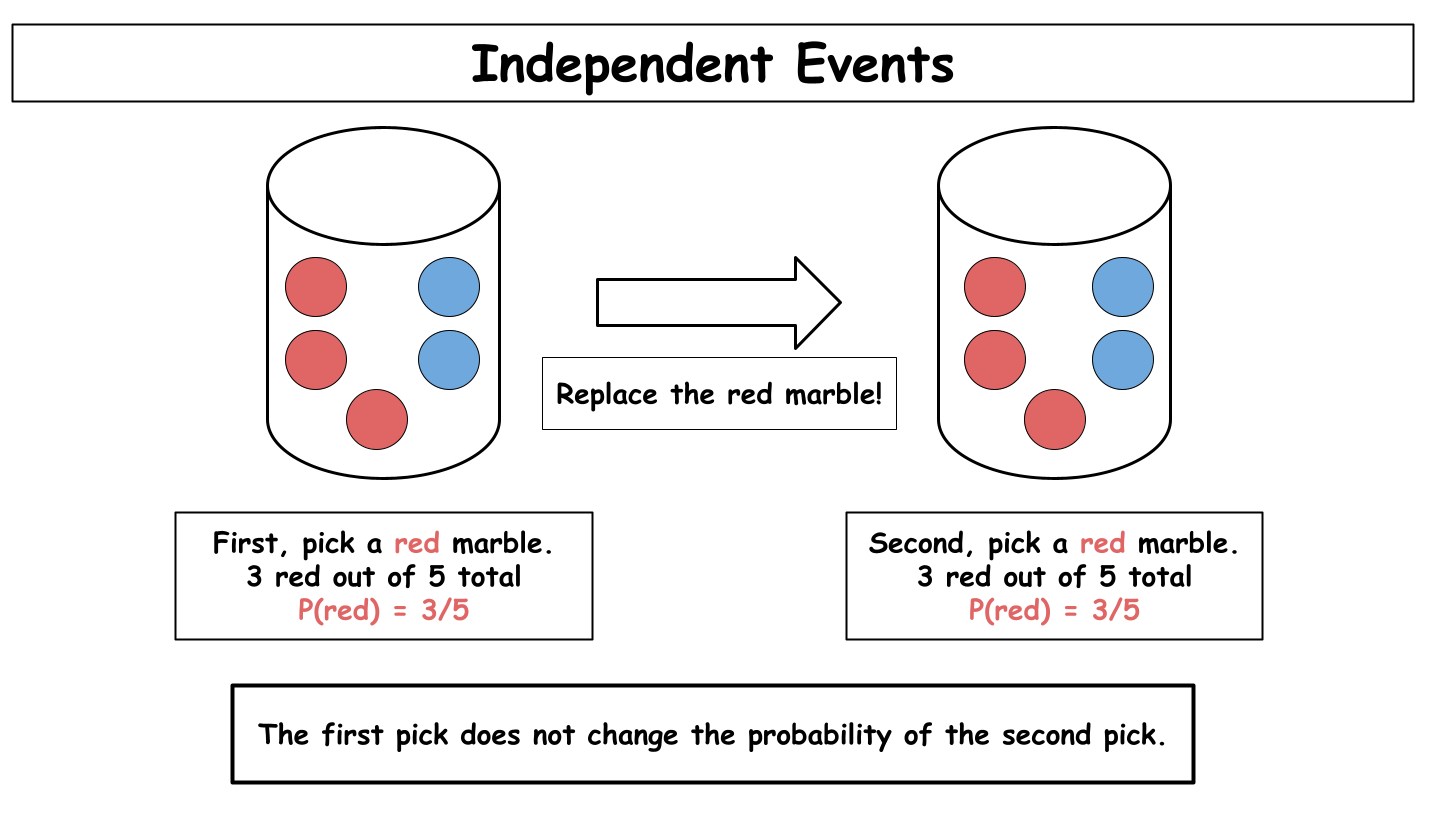
Independent Events
The first pick does not change the probability of the second pick

Image source: by Anusha Rahman

The two events are independent because the result of the coin flip does not affect the result of the die roll. Flipping the coin again would also be an independent event because each flip still has a 12\frac12 chance of landing on heads. Unlike dependent events, the probabilities do not change based on what happened before.

A tree diagram for number of outcomes can represent several independent events that occur in sequence. Each branch shows the possible result of the next event.

Similarly, if we pick a red marble out of a bag, and if we replace it, the probability of picking a red marble again stays the same.

When working with independent events, ask whether the first event changes the possible outcomes of the second event. If it does not, the events are independent.

Type a concept, like “slope” or “photosynthesis”.

↑ ↓ to choose · Enter to openSearch explanations and problems