Read · 1 min

Let's look at an example first. Suppose there are 77 people and we have to form a committee of 33 people out of these 77. (In the committee all 33 have equal power!)

Let's think about how many ways we can do this.

For the time being, let us assume that the committee's members are represented as M1,M2M_1,M_2 and M3M_3. The 77 people are denoted as P1,P2,…,P7P_1,P_2,\ldots,P_7. Then, as explained under What is a permutation?, the number of ways of forming the committee is 7×6×5=2107\times6\times5=210. But we have to notice one thing! Here, we have counted every committee that satisfies our needs six times.

We have considered the committee formed by P2,P4P_2,P_4 and P7P_7 six times. That's because we have considered the following committees to be distinct:

  1. M1=P2,M2=P4,M3=P7M_1=P_2,M_2=P_4,M_3=P_7

  2. M1=P2,M2=P7,M3=P4M_1=P_2,M_2=P_7,M_3=P_4

  3. M1=P4,M2=P2,M3=P7M_1=P_4,M_2=P_2,M_3=P_7

  4. M1=P4,M2=P7,M3=P2M_1=P_4,M_2=P_7,M_3=P_2

  5. M1=P7,M2=P2,M3=P4M_1=P_7,M_2=P_2,M_3=P_4

  6. M1=P7,M2=P4,M3=P2M_1=P_7,M_2=P_4,M_3=P_2

Whereas for our purposes, these should not be considered distinct, because as we said, in the committee every one has equal power — so they cannot be labelled as M1,M2M_1,M_2 and M3M_3. (Because we may consider M1M_1 as the chairperson and give M1M_1 more power than the others!)

We should divide 210210 by 66. (As then we will be considering one committee exactly 6/6=16/6=1 time).

So, our answer is 210/6=35210/6=35.

(Note that 6=3!6=3!, i.e., the number of ways that 33 distinguishable objects can be arranged among themselves.)

We say that there are 3535 combinations of 33 people from 77 people.

So, a combination is a permutation where the order of the objects is not important.

Since kk distinguishable objects can be arranged among themselves in k!k! distinct ways, so if there are pp permutations of kk objects from nn distinguishable objects, then how many combinations of kk objects from the nn distinguishable objects are there?

Yes, the required number is pk!\frac{p}{k!}.

Find your level

The problems run from approachable to very hard, and each is rated by how often real students solve it, so you can pick your next step. These are real problems from the AMC 8, AMC 10, AMC 12 and AIME, the national math competitions for middle and high school students, each with a worked solution on LIVE by Po-Shen Loh.

Interactive · 2 questions

The number of combinations of rr objects out of a set of nn is given by the formula (nr)=n!r!(n−r)!\binom{n}{r} = \frac{n!}{r!(n-r)!} You might also see combinations notated in several different ways. All of these have the exact same meaning. (nr)=nCr=C(n,r)\binom{n}{r} = {}_{n} C_r = C(n,r) Now you might be looking at the abundance of factorials and wondering how the equation even makes sense, so let's walk through it step by step!

Let's say we have 1010 tennis balls and we want to find the number of ways to choose a combination of 33 of them.

Let's choose the balls one at a time. For the first ball, we have 1010 balls to choose from. For the second, we have 99 remaining balls to choose from, and logically following, we have 88 choices for the third ball. This means that there are a total of 10⋅9⋅810\cdot 9\cdot 8 ways to choose the three balls.

Now, here's the catch — the balls we chose aren't distinguishable! If we had switched the order in which we chose the three balls we now have, the end result would still be the same: a group of 33 balls in our hands, ready to be played.

The number of ways these three balls could be ordered is 3⋅2⋅13\cdot 2\cdot 1. This means that overall, the number of ways we can pick 33 indistinguishable balls from a group of 1010 is 10⋅9⋅83⋅2⋅1=120.\frac{10\cdot 9\cdot 8}{3\cdot 2\cdot 1} = \boxed{120}.

Let's think about how this works with all the factorials in our combination formula. If we multiply the numerator and denominator by 7!7!, we find the following: 10⋅9⋅8⋅7!3⋅2⋅1⋅7!=10!3!⋅7!=10!3!⋅(10−3)!=(103)\frac{10\cdot 9\cdot 8\cdot 7!}{3\cdot 2\cdot 1\cdot 7!} = \frac{10!}{3!\cdot 7!} = \frac{10!}{3!\cdot (10-3)!} = \boxed{\binom{10}{3}} which works out with our formula! Now all the factorials make sense.

Here's a quick bit of practice:

What is the value of (73)\binom{7}{3}?

Choose one answer

Video · + 1 min read

(Video) Combinations made easy

by tecmath

Check out this video by tecmath to learn more about combinations!

##Combinations

According to the video, combinations are specifically finding probability when order doesn't matter. Let's dive deeper.

The example used in the video is that there are a total of 5 books, and we want to select 3 books.

For our first choice, we have 5 options to choose from. For the next book, we have 4 options to chose from. For the last book, we have 3 options to choose from.

Therefore we can multiply: 5×4×3=605 \times 4 \times 3 = 60. You may notice that this is the same as the permutation!

But, we're saying order doesn't matter, so we need to have another step.

We know there are a total of 3 different books we can take, so to find the number of ways 3 spaces can be ordered, we can do...

3×2×13 \times 2 \times 1, which would give us 66 spaces. We can also use factorials: 3!3!.

Finally, to find the number of combinations, we can do...

5×4×33×2×1=606=10\frac{5 \times 4 \times 3 }{3 \times 2 \times 1} = \frac{60}{6} = 10

The general formula to find the number of combinations is:

n!(n−r)!r!\frac{n!}{(n-r)!r!}

where...

n = number of total objects

r = number of items selected

Try the other examples in the video!

Illustrated · 1 min

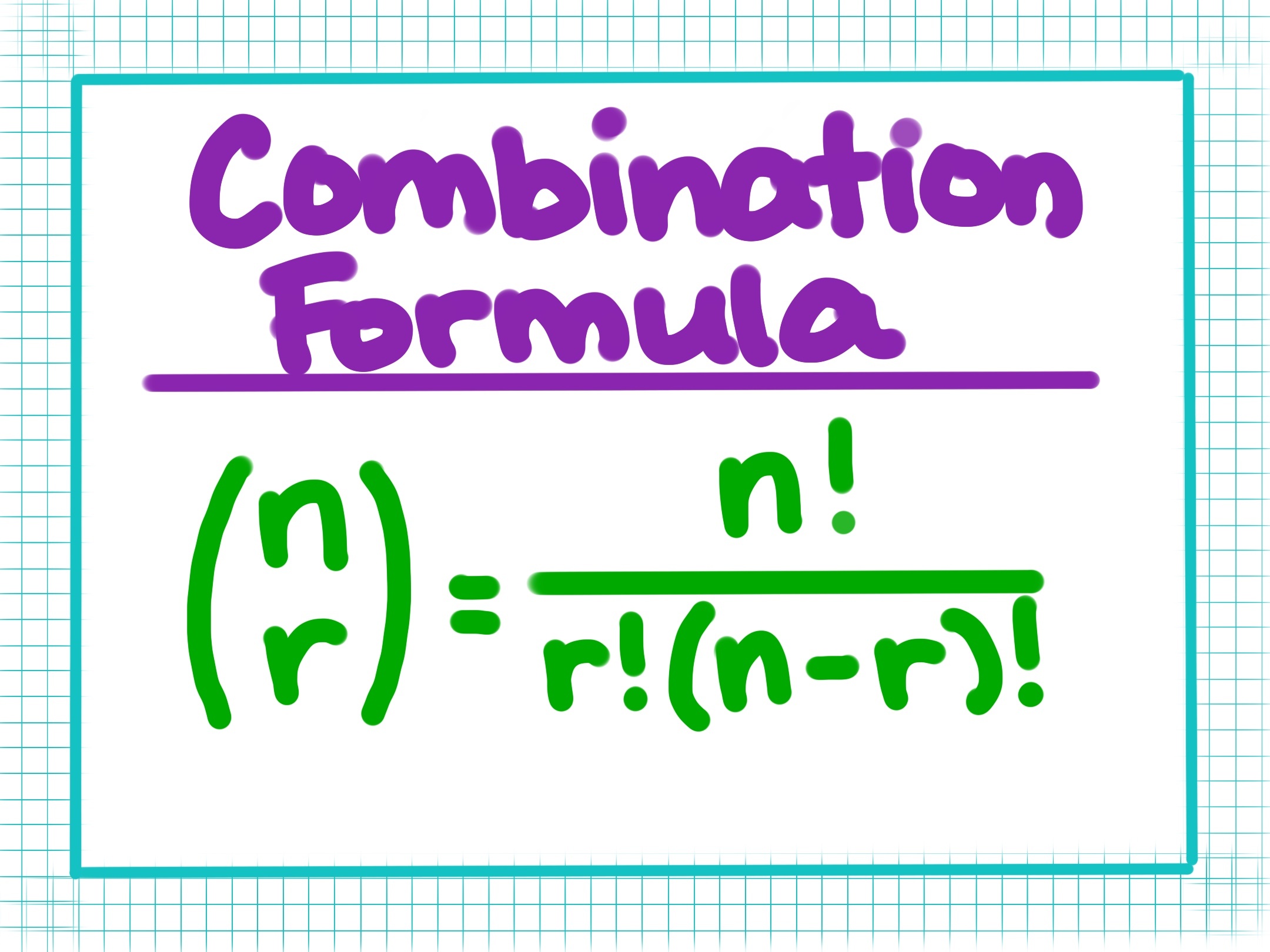
Combination Formula

In combinations, the arrangement or order of the elements selected does not matter. The order of the selection does not matter. That means that if you select the same set of items, regardless of the order in which they were selected, it's considered the same combination. Let's say we have a bag of red, blue, and green marbles. The total number of marbles in the bag is ten. Whether you pick a red then a blue marble, or you pick a blue then a red marble, the combination probability value will be the same.

This concept applies to larger sets, too. Selection order does not matter.

The formula to calculate combination is very similar to the formula for permutation.

Combination formula

Image source: by Anusha Rahman

In the realm of permutations and combinations, remember that permutation deals with arrangements where the order does matter, while combination deals with selections where the order doesn't matter.

There are types of permutation. The first is the repetition permutation, which allows repetition of elements in arrangements. Next, we have circular permutation, which deals with arrangements in a circular manner. Third, we have ordered permutation, where every arrangement is distinct. Lastly, we have unordered permutation, which is also known as combination!

Combinatorics with Pascal’s Triangle provides a visual way to find combinations. Each number in the triangle corresponds to the number of ways objects can be selected.

Type a concept, like “slope” or “photosynthesis”.

↑ ↓ to choose · Enter to openSearch explanations and problems