
Interactive · 6 questions
+5 contributors


Pascal's Triangle
The math behind Pascal’s Triangle is very simple. It is so simple that even young students can learn and repeat the pattern.
But as you look more closely, you start to notice interesting patterns. These patterns lead to powerful ideas in counting and other areas of math.
Remember: While Pascal’s Triangle helps count combinations where order does not matter (like combinations), permutations are used when the order of the selected items matters.
Let’s start by learning how the arithmetic works.
The foundation of the triangle is s. The first row is a The second row is two s. After that, the first and last entry in each row is a Let's look at the first rows:

Image source: by Trent Tormoehlen
The question mark is the first entry that is not a It is easily found by looking at the two entries it is between that are in the row above it. In this case the "?" is . Here is a look at the first rows. Note: the general convention is for the top row to be referred to as row Thus the first rows are rows through

Image source: by Trent Tormoehlen
As you can see, the next row is The s come from and .
What is row (remember - this is actually the fifth row) of the Pascal's triangle?
The first and last terms are s like every other row. The comes from the sum of the two numbers above it, , the , and then the second is .
Another important thing to note about the Pascal's Triangle is the first entry in each row is always a and is called entry So in row entry is a Row through row are shown below. Make sure you know where each number comes from before moving on...
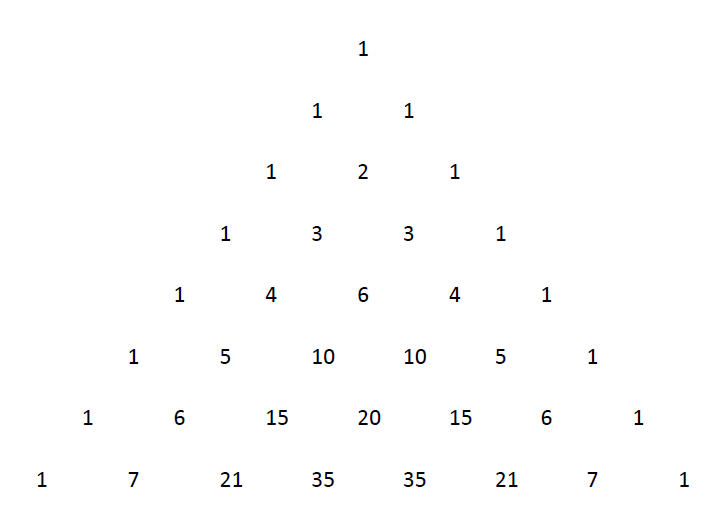
Image source: by Trent Tormoehlen
Test yourself - what is the th entry in the th row of the Pascal's Triangle?
Being able to generate new rows of the Pascal's Triangle is step of a long path that can lead to many interesting insights and wonders that such a simple pattern can be used to better understand a diverse set of mathematical situations. Lets begin by making some basic observations.
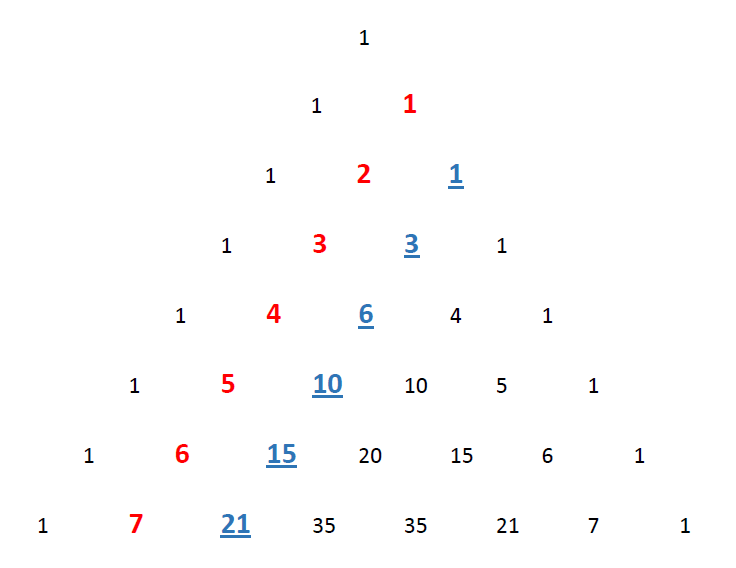
Image source: by Trent Tormoehlen
- The first pattern is in red and is simply the counting numbers.
- The second pattern is underlined and in blue. It is a special sequence called the trianglular numbers. The triangular numbers are the sum of the first counting numbers.
- A third important thing to notice is that each line is symmetric. This means it reads the same forwards and backwards.
- Lets look at the sum of the entries in each row.
See if you can notice the pattern.
What is the sum of row in the Pascal's Triangle?
The pattern is the sum of each row is the next power of 2. Row 0 is , row 4 is , and for the question, row 7 is .
- The Hockey Stick Principle - The hockey stick principle is a surprising relationship between diagonals of the Pascal's Triangle. Essentially, by looking at a diagonal starting with the and then drawing a hockey stick, you can quickly and easily find the sum of the diagonal. We will further discuss this later. The Pascal's Triangle below shows what is meant by the hockey stick principle. Note that and . These are the two cases highlighted in the picture below.
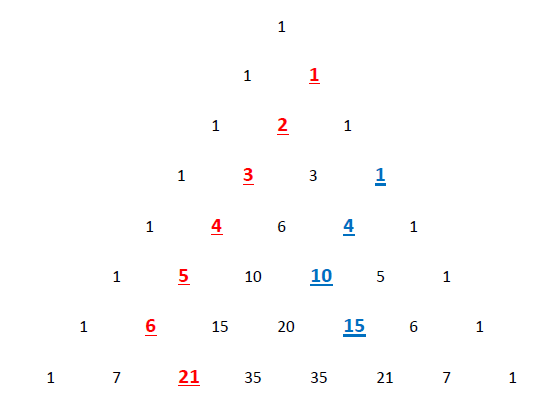
Image source: by Trent Tormoehlen
Look back at the Pascal's Triangle you used to answer the question about the 10th row. What is the sum of the following sequence:
The answer is as it is in row and diagonal from in row Now hopefully you are a little skeptical of the value of the hockey stick principle. After all, it may be easier to add those numbers together rather than generate rows of the Pascal's Triangle. Until you learn how to generate specific entries in the triangle without having to generate the entire triangle. This is the next (and last) of our basic observations about the triangle. Next we will begin discussing the applications of the triangle.
- It turns out that the entries in the Pascal's Triangle can be generated using the very important Combinations formula. This formula is used to determine how many ways to pick things from a group of things. Order does not matter and it can be generalized to imagine the selections happening simultaneously.
The formula is:
For example:
What is entry in row of the Pascal's Triangle?
This is found by: Which can be simplied to:
- Binomial Expansion - Binomial expansion is the process of multiplying out binomials raised to a certain power. Some basic binomial expansions are below. These can be verified by applying your favorite way to muliply binomials (FOIL, double distributive property, the smiley face method, etc.).
If you look closely at the coefficients of the variables, you should be able to spot the rows in the Pascal's Triangle. Row of the Pascal's Triangle is , which are exactly the coefficients of each term of . It is important to note two things from this. First, row number and the power are the same. This holds true for the connection between all binomial powers and the Pascal's Triangle. Second, the degree (sum of the powers in each term) of each term of the expansion is equal to the row number and power as well, which in this case 4. You can also count the entries based on the exponent of . has a coefficient of which is entry of row because there is an implied ("invisible") factor. has a coefficient of because it is entry in the th row and is the exponent on . We can further connect this to combinations like this:
has a coefficient of is entry in row of the Pascal's Triange entry of row can be found by the coefficient of can be found by .
What is the coefficient of the term in the expansion of ?
Solution: The term has a degree of and has exponent so the coefficient is .
Think about the case of . When it is not the expansion of binomial in two variables.
The point of tension comes from the second term in the binomial not being a variable. A nice way of keeping track of things is to look at it like this. Row 6 of the Pascal's Triangle is: Thus, the expansion is: which equals



