Interactive · 1 question

If you've seen combinatorics problems before, you've probably noticed that they contain many numbers with exclamation points after them. No, combinatorialists are not mobs of angry people who feel the need to yell to get whatever they want. Rather, they are simply very excited and happy people who wish to excite you about combinatorics as well!

The exclamation marks may still seem superfluous. However, when we ask you to calculate 4!4!, we're not just yelling out "FOUR!" because we feel like it (in fact, if that were the case, the grammar of this sentence would be wrong :-) ). That exclamation mark is the symbol for a mathematical operation called a factorial.

Example: Calculate 4!4!.

Solution: 4!=4∗3∗2∗1=4! = 4*3*2*1 = 2424.

I took all the natural numbers (positive integers) up to 44 and multiplied them all together.

I'm gonna throw you a curveball here. However, you're smart and awesome, so I know you'll hit it. :D

For any natural number nn, what is the formula for n!n!? In other words, what is the generalized formula for calculating n!n!?

Choose one answer

Put ideas together

Contest problems often need this idea together with one or two others. That is where understanding goes deeper than memory. These are real problems from the AMC 8, AMC 12 and AIME, the national math competitions for middle and high school students, each with a worked solution on LIVE by Po-Shen Loh.

Read · 1 min

Factorial

A factorial of a non-negative integer is denoted as n!n!, and it is the product of all positive integers less than or equal to n. The factorial looks like 4!4!, or 12!12!, or 724!724!. Let's look at 4!4!. This can be rewritten as: 4!=4×3×2×14! = 4 \times 3 \times 2 \times 1 So, given this expression, we can conclude that 4!=244! = 24 by performing the arithmetic.

If you want a further description, or just a reminder of factorials in more depth, you can check out the other explanations!

Factorials can also be used in probability or statistics. They are primarily used in combinatorics, or the counting of very large populations that would take forever to count.

Example of Factorials in Combinatorics

Let's say that you have 9 cards. How many ways can you lay out the cards? Well, we can use a factorial to figure this out! We can lay out the cards in: 9×8×7×6×5×4×3×2×1=3668209 \times 8 \times 7 \times 6 \times 5 \times 4 \times 3 \times 2 \times 1 = 366820

You can lay out the cards in 366820366820 different ways.

As you can see, this is a very large number that would take forever to count. Factorials are here to help in these situations!

A credit card has 1616 numbers, where the first 44 are specific to each bank. Let's say that this specific bank has the first 44 numbers of 12341234, how many cards can be issued, each with a different combination of numbers?

There are 1212 numbers following the first four that are set for the bank. So we can write: 12×11×10×9×8...×3×2×112 \times 11 \times 10 \times 9 \times 8 ... \times 3 \times 2 \times 1

Performing the above calculation, we can conclude that there are 479001600479001600 ways to combine the numbers where it would be unique to each person.

Looking Further

To make this concept a little bit harder, I am going to introduce the gamma function! The gamma function is an extension of the factorial that can be applied to complex numbers. We won't really talk about it now, but expect to see it in your math future.

Interactive · 2 questions

Factorials are a shorthand for the product of all the integers from 1 to nn. They appear as n!n! in which nn is a positive integer.

From a combinatorial perspective, factorials count the number of ways to arrange nn distinct objects such that order matters. This can easily be seen through constructive counting--the first object has nn places it can go to, the next has n−1n-1, the one after that has n−2n-2 choices, and so on until the last one has 11 choice.

From here, factorials expand into permutations and combinations (binomial coefficients), which, in part, form the basis of combinatorics.

Factorials also have some application in number theory, especially in modular arithmetic identities such as Wilson's Theorem.

Evaluate 6!6!

Choose one answer

Video

(Video) INTRO TO FACTORIALS!

by Mashup Math

Now that we have learned in depth about probability and series, let's dive into the topic of permutations and combinations, starting with factorials!

As Mashup Math explains in the video, we denote a factorial by using an exclamation point, "!" after a number.

For example, 7!=7×6×5×4×3×2×1=50407! = 7 \times 6 \times 5 \times 4 \times 3 \times 2 \times 1 = 5040.

Beware the special cases that 1!=11!=1 and 0!=10!=1.

We can also use order of operations with factorials.

The example in the video is: (14−10)!=4!=4×3×2×1=24(14-10)!=4!= 4 \times 3 \times 2 \times 1 = 24.

Keep watching the video to learn how to divide factorials! When we divide factorials, we can expand the factorials, then any repeated values can be cancelled out.

The example in the video is: 9!5!=9×8×7×6×5×4×3×2×15×4×3×2×1\frac{9!}{5!} = \frac{9 \times 8 \times 7\times 6\times5\times4\times3\times2\times1}{5\times4\times3\times2\times1}, so 5×4×3×2×15\times4\times3\times2\times1 can be cancelled. We are left with 9×8×7×69 \times 8 \times 7\times 6 which equals 30243024.

Illustrated · 1 min

Factorials

In this first lesson in Permutations & Combinations, we will learn about factorials!

A factorial is a way to multiply a whole number by every positive whole number below it. Factorials are useful when counting how many different ways objects can be arranged.

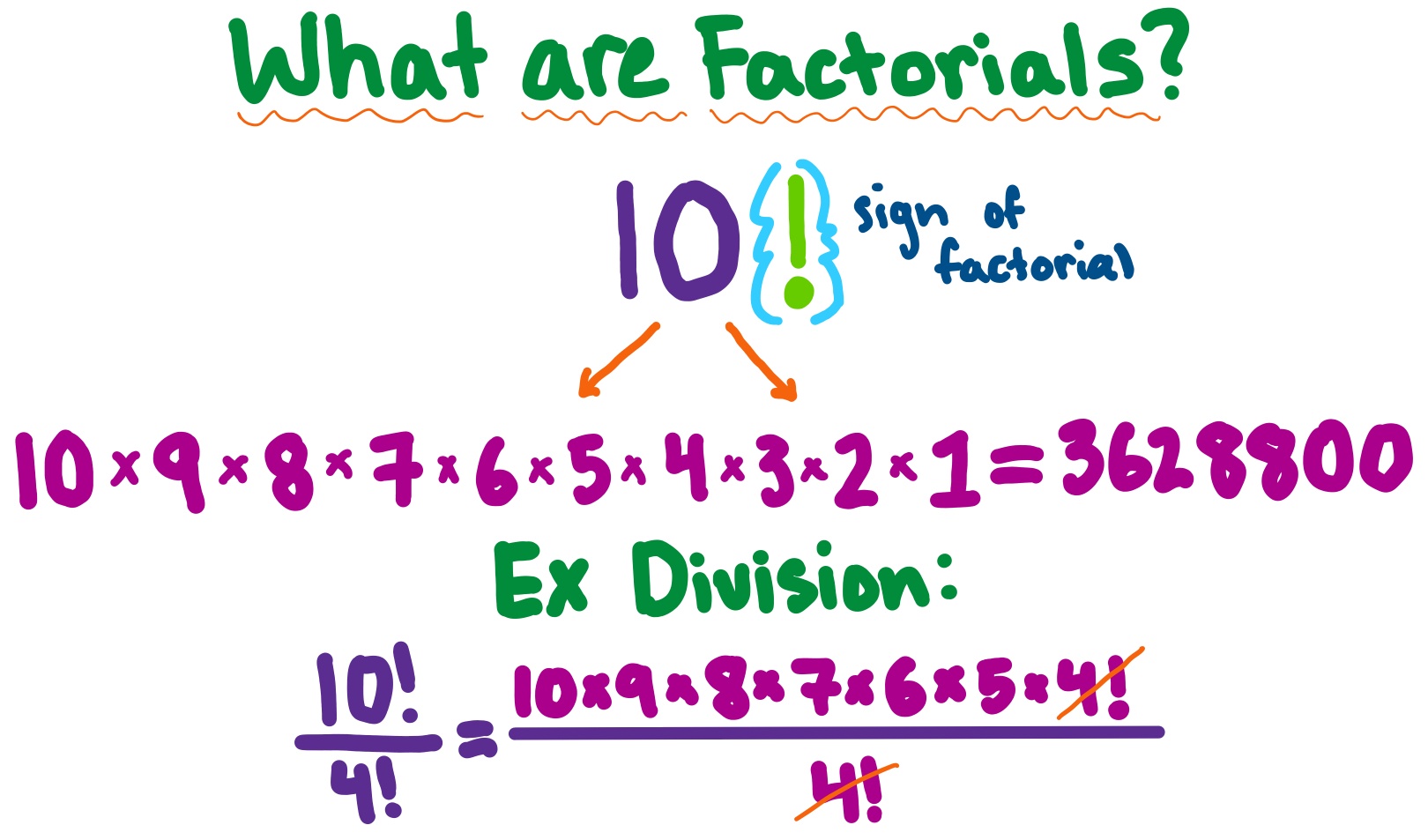
What are factorials?

10! 
{!} = sign of factorial
Arrow pointing downwards

10 x 9 x 8 x 7 x 6 x 5 x 4 x 3 x 2 x 1 = 3628800
Ex Division:

10! divided by 4! = 10 x 9 x 8 x 7 x 6 x 5 x 4! divided by 4!. 
4! canceled on both numerator and denominator.

Image source: by Trisha

n!n! is equal to all of the numbers from 11 to nn multiplied together:

n!=(n)(n−1)(...)(2)(1)n!=(n)(n-1)(...)(2)(1)

We would say this as "nn factorial".

Factorials grow very quickly as the starting number gets larger. For example, (3!=6)(3! = 6), while (6!=720)(6! = 720). By definition, (0!=1)(0! = 1).

Factorials are especially useful when the order of objects matters. Imagine five students are standing in a line. There are 55 choices for the first position, then 44 choices for the second position, and so on. Using the Fundamental Counting Principle, the total number of arrangements is 5×4×3×2×15 \times 4 \times 3 \times 2 \times 1, or 5!5!.

Factorials give us a shorter way to write this long multiplication. They are also an important part of formulas for permutations and combinations. Understanding factorials makes it easier to solve many different counting and probability problems.

Type a concept, like “slope” or “photosynthesis”.

↑ ↓ to choose · Enter to openSearch explanations and problems