
Illustrated · 1 min
By Gabi Slizewska

+1 contributors
Contributors


Image source: By Gabi Slizewska
Illustrated · 1 min
Image source: By Gabi Slizewska
Interactive · 1 question
They are groups of different species that interact with each other in an ecosystem.
Community ecology looks at how different species interact in an ecosystem. The community in a pond might include fish, frogs, algae, plants, and snakes.
Community ecologists study interspecific interactions, like predator-prey and competition. There are also symbiotic interactions like mutualism, commensalism, and parasitism.
Scientists study all these interactions using various methods and diagrams. Understanding them helps us see how energy and resources move through an environment. Commonly, scientists use food chains, food webs, and energy pyramids to show this information.
An organism's interactions affect its niche.

Image source: By W.carter [CC0], via Wikimedia Commons
Which of these are part of the community in the pond shown above? Check all that apply.
Distinguishing between the different levels of biological organization can be confusing. However, a few key differences can make it much easier.
A population is more specific than a community. Populations are made up of members of just one species. Communities consists of multiple species and multiple populations.
An ecosystem is a broader level of organization because it consists of a community and the nonliving factors that it interacts with, like water and sunlight. Communities do not include nonliving things.
Illustrated · 1 min

Image source: By 27707 CC0, via pixabay.com
Communities are not quite the same as populations. That's because a population is made up of just one species. Communities include many populations of different species. Scientists can look to communities in order to study population dynamics.
The picture above shows an example of a community. It is made up of several species of fish.
It's important to remember that a community is also different from an ecosystem. This is because an ecosystem includes all the different species that live in a region as well as all the nonliving components like water, sunlight, and soil. This is important to note because communities do not include nonliving things.
When disasters affect communities, they recover and regrow through a process called ecological succession.
Illustrated · 1 min
This schematic represents a community that includes n populations. These populations interact with one another in their ecosystem.
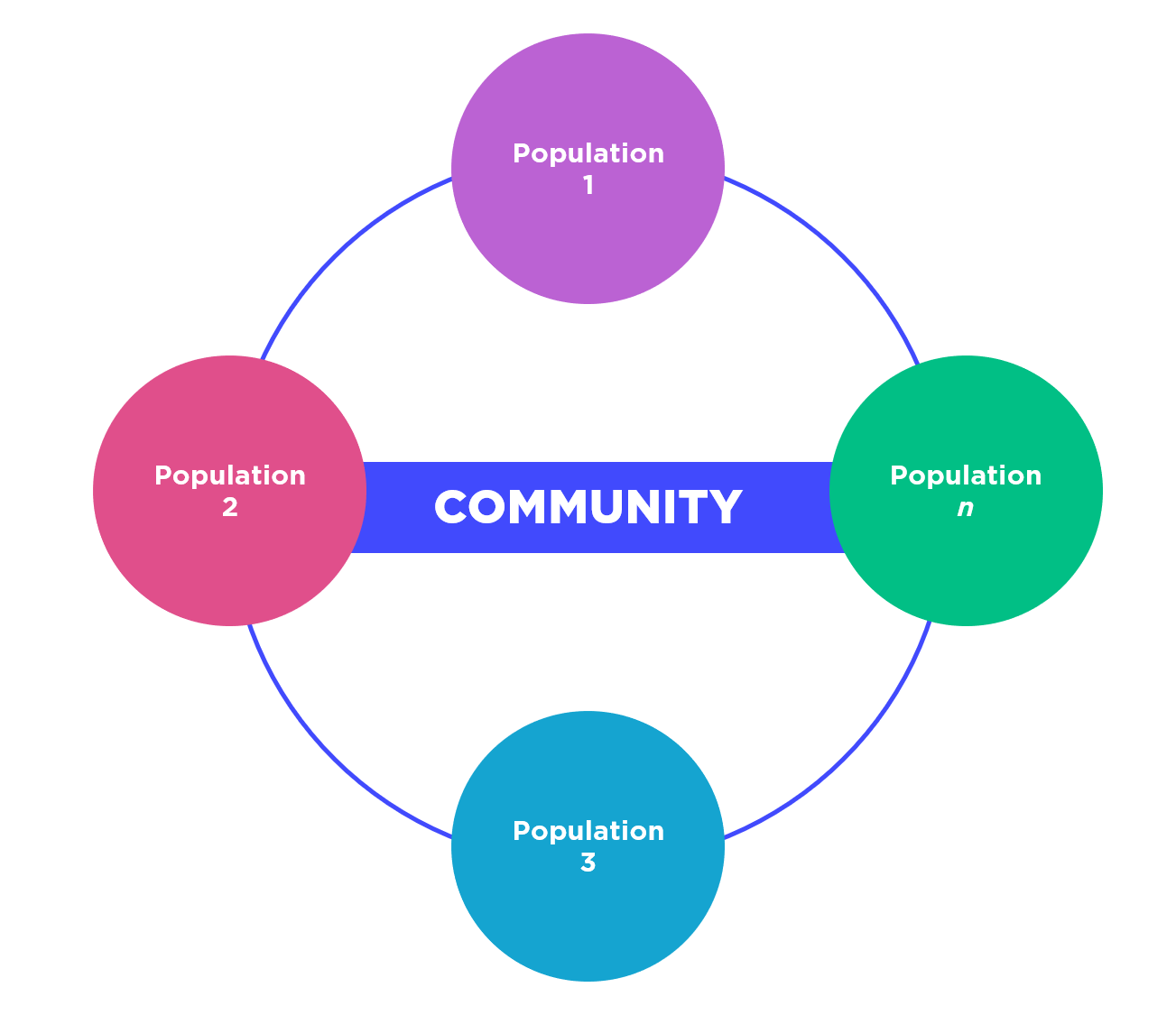
Image source: By Valeri Natole
A population consists of members of just one species living together in a given area.
A community is made up of several populations of different species interacting in an area.
When you also include the nonliving components found in that area, like water and sunlight, you get an ecosystem.
Video
by CrashCourse

A community is all the living things in a specific environment and the interactions between them. If you think of a stream ecosystem, the community is all the living things in that stream, but none of the nonliving things.
This branch of ecology studies the interactions between organisms living in communities. This field of study can help explain why the natural world looks the way it does.
Communities are largely defined by the competition that takes place between organisms found within them. Resources are limited in nature so competition is necessary.


