Interactive · 7 questions
+3 contributors


Finding Permutations
When working with permutations, the first thing to know is that they are different from combinations.
With combinations, order doesn't matter. Jaya, Zach, and Marlee is the same as Zach, Marlee, and Jaya. Either way, it's the same combination of people.
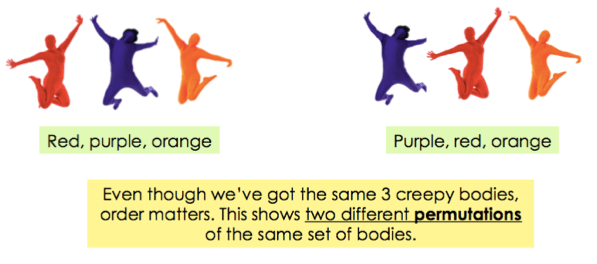
With permutations on the other hand, order matters. Jaya, Zach, and Marlee is a totally different permutation than Marlee, Jaya, and Zach.
Permutations show us how many possible ways there are do something.
Here's another example, based on a joke that math teachers like to tell:
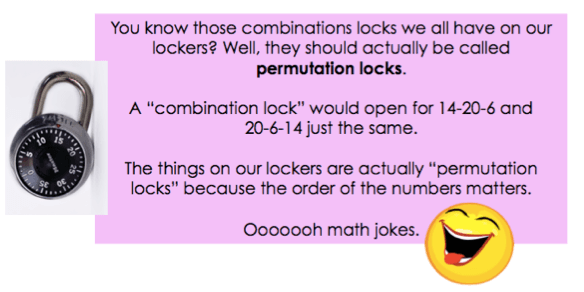
Let's try a practice problem to see how we can calculate permutations.
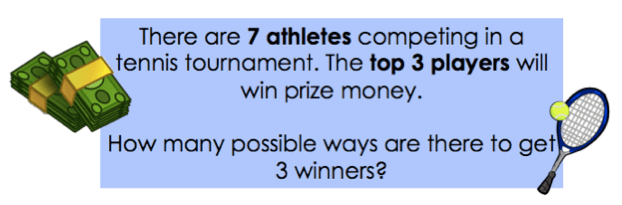
To answer this question, we need to calculate how many permutations there are for the top 3 players given that we have 7 players overall. Remember, order matters.
Here's the general formula for calculating permutations:
- stands for permutation.
- is the number of people or objects to choose from.
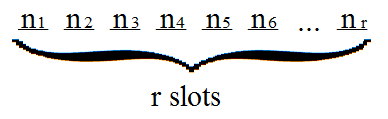
- is the number of spaces to fill.
- The s in this equation don't mean that you need to read it really loudly. In math, exclamation points are the symbol for factorials.
To find a factorial, multiply the number before the exclamation point by every number less than it, all the way down to 1.
For example:
Let's practice factorials before we bring our focus back to permutations.
What is ?
What is ?
What is ?
Let's come back to our permutation problem now that we know what factorials are.
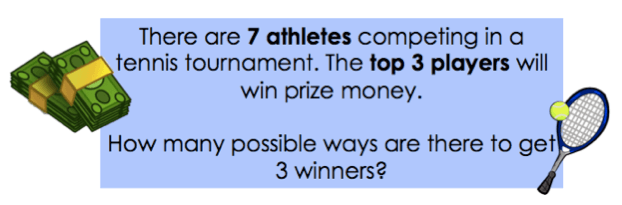
For our tennis question, what is the value of ?
What is the value of r?
Look at the denominator in our equation.
Which of the choices below is equal to ?
Solve the equation.
How many permutations are there for us to get top players from the athletes competing?