Interactive · 2 questions
+5 contributors



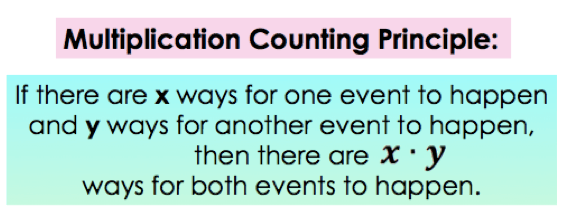
The multiplication counting principle states that the number of ways a sequence of events can occur is the product of the number of ways each individual event can occur.
Example 1:
Jack, Mary, and Tom each roll two dice. What is the number of ways in which Jack can get a total of Mary can get a total of and Tom can get a total of
First we must look at the individual events — let's start with Jack. Jack must get a total of from two dice. Let the possible combinations be in the form where is the number the first dice lands on and is the number the second dice lands on. The possible combinations are , , , and so there are ways Jack can get a total of
Similarly, the possible combinations for Mary are , , ways. The possible combinations for Tom are and ways.
The number of ways in which Jack can get a total of , Mary can get a total , and Tom can get a total of is
Example 2:
You are planning your schedule for next year; there are Math courses, English courses and Science courses that you are eligible to enroll in. You want to take course in each subject, how many combinations of courses ( from each subject) do you have to choose from?
Number the courses in each subject from to the number courses you are eligible to enroll in for that subject.
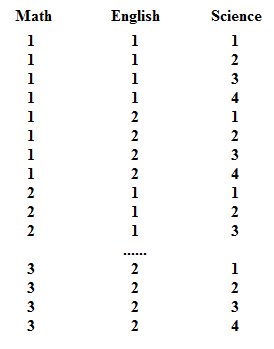
There are 4 different science classes you can take with each English class and there are 2 different English classes you can take with 3 possible Math classes. If you follow the pattern above you will get 24 combinations. Note that since there are 3, 2 and 4 Math, English and Science classes you can take (respectively) you get...
Test Yourself!
How many numbers in the range - do not have any repeated digits?
License plates in Ontario, Canada have letters followed by digits - (the letters and digits are not necessarily distinct). How many different license plates can be created in Ontario?