Combination Notation

Video · + 2 min read

(Video) Counting Using Combinations

by PatrickJMT

In this video, by PatrickJMT, Patrick explains combinations and how you use them.

Summary\large{\text{Summary}}

Combinations are counting without replacement and the order does NOT matter.

> Suppose you have nn objects and you want to select rr of those. How many different combinations can you make?

We use a special combination notation to represent the sentences above. All three of them mean the same thing: "nn choose rr." nCr=Crn=(nr)_nC_r=C_r^n=\binom{n}{r}

All of these refer to the same equation: =n!(n−r)!r!\boxed{=\frac{n!}{(n-r)!r!}}

A line break.

Example 1

The first example Patrick looks at is: 5C2=_5C_2=

This is pretty straightforward to solve. We just use the formula and plug nn and rr. So, "55 choose 22" is equal to: n!(n−r)!r!=5!(5−2)!2! =5!3!2! =5⋅4⋅3⋅2⋅13⋅2⋅1⋅2⋅1=5⋅4⋅3⋅2⋅13⋅2⋅1⋅2⋅1=5⋅42⋅1=202=10\begin{align} \frac{n!}{(n-r)!r!}&=\frac{5!}{(5-2)!2!}\\\ &=\frac{5!}{3!2!}\\\ &=\frac{5\cdot4\cdot3\cdot2\cdot1}{3\cdot2\cdot1\cdot2\cdot1}\\ &=\frac{5\cdot4\cdot\color{red}{3}\cdot\color{red}{2}\cdot\color{red}{1}}{\color{red}{3}\cdot\color{red}{2}\cdot\color{red}{1}\cdot2\cdot1}\\ &=\frac{5\cdot4}{2\cdot1}\\ &=\frac{20}{2}\\ &=10 \end{align} This tells us that if we have 55 objects and we only choose 22 of them, there are 1010 combinations!

Try this on your own. 8C6=_8C_6=

Choose one answer

Interactive · 6 questions

Combinations

The first thing to know about combinations is that they are not the same thing as permutations.

I'm going to include a few of the comparisons and examples that you can also find in my permutations explanation here. I think they do a pretty good job of illustrating how the two concepts are different.

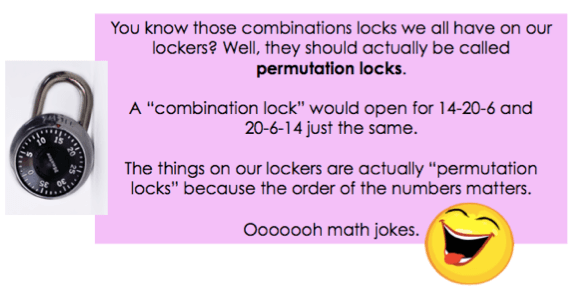
A picture of a combination lock with numbers ranging from 0 to 39

Combination locks - we've all used them, but have you ever thought about exactly what the word "combination" means?

With combinations, order doesn't matter. Jaya, Zach, and Marlee is the same as Zach, Marlee, and Jaya. Either way, it's the same combination of people.

With permutations on the other hand, order matters. Jaya, Zach, and Marlee is a totally different permutation than Marlee, Jaya, and Zach.

Here's another example, based on a joke that math teachers like to tell:

You know those combination locks we all have on our lockers? Well, they should actually be called permutation locks. A "combination lock" would open for 14-20-6 and 20-6-14 just the same. The things on our lockers are actually "permutation locks" because the order of the numbers matters. Oooooooh math jokes.

Here's another example that might help.

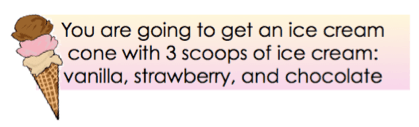
You are going to get an ice cream cone with 3 scoops of ice cream: vanilla, strawberry, and chocolate.
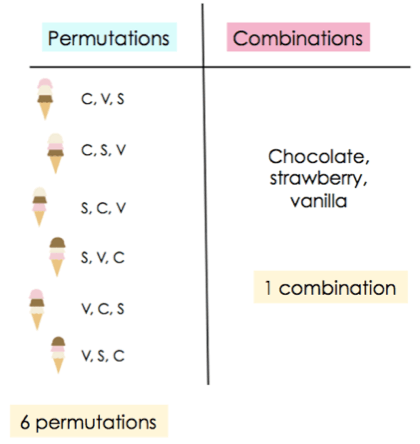
6 permutations of the three ice cream flavors, but only one combination

When we're trying to come up with permutations, the order of the scoops matters. However, when we're talking about combinations, order doesn't matter.

Whether you start with strawberry, chocolate, or vanilla, you have the same combination of 3 flavors no matter how you stack the scoops.

Here's the formula and notation you'll need to use to officially figure out the number of combinations you've got:

nCr=n!r!(n−r)!_nC_r = \frac{n!}{r!(n - r)!}

In math, an exclamation point is the symbol for a factorial. Scroll down in the explanation linked here to see what factorials are.

What is 4!4!

Choose one answer

Video

(Video) The Counting Principle, Permutations, and Combinations

by Jack Walker

Jack Walker has a great video on the multiplication counting principle, permutations, and combinations.

Summary\large{\text{Summary}}

The first part of the video details the multiplication counting principle. Then it moves into permutations, and finally combinations. Great emphasis is placed on the differences between permutations and combinations. On that note we present a conceptual question to drive that point home. Feel free to re-watch the video as many times as you'd like.

When picking objects out of a group, are there more permutations or combinations to do this?

Choose one answer

Interactive · 1 question

COMBINATIONS

Combinations are very similar to permutations as they are also trying to find how many smaller groups can be made out of a larger set of elements. Just like how permutations have permutation notation, combinations have combination notation: nCr_n C_r Where nn is the number of elements in the overall set, and rr is the number in each group that you’re trying to calculate. Once again, nn will always be the larger number. The equation for combinations is very similar to permutations, but with one extra step: nCr=n!(n−r)!⋅r!_n C_r =\frac{n!}{\left(n-r\right)!\cdot r!} In the denominator, you multiply (n−r)!(n-r)! by r!r! . This is the only part that is different in this equation compared to the one for permutations.

Let’s run through a problem just to understand the use of this equation.

In music, a triad is defined as any combination of 33 notes. Between each octave on a keyboard there are 1212 different notes that can be played. How many different chords could be played within one octave?

In this case n=12n = 12 notes per octave, and r=3r = 3 notes in each triad. 12C3=12!(12−3)!⋅3!=12!9!⋅3!_{12} C_3=\frac{12!}{(12-3)!\cdot3!}=\frac{12!}{9!\cdot3!} Once again, break each factorial into its own factors, and cancel out factors that are on both sides. 12!9!3!=12⋅11⋅10⋅9⋅8⋅7⋅6⋅5⋅4⋅3⋅2⋅19⋅8⋅7⋅6⋅5⋅4⋅3⋅2⋅1⋅3⋅2⋅1=12⋅11⋅103⋅2⋅1=13206=220\begin{align}\frac{12!}{9!3!} &=\frac{12\cdot11\cdot10\cdot9\cdot8\cdot7\cdot6\cdot5\cdot4\cdot3\cdot2\cdot1}{9\cdot8\cdot7\cdot6\cdot5\cdot4\cdot3\cdot2\cdot1\cdot3\cdot2\cdot1} \\ &=\frac{12\cdot11\cdot10}{3\cdot2\cdot1} \\ &=\frac{1320}{6} \\ &=\boxed{220}\end{align} The denominator shows 9!9! immediately followed by 3!3!. There is no need to separate them as each factor is being multiplied. In this problem, the (3⋅2⋅1)(3\cdot2\cdot1) from 3!3! cancels out with the same set from the 12!12! in the numerator, as does (9⋅8⋅7⋅6⋅5⋅4)(9\cdot8\cdot7\cdot6\cdot5\cdot4) from 9!9!, but there is still (3⋅2⋅1)(3\cdot2\cdot1) left over at the end. This is because that set of numbers is repeated in the denominator, but not in the numerator, and therefore will not get cancelled out.

If you're still a little uncomfortable with the idea, here is a video that goes over both Permutations and Combinations in depth by Brandon Foltz on YouTube.

You and 77 of your friends are spending a night together playing Super Smash Brothers. How many different 1-on-1 matchups could be played?

Choose one answer

Type a concept, like “slope” or “photosynthesis”.

↑ ↓ to choose · Enter to openSearch explanations and problems