Interactive · 1 question
+2 contributors


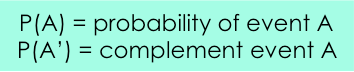
The Complement of an event is the case where the event does not occur. Usually we add a bar over the symbol for an event to denote its complement, so the complement of is .
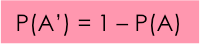
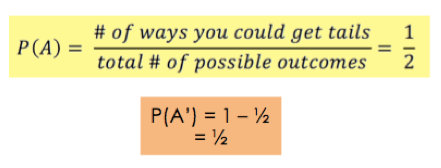
The probability of the complement of an event is Let's say we're curious about whether it will snow tomorrow. We would say that the event of interest is "It snows tomorrow." Therefore, asking about means that we want to know "What is the probability that it snows?" If we ask about , then we want to know "What is the probability of it not snowing tomorrow?" If the weatherman says that there is a chance of snow, then by the logic of complements, there is a chance of not snow - which includes the possibility that the sun will shine, that it will rain or hail, and the possibility of the inevitable heat death of the universe finally occurring. Many other unlikely, but possible states of the weather tomorrow, too.
If there is a chance of cats and dogs raining from the sky, what is the probability of its complement (no cats and dogs falling from the stratosphere)?
Seems pretty simple, right? But why does it work?
The probability that something within the realm of possibility happens is always . This is because something will always happen - when you roll a die, one of the sides will always come up (You're not going to let your game be ruined by the fact that the die fell into a crack or off of the table, so you'll pick it up and re-roll it).
Which intuitively makes sense - it is certain (probability = ) that some event within the realm of possibility happens, possibly including nothing at all.
Next we use the logical "or" rules in a nifty way. For simplicity, let's assume that all possibilities are disjoint - they cannot occur together, or . It turns out the property holds even without this claim, but it's easier to see it this way.
As we said before, the probability of absolutely any of the possible events happening is . "Absolutely any event happening" is equivalent to happens or happens or happens... and so on till you have all of the possible events in a giant "or" chain. This means that the probability of all possible events has to add up to .
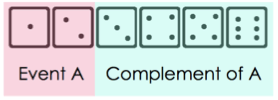
Let's say there are 4 events, through
We know
We want to know , which is equivalent to (all the events that are not )
Simple subtraction shows that
Therefore,
Cool, right?