Counting and Probability: Conducting Simulations

Interactive · 1 question

Example: Simulations and Probability

\\

Probability of any outcome of a chance process is between 0 and 1.\text{Probability of any outcome of a chance process is between 0 and 1.}  It describes the proportion of times the outcome would occur\text{ It describes the proportion of times the outcome would occur} in a series of repetitions. \text{in a series of repetitions. }

We can calculate and predict the probability of different events, that is called the theoretical probability.

We can also conduct trials to find the probability, this is called the experimental probability.

What Simulations? \\

It is a lot of work and sometimes very hard to conduct trials to find the experimental probability––especially if we need to conduct a large number of trials. Conducting simulations allow us to find the experimental probability without all the trouble.

Coin Toss Simulation \\

Let's toss a fair coin (head and tail are equally likely to show up) and calculate the probability of getting a head.

Generally, the more trials we run, the more accurate the probability.

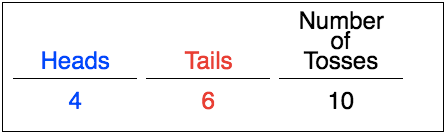
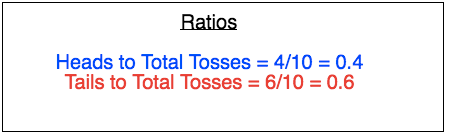
Let's start with tossing a fair coin 1010 times with an online simulator.

4 heads, 6 tails, 10 tosses total

Tossing a coin 10 times

Heads to total tosses: 0.4; tails to total tosses: 0.6

The probability of getting heads

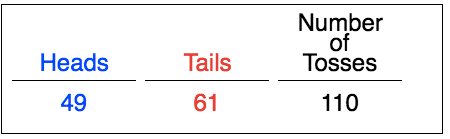
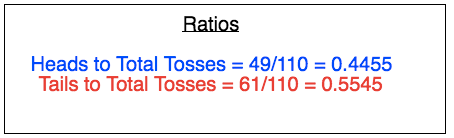
Let's toss the coin 110110 times.

49 heads, 61 tails, 110 total tosses

Tossing a coin 110 times

Heads to total tosses: 0.4455; tails to total tosses: 0.5545

The probability of getting heads

Let's toss the coin 10001000 times.

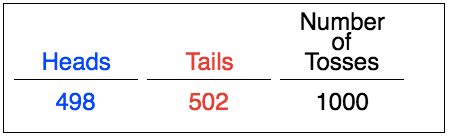
498 heads, 502 tails, 1000 tosses total

Tossing a coin 1000 times

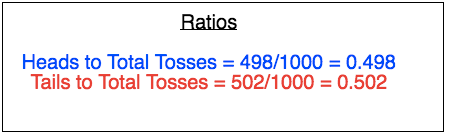
0.498 heads to total tosses, 0.502 tails to total tosses

The probability of getting heads

Consider the follow simulation for a simple coin toss. Suppose we have a fair coin (this means heads and tails are equally likely to appear when we toss the coin).

How many trials will yield a probability closest to the one we predict (12\frac{1}{2}, since the coin is fair)? Choose the best answer available.
Choose one answer

Illustrated · 2 min

What is a simulation and why is it helpful?

A simulation is a way to model or imitate events in such a way that the outcome is representative of a real world result. In other words, it is a way to learn about the possible outcomes of a situation without the actual situation occurring. Simulations are conducted when it is too difficult, dangerous, time-consuming, or costly to conduct an experiment. The results of the simulation can be thought of as a hypothesis as to what would actually happen.

How to conduct a simulation?

1.1. When conducting a simulation begin by finding the possible outcomes.

Let's say we want to know the probability of guessing and getting three questions correct out of five. In this case there are two possible outcomes per question, correct and incorrect.

2.2. Once the possible outcomes have been identified, decide on a simulation method that fits the scenario and assign each possible real world outcome to a possible outcome in the simulation.

Let's continue with the above scenario. If we want to know the probability of guessing and getting three out of five questions correct we can flip a coin. We can assign heads\color{red}{\text{heads}} to a correct\color{red}{\text{correct}} answer and tails\color{blue}{\text{tails}} to an incorrect\color{blue}{\text{incorrect}} answer.

Note: A coin flip simulation can be conducted anytime there are two possible outcomes.

3.3. Next, begin conducting the situation, completing several trials.

In the above situation, we want to know the probability of getting three questions correct out of five. This means we should flip the coin five times, once per question, per trial.

Note: It is important to conduct multiple trials in order to get an end result that is accurate. The more trials conducted, the closer we get to an accurate theoretical probability.

44. Finally, analyze the simulated outcome and report your findings.

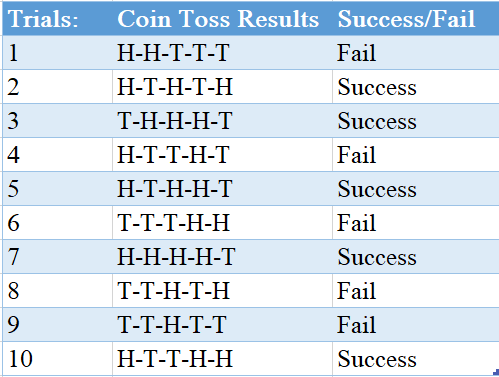
The table below represents the results of the simulation described throughout this section.

An example of eight trials of flipping a coin 5 times and recording if three heads and two tails appeared

In this simulation ten trials were conducted with five coin tosses per trial. In the case a coin landed on heads at least three times in a trial, the trial is consider a "success" (the successful trials represent the event that some one does guess three out of five questions correctly). The results can then be analyzed to give an experimental probability that someone will guess three out of five questions correctly.

Pexperimental=successtotal trials=510=0.5P_{experimental}=\frac{\text{success}}{\text{total trials}}=\frac{5}{10}=0.5

Video

(Video) Simulations

by MathHelp.com

Math Help.com has a good simple video explaining what simulations are and how to conduct them.

Summary\large{\text{Summary}}

Now, here's an example problem that gives a sample simulation scenario (say that three times fast).

We have a box of crayons with lots of colors, but we want a white crayon. We randomly pull out a crayon, record the color, and put it back. What are the two possible outcomes we want to record?

Choose all correct answers

Type a concept, like “slope” or “photosynthesis”.

↑ ↓ to choose · Enter to openSearch explanations and problems