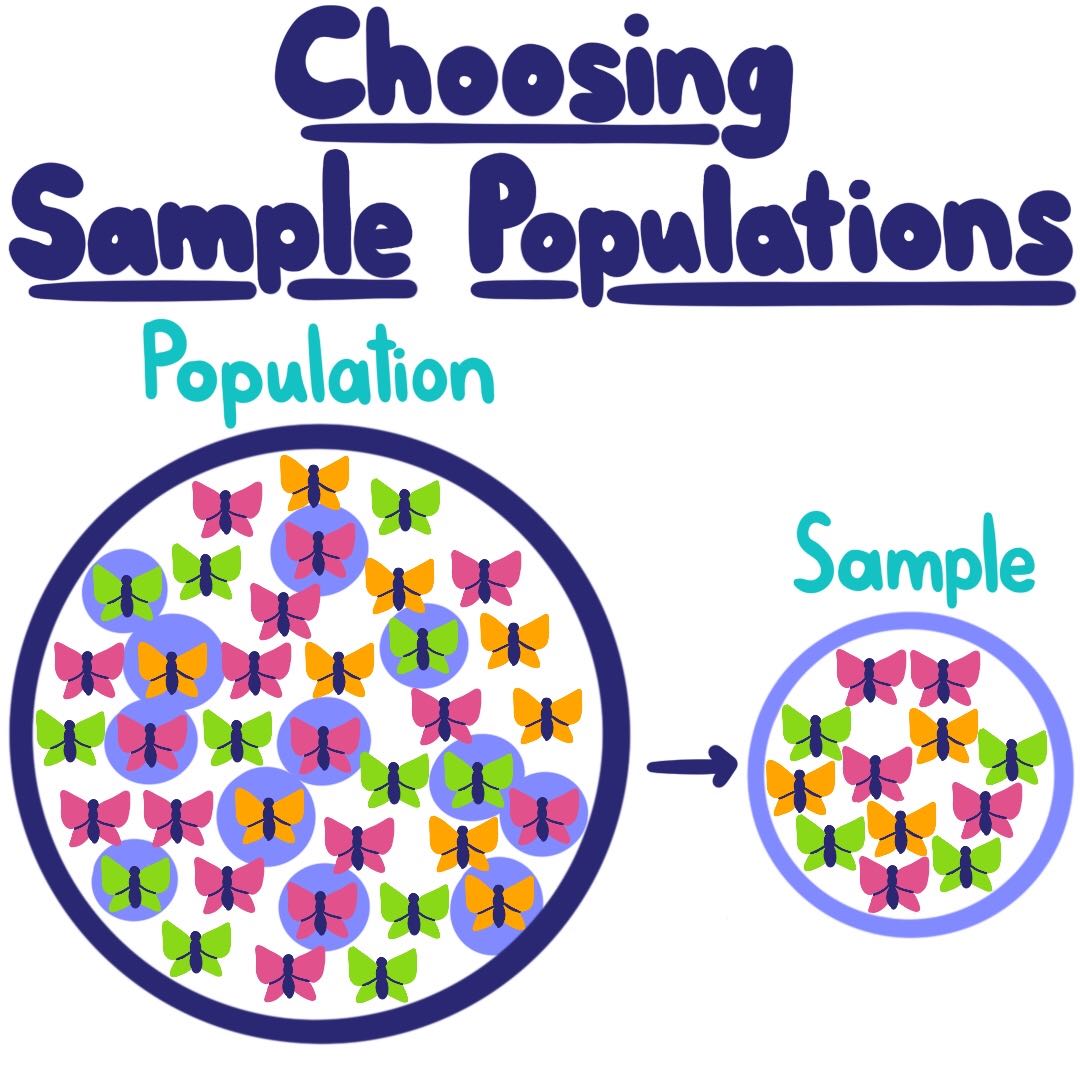
Sample Populations
The goal of statistics is to discover the underlying trends or correlations within an entire group. An issue that comes up is that most of the time is that the group, or population, you're trying to study is simply too large. If you're trying to learn about the favorite foods of every person in the country and compare it to where they live, there would be too many people to survey. It would be almost impossible not only to ask every person in the country what their favorite food was and where they live, but also to get every person you ask to respond. In these cases you would want to use a sample population.
A sample population is a smaller group within the entire population you are trying to study that can be surveyed to find similar results. There are more than 325 million people living in the United States right now, making it impossible to ask everyone. However, you could ask 1000 people from each of the 50 states. This means you still have to survey 50000 people, but this is much more manageable than 325 million!
If your population is small enough, you may not have to use a sample population. For instance, you wouldn't need a sample population to ask everyone in your class what their favorite color is.
Let's look at a population and see if we can break it down.
You're trying to figure out what kind of vehicle is more popular to drive in your state: cars or trucks.
Here you would definitely need to use a sample population. Looking at Pennsylvania as an example, there would be over 8 million cars to analyze, and that's only if everyone you ask responds to you. You would want to break this down into a smaller sample population.