Додавання та віднімання функцій

Interactive · 4 questions

Operations with Functions

We can add or subtract two functions and simplify.

Addition

Given two formulas f(x)f(x) and g(x)g(x), we can add two functions and simplify. (f+g)(x)=f(x)+g(x)(f+g)(x) = f(x) + g(x) Let's try a couple of example problems.

Given f(x)=5x+8f(x) = 5x+8 and g(x)=x−9g(x) = x-9, find the sum of the two functions.

Choose one answer

Video

(Video) Adding and Subtracting Functions

by PatrickJMT

Here's a video by PatrickJMT showing you how to add and subtract functions. Once you've watched the video, try this related problem.

If f(x)=x3−2f(x) = x^3 - 2 and g(x)=x2−2,g(x) = x^2 - 2, find f(x)−g(x)f(x) - g(x)

Choose one answer

Video

(Videos) Function Operations and Composition

by mathman1024

Here's a video by mathman1024 explaining how to deal with adding, subtracting, multiplying, and dividing functions. These are very simple and it's best to show how it's done with an example.

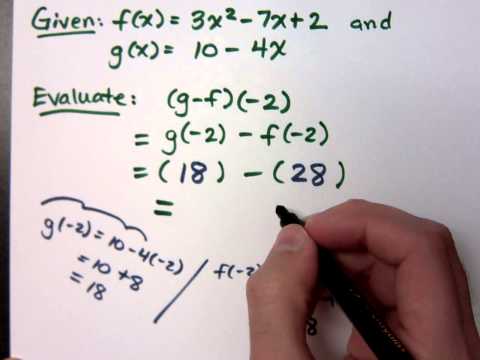
So the functions he uses for the problems are {f(x)=3x2−7x+2g(x)=10−4x\begin{cases}f(x)=3x^2-7x+2\\g(x)=10-4x\end{cases}. The first thing he wants to solve is: (g−f)(−2)(g-f)(-2). This means g minus f of negative two. This just means: (g−f)(−2)=g(−2)−f(−2)(g-f)(-2)=g(-2)-f(-2) From here we just plug −2-2 into the functions then subtract them. g(−2)−f(−2)[10−4(−2)]−[3(−2)2−7(−2)+2][10+8]−[12+14+2]18−28−10\begin{align} &g(-2)-f(-2)\\ &[10-4\color{#8925AE}{(-2)}]-[3\color{#8925AE}{(-2)}^2-7\color{#8925AE}{(-2)}+2]\\ &[10+8]-[12+14+2]\\ &18-28\\ &-10 \end{align}

See if you can solve this next one on your own. It's the same idea just with a different operation.

  1. (fg)(5)(fg)(5)

Here's one more example problem by mathman1024, looking at the multiplication of two functions.

Test Yourself: Using the same functions above, solve (fg)(2)(fg)(2).

Choose one answer

Video

(Videos) Operations with Functions

by mathman1024

Here's a video by mathman1024 explaining function operations.

(f+g)(x)=f(x)+g(x)(f−g)(x)=f(x)−g(x)(fg)(x)=f(x)⋅g(x)(fg)(x)=f(x)g(x), where g(x)≠0(f+g)(x)=f(x)+g(x)\\ (f-g)(x)=f(x)-g(x)\\ (fg)(x)=f(x)\cdot g(x)\\ \bigg(\frac{f}{g}\bigg)(x)=\frac{f(x)}{g(x)},\text{ where }g(x)\ne0

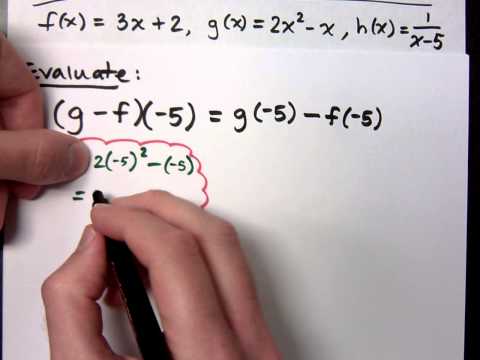
He then does some examples. He gives a list of functions. f(x)=3x+2g(x)=2x2−xh(x)=1x−5f(x)=3x+2\\g(x)=2x^2-x\\h(x)=\frac{1}{x-5} The first example he gives is: (f+h)(4)(f+h)(4). (f+h)(4)=f(4)+h(4)=[3(4)+2]+[1(4)−5]=14+−1=13\begin{align} (f+h)(4)&=f(4)+h(4)\\ &=[3\color{#8925AE}{(4)}+2]+\bigg[\frac{1}{\color{#8925AE}{(4)}-5}\bigg]\\ &=14+-1\\ &=13 \end{align}

Here's another video with another example still using the same functions. (f+g)(x)=f(x)+g(x)(f−g)(x)=f(x)−g(x)(fg)(x)=f(x)⋅g(x)(fg)(x)=f(x)g(x), where g(x)≠0(f+g)(x)=f(x)+g(x)\\ (f-g)(x)=f(x)-g(x)\\ (fg)(x)=f(x)\cdot g(x)\\ \bigg(\frac{f}{g}\bigg)(x)=\frac{f(x)}{g(x)},\text{ where }g(x)\ne0

Try this on your own and then watch the video to see the answer!

  1. (g−f)(−5)(g-f)(-5)

Here's another video with another example still using the same functions. (f+g)(x)=f(x)+g(x)(f−g)(x)=f(x)−g(x)(fg)(x)=f(x)⋅g(x)(fg)(x)=f(x)g(x), where g(x)≠0(f+g)(x)=f(x)+g(x)\\ (f-g)(x)=f(x)-g(x)\\ (fg)(x)=f(x)\cdot g(x)\\ \bigg(\frac{f}{g}\bigg)(x)=\frac{f(x)}{g(x)},\text{ where }g(x)\ne0

Try this on your own and then watch the video to see the answer!

  1. (gh)(3)(gh)(3)

Illustrated · 1 min

Adding and Subtracting Functions

Adding and subtracting functions can seem overwhelming at first, but there's a way to rewrite to make it easier to solve.

Add & Subtract Functions
Addition: (f+g)(x)=f(x)+g(x)
Subtraction: (f-g)(x)=f(x)-g(x)
Then, combine like terms and simplify

Image source: by Anusha Rahman

To add or subtract functions, you combine or subtract the outputs of the functions for each input.

For example, if you have two functions, f(x)f(x) and g(x)g(x), and you want to add them, you write (f+g)(x)=f(x)+g(x)(f+g)(x)=f(x)+g(x). This means you take the output of f(x)f(x) and the output of g(x)g(x) for the same xx-value, then add them together.

If you want to subtract the functions, you write (f−g)(x)=f(x)−g(x)(f−g)(x)=f(x)−g(x), and subtract the output of g(x)g(x) from f(x)f(x). Always remember to apply the operations separately to each function and then combine the results.

It’s just like combining regular numbers, but with functions!

Looking Further

In our next lesson in function operations, we will learn about multiplying and dividing functions. Once you have mastered that, we will learn to compose functions at a point and simplify composite functions.

Type a concept, like “slope” or “photosynthesis”.

↑ ↓ to choose · Enter to openSearch explanations and problems