Що таке композиція/перетворення?

Interactive · 1 question

There are a few different scenarios in which you might have to evaluate a composite function at a given point: using a table, using a graph, or using the expressions of the functions themselves.

Tables\textbf{Tables}

Sometimes you may be given a table (or tables) that show the input and output of functions, and you'll be asked to evaluate a composition of these functions at a certain point. How would you go about doing this?

Let's look at an example to see how to solve these types of problems. Say you're given the following table, and you're asked to evaluate g(f(2)).g(f(2)).

xf(x)g(x)031186215337412\begin{array}{|c|c|c|} \hline x&f(x)&g(x)\\ \hline 0&3&1\\ 1&8&6\\ 2&1&5\\ 3&3&7\\ 4&1&2\\ \hline \end{array}

To solve this problem, we will first evaluate f(2).f(2). Then we will substitute the answer we get into our g(x)g(x) function. After that, we can find g(f(2)).g(f(2)).

Step 1: Evaluating f(2)\text{Step 1: Evaluating $f(2)$}

In order to evaluate f(2),f(2), all we have to do it look at the table and find the f(x)f(x) value when x=2.x=2. As you can see, when x=2,x=2, then f(x)=1.f(x)=1. Thus, f(2)=1.f(2)=1.

Step 2: Substituting f(2) into g(x)\text{Step 2: Substituting $f(2)$ into $g(x)$}

Our next step is easy. Remember, we are trying to find g(f(2)).g(f(2)). But we just found f(2)…f(2) \dots it's 1!1! Thus, we can substitute in 11 for f(2)f(2) like so: g(f(2))=g(1)g(f(2)) = g(1)

Step 3: Evaluating g(f(2))\text{Step 3: Evaluating $g(f(2))$}

Our final step is kind of like the first step. Now that we know that g(f(2))=g(1),g(f(2)) = g(1), we just have to find the g(x)g(x) value when x=1.x=1. We can see that when x=1,x=1, then g(x)=6.g(x)=6. Thus, g(f(2)),g(f(2)), our answer, equals 6.6.

((Note: Be careful with tables! What if you had been asked to find g(f(1))?g(f(1))? Using the strategy we just learned, we can see that g(f(1))=g(8)g(f(1))= g(8) since f(1)=8.f(1)=8. But wait! We can't evaluate g(8)g(8) because 88 is not a defined xx value for g(x)g(x) …\dots it is not in the domain of g(x).)g(x).)

Graphs\textbf{Graphs}

Sometimes, you may be given a graph instead of tables to help you evaluate a composite function at a given point. Let's look at an example to learn how to tackle these problems −- it's similar to the method we used before with tables.

Say you're given the following graph with the function f(x)=x2f(x)=x^2 in blue and the function g(x)=xg(x)=x in orange, and you're asked to evaluate f(g(2)).f(g(2)).

f(x)=x^2 in blue and the function g(x)=x in orange

Created using Desmos

Like we previously learned, we will first evaluate g(2).g(2). Next, we will substitute the answer we get into our f(x)f(x) function. Then we can find f(g(2)).f(g(2)).

Step 1: Evaluating g(2)\text{Step 1: Evaluating $g(2)$}

To evaluate g(2),g(2), we first look at the graph of g(x)g(x) and find the yy value when x=2.x=2. Since g(x)=x,g(x)=x, we can see that when x=2,x=2, then y=2.y=2. Thus, g(2)=2.g(2)=2.

Step 2: Substituting g(2) into f(x)\text{Step 2: Substituting $g(2)$ into $f(x)$}

Since g(2)=2,g(2)=2, we can substitute in 22 for g(2):g(2): f(g(2))=f(2)f(g(2)) = f(2)

Step 3: Evaluating f(g(2))\text{Step 3: Evaluating $f(g(2))$}

Finally, since we know that f(g(2))=f(2),f(g(2)) = f(2), we just have to look at the graph of f(x)f(x) and find the yy value when x=2.x=2. Since f(x)=x2,f(x)=x^2, we can see that when x=2,x=2, then y=4.y=4. So, f(g(2)),f(g(2)), our answer, equals 4.4.

Function Expressions\textbf{Function Expressions}

Lastly, you may only be given the functions themselves, without a table or a graph. Let's see if you can use what you learned to solve a problem of this type:

Let f(x)=3xf(x)=3^x and g(x)=5x−7.g(x)=5x-7. Evaluate f(g(2)).f(g(2)).

Choose one answer

Check what you really know

If you can solve a contest problem with this idea, you know it well. If not, you know exactly what to review. These are real problems from the AMC 8, AMC 10, AMC 12 and AIME, the national math competitions for middle and high school students, each with a worked solution on LIVE by Po-Shen Loh.

Video

(Video) Function Operations and Composition

by mathman1024

In this video by mathman1024 he goes over evaluating composite functions. Composite functions are denoted with a ∘\circ symbol. For example, (f∘g)(1)(f\circ g)(1). This can be rewritten as f(g(1))f(g(1)) where we first solve for g(1)g(1) and whatever you get as the answer you put that into f(x)f(x).

The first example he looks at is with the functions {f(x)=3x2−7x+2g(x)=10−4x\begin{cases}f(x) = 3x^2-7x+2\\g(x) = 10-4x\end{cases}. The problem is to find (f∘g)(2).(f\circ g)(2). (f∘g)(2)=f(g(2))(f\circ g)(2)=f(g(2)) So our first step is to find g(2)g(2). g(x)=10−4xg(2)=10−4(2)=10−8=2\begin{align} g(x)&=10-4x\\ g(2)&=10-4\color{#8925AE}{(2)}\\ &=10-8\\ &=2 \end{align} Now we can use this to find f(g(2))f(g(2)). f(x)=3x2−7x+2f(g(2))=3(g(2))2−7(g(2))+2=3(2)2−7(2)+2=12−14+2=0\begin{align} f(x)&=3x^2-7x+2\\ f(g(2))&=3\color{#8925AE}{(g(2))}^2\color{black}{-7}\color{#8925AE}{(g(2))}\color{black}{+2}\\ &=3(2)^2 - 7(2) + 2 \\ &=12-14+2\\ &=0 \end{align}

Try the next ones on your own and see if you get the same answers.

  1. (g∘f)(2)(g\circ f)(2)
  2. (g∘g)(−72)(g\circ g)(-\frac72)

Test Yourself: Using the functions defined above, find the value of (f∘f)(2)(f\circ f)(2).

Choose one answer

Interactive · 1 question

A function ff is such that if you input a number x,x, you spit out a number yy by applying ff to it; that is, y=f(x).y = f(x). But what if you want to plug yy into a different function g?g?

Well, that's why we have function compositions. A function composition refers to the act of successively plugging numbers into different functions, taking your output from one function and plugging it into another. After all, regardless of what functions we have, they output numbers, right?

With that we establish notation. If we plug xx into function ff and then plug the result into function g,g, this is shown with the symbols g(f(x))g(f(x)) or g∘f(x)g \circ f(x). We'll usually use g(f(x))g(f(x)) since it's shorter, though. g(x)g(x) is the outer function, and f(x)f(x) is the inner function. Remember, if you reverse the order, your answer will not be the same.

If we are given formulas for ff and g,g, and a number x,x, we can evaluate the function ff at the point x,x, and then gg at the point f(x).f(x). Let's do an example.

Example: If f(x)=x+3f(x) = x + 3 and g(x)=x−5,g(x) = x - 5, what is g(f(2))?g(f(2))?

Solution: The first step is to find f(2)f(2) since the function ff is on the inside. Luckily this is easy:

f(2)=2+3=5.f(2) = 2 + 3 = 5.

Then f(2)=5,f(2) = 5, so we replace f(2)f(2) with 55 in g(f(2)):g(f(2)):

g(f(2))=g(5)=5−5=0.g(f(2)) = g(5) = 5 - 5 = 0.

As a result we get g(f(2))=0.g(f(2)) = 0.

Here's another example where the algebra is a little bit trickier.

Example: If f(x)=x2+7x−1f(x) = x^2 + 7x - 1 and g(x)=x+x,g(x) = x + \sqrt{x}, find f(g(4)).f(g(4)).

Solution: This time in the expression we want to evaluate, gg is on the inside, so we start by evaluating g(4):g(4):

g(4)=4+4=4+2=6.g(4) = 4 + \sqrt{4} = 4 + 2 = 6.

Be careful with the square root!

Now we plug this value of g(4)g(4) into f(g(4)):f(g(4)):

f(g(4))=f(6)=62+7(6)−1=36+42−1=77.f(g(4)) = f(6) = 6^2 + 7(6) - 1 = 36 + 42 - 1 = 77.

That's the end of that example, so I'm going to hand this last problem off to you to try.

Let f(x)=2xf(x) = 2^x and g(x)=x+3.g(x) = x + 3. Find g(f(3)).g(f(3)).

Choose one answer

Video

(Videos) Function Operations and Composition

by mathman1024

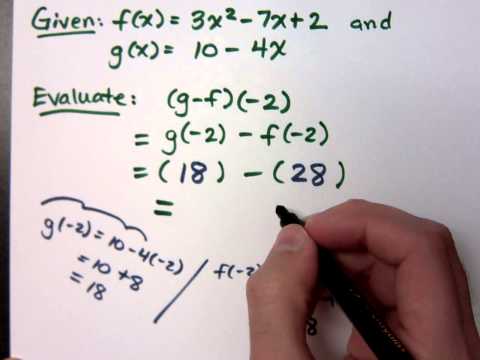
Here's a video by mathman1024 explaining how to deal with adding, subtracting, multiplying, and dividing functions. These are very simple and it's best to show how it's done with an example.

So the functions he uses for the problems are {f(x)=3x2−7x+2g(x)=10−4x\begin{cases}f(x)=3x^2-7x+2\\g(x)=10-4x\end{cases}. The first thing he wants to solve is: (g−f)(−2)(g-f)(-2). This means g minus f of negative two. This just means: (g−f)(−2)=g(−2)−f(−2)(g-f)(-2)=g(-2)-f(-2) From here we just plug −2-2 into the functions then subtract them. g(−2)−f(−2)[10−4(−2)]−[3(−2)2−7(−2)+2][10+8]−[12+14+2]18−28−10\begin{align} &g(-2)-f(-2)\\ &[10-4\color{#8925AE}{(-2)}]-[3\color{#8925AE}{(-2)}^2-7\color{#8925AE}{(-2)}+2]\\ &[10+8]-[12+14+2]\\ &18-28\\ &-10 \end{align}

See if you can solve this next one on your own. It's the same idea just with a different operation.

  1. (fg)(5)(fg)(5)

Here's one more example problem by mathman1024, looking at the multiplication of two functions.

Test Yourself: Using the same functions above, solve (fg)(2)(fg)(2).

Choose one answer

Illustrated · 1 min

Function Composition

Function composition is when you take two functions and combine them to make a new one.

Function Composition 
(f of g)(x)

Image source: by Anusha Rahman

If you're given two functions, f(x)f(x) and g(x)g(x), the composition of the two functions is (f∘g)(x)(f \circ g)(x). This means that you first find the output of g(x)g(x), and then you take that output and put it into f(x)f(x). Basically, you do one function inside the other.

Let's look at an example.

####Example

If f(x)=2xf(x)=2x and g(x)=x+3g(x)=x+3, find (f∘g)(x)(f \circ g)(x).

First, we put g(x)g(x) into f(x)f(x), and then we simplify.

f(x)=2(x+3)=2x+6f(x)=2(x+3) = 2x+6

Type a concept, like “slope” or “photosynthesis”.

↑ ↓ to choose · Enter to openSearch explanations and problems