Множення та ділення функцій

Before this, knowДодавання та віднімання функцій

Read · 2 min

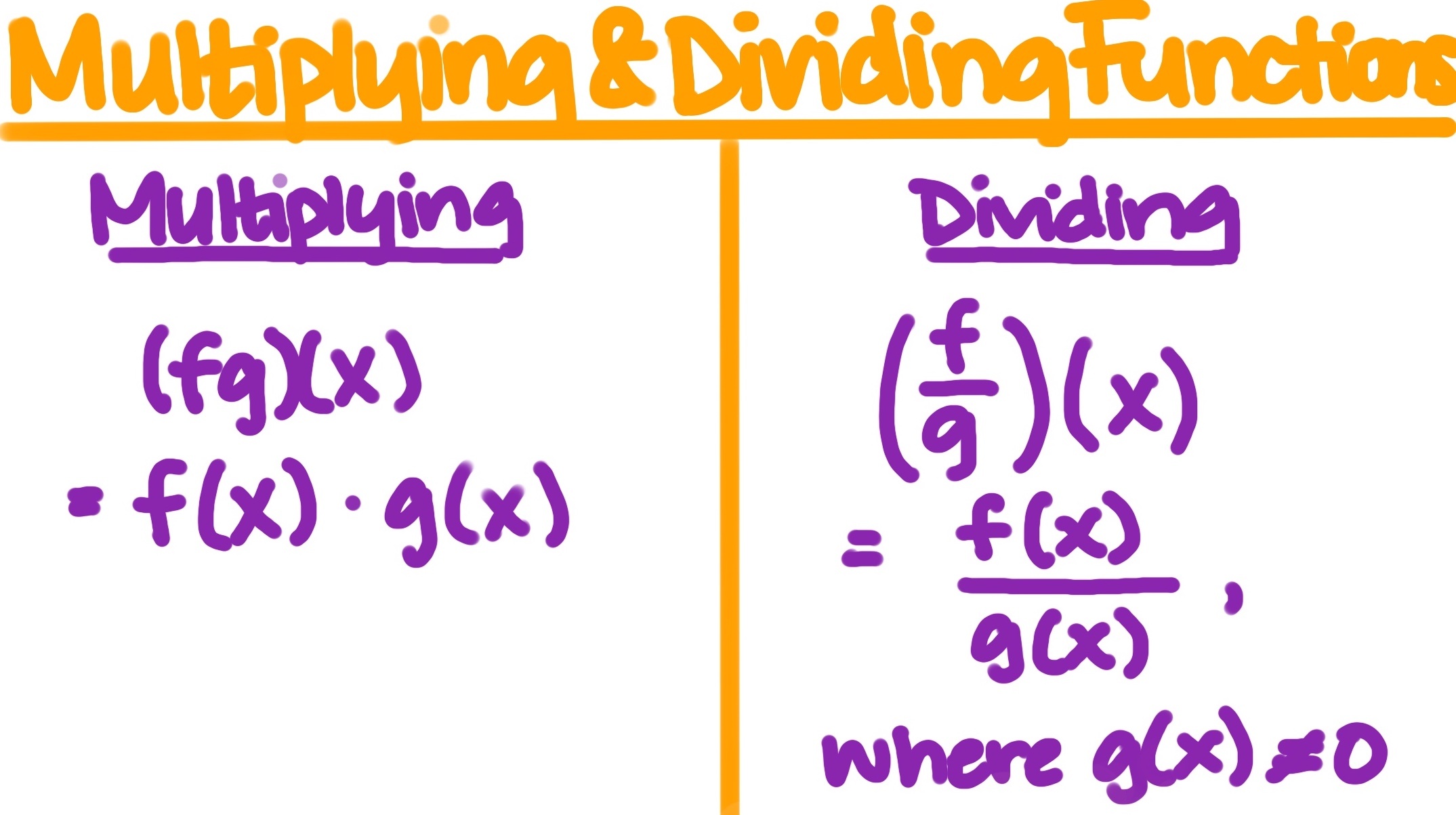
Here are some different notations that you might come across when multiplying and dividing functions: (fg)(x)=f(x)⋅g(x)(fg)(x)=f(x)g(x), where g(x)≠0\begin{align} (fg)(x) &= f(x) \cdot g(x)\\ \bigg(\frac{f}{g}\bigg)(x) &=\frac{f(x)}{g(x)}, \text{ where }g(x)\neq 0 \end{align}

Let's do an example to illustrate how to multiply and divide functions! Say you're given f(x)=x+1f(x)=x+1 and g(x)=x2−1,g(x)=x^2-1, and you're asked to find (fg)(x)(fg)(x) and (fg)(x).\bigg(\dfrac{f}{g}\bigg)(x). Let's talk about how to do this.

Multiplying Functions\textbf{Multiplying Functions}

First, let's find (fg)(x).(fg)(x). We know that (fg)(x)=f(x)⋅g(x).(fg)(x) = f(x) \cdot g(x). Since we already know that f(x)=x+1f(x)=x+1 and g(x)=x2−1,g(x)=x^2-1, we can easily find f(x)⋅g(x)!f(x) \cdot g(x)!

(fg)(x)=f(x)⋅g(x)=(x+1)⋅(x2−1)=x3−x+x2−1=x3+x2−x−1\begin{align} (fg)(x) = f(x) \cdot g(x) &=(x+1)\cdot (x^2-1)\\ &=x^3-x+x^2-1\\ &=x^3+x^2-x-1 \end{align}

So (fg)(x)=x3+x2−x−1.(fg)(x)=x^3+x^2-x-1. Let's think about if you had been asked to find (fg)(2)(fg)(2).

Well, since (fg)(x)=f(x)⋅g(x),(fg)(x) = f(x) \cdot g(x), we know that (fg)(2)=f(2)⋅g(2).(fg)(2) = f(2) \cdot g(2). There are a couple ways to evaluate (fg)(2):(fg)(2): we could find find (fg)(x)(fg)(x) and then plug in 22 for xx in this product, or we could evaluate f(2)f(2) and g(2)g(2) and then find their product. Let's try out both methods.

First, let's find (fg)(x)(fg)(x) and substitute a 22 wherever we see an xx in the resulting expression. We have already found (fg)(x)(fg)(x). It's x3+x2−x−1.x^3+x^2-x-1. Now, let's plug in a 22 for x.x. (fg)(2)=(2)3+(2)2−(2)−1=8+4−2−1=9\begin{align} (fg)(2) &= (2)^3+(2)^2-(2)-1\\ &=8+4-2-1\\ &=9 \end{align}

So (fg)(2)=9.(fg)(2)=9. Let's see if we get the same answer by using the other method. This time, we will evaluate the product of f(2)f(2) and g(2).g(2). (fg)(2)=f(2)⋅g(2)=((2)+1)⋅((2)2−1)=3⋅(4−1)=3⋅3=9\begin{align} (fg)(2)=f(2)\cdot g(2) &=((2)+1)\cdot ((2)^2-1)\\ &=3 \cdot (4-1)\\ &=3\cdot 3\\ &=9 \end{align}

No matter the method we use, we can see that (fg)(2)=f(2)⋅g(2)=9.(fg)(2)=f(2)\cdot g(2) = 9.

Dividing Functions\textbf{Dividing Functions}

Now, let's find (fg)(x).\bigg(\frac{f}{g}\bigg)(x). When dividing functions, we first need to make sure that the function in the denominator ((in this case, g(x))g(x)) is not 0.0. In this case, g(x)=x2−1,g(x)=x^2-1, so we can proceed.

We know that (fg)(x)=f(x)g(x).\bigg(\dfrac{f}{g}\bigg)(x) =\dfrac{f(x)}{g(x)}. Since we already know that f(x)=x+1f(x)=x+1 and g(x)=x2−1,g(x)=x^2-1, we can find f(x)g(x)!\dfrac{f(x)}{g(x)}!

(fg)(x)=f(x)g(x)=(x+1)(x2−1)=(x+1)(x+1)(x−1)=(x+1)(x+1)(x−1)=1(x−1)\begin{align} \bigg(\dfrac{f}{g}\bigg)(x) =\dfrac{f(x)}{g(x)}&=\dfrac{(x+1)}{(x^2-1)}\\ \\ &=\dfrac{(x+1)}{(x+1)(x-1)}\\ \\ &=\dfrac{\cancel{(x+1)}}{\cancel{(x+1)}(x-1)}\\ \\ &=\dfrac{1}{(x-1)} \end{align}

So (fg)(x)=1(x−1).\bigg(\dfrac{f}{g}\bigg)(x)=\dfrac{1}{(x-1)}. Think about what you should do if you had been asked to find (fg)(2)\bigg(\dfrac{f}{g}\bigg)(2).

Since (fg)(x)=f(x)g(x),\bigg(\dfrac{f}{g}\bigg)(x) =\dfrac{f(x)}{g(x)}, we know that (fg)(2)=f(2)g(2).\bigg(\dfrac{f}{g}\bigg)(2) =\dfrac{f(2)}{g(2)}. Like before with multiplication, there are a couple ways to evaluate (fg)(2):\bigg(\dfrac{f}{g}\bigg)(2): we could find find (fg)(x)\bigg(\dfrac{f}{g}\bigg)(x) and plug in 22 for xx in this quotient, or we could evaluate f(2)f(2) and g(2)g(2) and then find their quotient. Time to try out both methods!

First, let's find (fg)(x)\bigg(\dfrac{f}{g}\bigg)(x) and substitute a 22 wherever we see an xx in the resulting expression. We have already found (fg)(x)…\bigg(\dfrac{f}{g}\bigg)(x)\dots it's 1(x−1).\dfrac{1}{(x-1)}. Now, let's plug in 22 for x.x. (fg)(2)=1((2)−1)=1(1)=1\begin{align} \bigg(\dfrac{f}{g}\bigg)(2)&=\dfrac{1}{((2)-1)}\\ \\ &=\dfrac{1}{(1)}\\ \\ &=1 \end{align}

So (fg)(2)=1.\bigg(\dfrac{f}{g}\bigg)(2)=1. Let's check that we get the same answer by using the other strategy. This time, we will evaluate the quotient of f(2)f(2) and g(2),g(2), or f(2)g(2).\dfrac{f(2)}{g(2)}. First, we have to make sure that g(2)≠0,g(2) \neq 0, because we cannot divide by 0:0: g(2)=(2)2−1=4−1=3, and 3≠0g(2)=(2)^2-1=4-1=3, \text{ and }3\neq 0

Now that we have confirmed that g(2)≠0,g(2)\neq 0, we can go ahead and solve for (fg)(2).\bigg(\dfrac{f}{g}\bigg)(2). Remember, we already know that g(2)=3.g(2)=3.

(fg)(2)=f(2)g(2)=((2)+1)3=(3)3=1\begin{align} \bigg(\dfrac{f}{g}\bigg)(2)=\dfrac{f(2)}{g(2)}&=\dfrac{((2)+1)}{3}\\ \\ &=\dfrac{(3)}{3}\\ \\ &=1 \end{align}

No matter which method we use, we can see that (fg)(2)=f(2)g(2)=1.\bigg(\dfrac{f}{g}\bigg)(2)=\dfrac{f(2)}{g(2)} = 1.

Interactive · 2 questions

Function Operations: Multiplying and Dividing

You've already learned how to add and subtract functions, so now it's time to learn about the other function operations: multiplying and dividing.

Multiplying

The normal notation for function multplication is as follows: f(x)⋅g(x)=(fg)(x)f(x)\cdot g(x)= (fg)(x) Let's see this in action. We're going to use the functions f(x)=xf(x)=x and g(x)=x−5g(x)=x-5. (fg)(x)=(x)(x−5)(fg)(x)=x2−5x\begin{align}(fg)(x)&=(x)(x-5)\\ (fg)(x)&=x^2-5x \end{align} Try one for yourself!

Question

f(x)=2x+1g(x)=x−3\begin{align} f(x)&=2x+1\\ g(x)&=x-3 \end{align}

What is (fg)(x)(fg)(x)?

Try it on your own....

The answer is: (fg)(x)=2x2−5x−3(fg)(x)=2x^2-5x-3

Our two functions are 2x+12x+1 and x−3x-3, so we need to FOIL to find our final function. (fg)(x)=(2x+1)(x−3)(fg)(x)=2x2−6x+x−3(fg)(x)=2x2−5x−3\begin{align} (fg)(x)&=(2x+1)(x-3)\\ (fg)(x)&=2x^2-6x+x-3\\ (fg)(x)&=2x^2-5x-3 \end{align}

Dividing

Dividing functions has a similar process and notation as multiplying. (fg)(x)=f(x)g(x)\left(\frac{f}{g}\right)(x)=\frac{f(x)}{g(x)} Sometimes the resulting function is unable to be simplified. Let's look at an example of a function that doesn't simplify. f(x)=xg(x)=x+1(fg)(x)=xx+1\begin{align} f(x)&=x\\ g(x)&=x+1\\ \\ \left(\frac{f}{g}\right)(x)&=\frac{x}{x+1} \end{align} We can't simplify xx+1\frac{x}{x+1} any further, so this function can stay as is. In some cases, you will need to simplify your final function. Let's look at a problem where f(x)=x2+4x+4f(x)=x^2+4x+4 and g(x)=x+2g(x)=x+2. (fg)(x)=x2+4x+4x+2(fg)(x)=(x+2)(x+2)x+2(fg)(x)=x+2\begin{align} \left(\frac{f}{g}\right)(x)&=\frac{x^2+4x+4}{x+2}\\ \left(\frac{f}{g}\right)(x)&=\frac{(x+2)\cancel{(x+2)}}{\cancel{x+2}}\\ \left(\frac{f}{g}\right)(x)&=x+2 \end{align}

When you're dividing functions, make sure that the denominator is not 00. Dividing by 00 breaks mathematics and ruptures the space-time continuum, so we need to make a point to not let 00 be our denominator.

Here's a practice problem to check our understanding.

f(x)=2x−1g(x)=6x2−7x+2\begin{align} f(x)&=2x-1\\ g(x)&=6x^2-7x+2 \end{align}

What is (fg)(x)\left(\frac{f}{g}\right)(x)?

Choose one answer

Video

(Video) Multiplying and Dividing Functions

by PatrickJMT

Here's a video by PatrickJMT showing you how to multiply and divide different functions.

He starts off by going over the notation of these types of functions. (fg)(x)=f(x)⋅g(x)(fg)(x)=f(x)g(x)\begin{align}(fg)(x)&=f(x) \cdot g(x)\\ \left(\frac{f}{g}\right)(x)&=\frac{f(x)}{g(x)} \end{align}

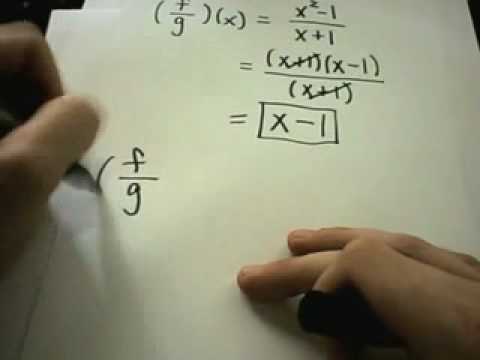
The second equation above only works if g(x)≠0.g(x) \neq 0. He then goes into examples with the following functions: f(x)=x2−1g(x)=x+1\begin{align} f(x)&=x^2-1\\ g(x)&=x+1 \end{align}

First, he goes through finding (fg)(x)(fg)(x). (fg)(x)=(x2−1)(x+1)(fg)(x)=x3+x2−x−1\begin{align}(fg)(x)&=(x^2-1)(x+1)\\ (fg)(x)&=x^3+x^2-x-1 \end{align}

Next, he finds (fg)(x):\left(\frac{f}{g}\right)(x): (fg)(x)=x2−1x+1(fg)(x)=(x+1)(x−1)x+1(fg)(x)=x−1\begin{align}\left(\frac{f}{g}\right)(x)&=\frac{x^2-1}{x+1}\\ \left(\frac{f}{g}\right)(x)&=\frac{\cancel{(x+1)}(x-1)}{\cancel{x+1}}\\ \left(\frac{f}{g}\right)(x)&=x-1 \end{align}

Let's think about what happens if you're asked to find (fg)(4)\left(\frac{f}{g}\right)(4). (fg)(4)=f(4)g(4)\left(\frac{f}{g}\right)(4)=\frac{f(4)}{g(4)}. We just need to plug 44 into our original functions, then divide.

(fg)(4)=(4)2−1(4)+1(fg)(4)=155(fg)(4)=3\begin{align}\left(\frac{f}{g}\right)(4)&=\frac{(4)^2-1}{(4)+1}\\ \left(\frac{f}{g}\right)(4)&=\frac{15}{5}\\ \left(\frac{f}{g}\right)(4)&=3 \end{align}

We can also find f(4)f(4) by plugging 44 into our final function we found when doing (fg)(x)\left(\frac{f}{g}\right)(x).

(fg)(x)=x−1(fg)(4)=(4)−1(fg)(4)=3\begin{align}\left(\frac{f}{g}\right)(x)&= x-1\\ \left(\frac{f}{g}\right)(4)&=(4)-1\\ \left(\frac{f}{g}\right)(4)&=3 \end{align}

Illustrated · 1 min

Multiplying and Dividing Functions

Now that we've covered adding and subtracting functions, we can dive into the next lesson on the last two functions of function operations.

Multiplying and Dividing Functions

Image source: by Anusha Rahman

When we multiply or divide functions, we are working with two functions at once, which can make things complicated. Not to worry - we will show you how to tackle these types of problems.

####Multiplying Functions

If you have two functions f(x)f(x) and g(x)g(x), you can multiply them together to create a new function called (f⋅g)(x)(f \cdot g)(x), which means you can multiply the outputs of f(x)f(x) and g(x)g(x) for the same input values of xx.

For example, if f(x)=2xf(x)=2x and g(x)=x+1g(x)=x+1, then (f⋅g)(x)=2x(x+1)(f \cdot g)(x) = 2x(x+1)

####Dividing Functions

Similarly, if you divide two functions, you get a new function called f(x)g(x)\frac{f(x)}{g(x)}, where you divide the output of f(x)f(x) by the output of g(x)g(x). It's important to remember that you cannot divide by zero, so g(x)≠0g(x) \neq 0.

(fg)(x)=f(x)g(x), where g(x)≠0(\frac{f}{g})(x) = \frac{f(x)}{g(x)}, \text{ where } g(x) \neq 0

For example, if f(x)=2xf(x)=2x and g(x)=x+1g(x)=x+1, then f(x)g(x)=2xx+1\frac{f(x)}{g(x)} = \frac{2x}{x+1}.

Note: always simplify your answers if you can!

Looking Further

Once you have mastered function operations, we will learn to compose functions at a point and simplify composite functions.

Type a concept, like “slope” or “photosynthesis”.

↑ ↓ to choose · Enter to openSearch explanations and problems