We have been studying the phases of matter. During our studies, we turned our attention to the physical properties of gases. In chemistry, gases have a long history. Scientists discovered all the gas laws between the 1600s and 1800s.
It started in 1662 with Robert Boyle's discovery that connected gas pressure and volume. Boyle's law inspired later generations of chemists to continue working on gases. But, it wasn't until 1787 that physical chemist Jacques Charles' developed Charles' Law. It connected the volume and temperature. Sadly, he never published his work. So, we didn't know it until 1802! That's when Gay-Lussac published Charles' work. Gay-Lussac continued to study gases and in 1808 confirmed and expanded the work of Amontons. So, we had a relationship between pressure and temperature. It's often referred to as the Gay-Lussac law. But, sometimes it's called Amontons' law. Together, these three gas laws produced the combined gas law.
But, what about the final piece of the puzzle? The last inspired scientist was Amedeo Avagadro. He claimed that two different gases with the same volume had an equal number of particles. So, the gas volume is an extensive property. It depends on the amount of gas! Why was Avagadro's law the final puzzle piece? With it, we combined the four gas laws into the ideal gas law!
Sadly, the scientific community ignored Avagardo's work until after his death. Why? At the time, we did not understand the distinction between atoms and molecules. We had no proof of their existence. A fundamental part of Avagadro's hypothesis was that they did exist. Furthermore, some chemists tested Avagardro's laws. It worked for some molecules but not others. What could be happening? Some molecules were undergoing decomposition reactions. So, they produced more gas than expected. But, they didn't recognize what was happening! Eventually, all the misunderstandings were cleared up!
Today, in honor of his insights, we named Avagadro's constant after him. Now, we remember him every time we use it. So, when you remember that one mole of gas is 6.023×10²³ particles, you honor Avagardo.
Avagadro's Law Assumptions
Like the other gas laws, Avagadro's law makes a few assumptions.
- The pressure and temperature are constant.
- The n term is always in moles.
- The V term can be any volume unit.
- We meet the conditions of the kinetic molecular theory. So, we have an ideal gas.
Forms of Avagadro's Law
n∝V
The first form of Avagadro's law is a proportionality. The number of moles and the volume are directly related. That makes sense! Imagine filling a balloon with the noble gas helium. As we add helium, the balloon expands. The balloon's volume is increasing.
nV=k
The second equation is a ratio. The numerator is the volume, and the denominator is the moles. It equals a constant. The ratio allows us to use the relationship qualitatively. For example, let's say the volume increased. For the quotient to stay the same, the moles also had to grow. Yet, we can also use the proportion quantitatively. For example, if we double the number of moles, the volume also doubles.
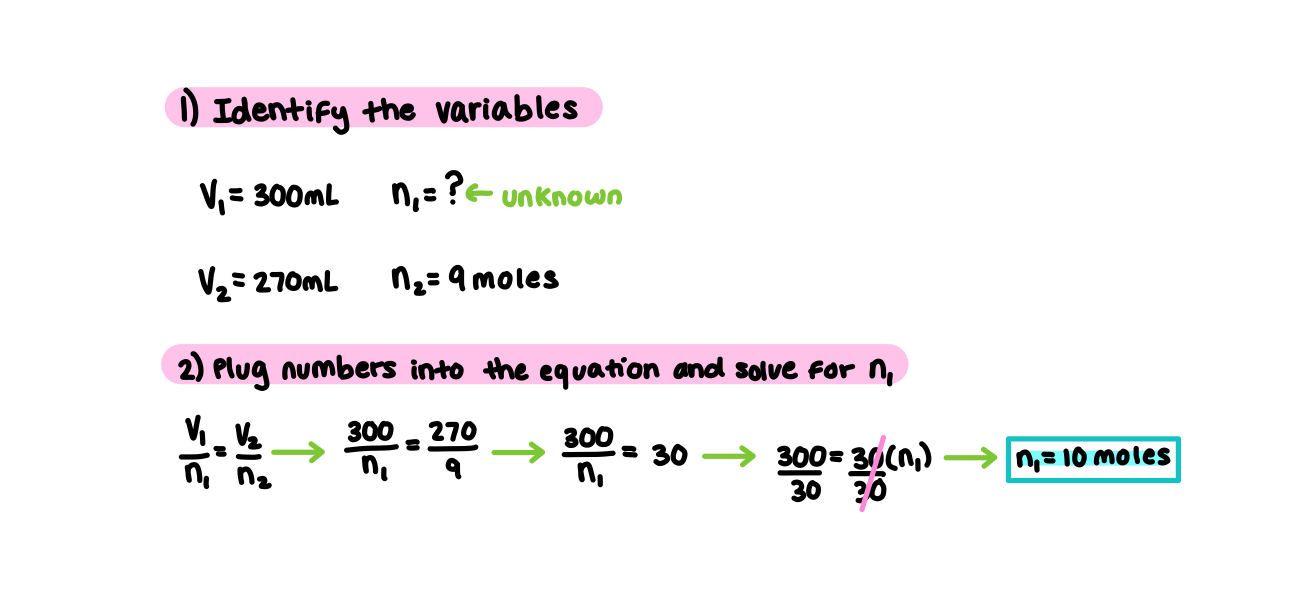
n1V1=n2V2
The last appearance of Avagadro's law links a system's initial and final states. We know from the second form that the ratio stays constant. So, the initial and final situations must be equal. The final form of Avagadro's law is the most quantitative. If we know three of the four terms, we can solve for the fourth.
Avagadro's Law Calculations
Let's look at an example. We start with a balloon with one mole of helium at 15.00 L. Now, we add 2.25 moles. What's the new volume?
- Use Avagadro's law. n1V1=n2V2 → 1.00mol15.00L=1.00mol+2.25molV2 → V2=15.00molL×3.25mols=48.75L
Let's look at a second example. A moveable piston cylinder has 2.00 grams of argon (Ar) at room temperature. We added more argon to the cylinder. The volume self-adjusted and kept the gas pressure even. Let's say the volume changed from 2.00 L to 2.70 L. How many grams of argon did we add to the cylinder? Assume we kept the temperature constant.
-
Convert grams of argon to moles by using the molar mass. n=39.90molg2.00g=0.05mols
-
Use Avogadro's Law. n1V1=n2V2 → 0.05mols2.00L=n22.70L → n2=0.06mols
-
Convert moles to grams. mass(m)=0.06mol×39.9molg=2.69g.
-
Determine how many grams we added. madded=mfinal−minitial=2.69g−2.00g=0.69g
Let's look at a final example. This time, we have a balloon filled with 22.4 L of diatomic hydrogen and another with 22.4 L of the diatomic halogen, chlorine. Both are at STP. How many particles are in each balloon?
The problem is a trick question! We know, at STP, that 22.4L is one mole of gas. Both hydrogen and chlorine have the same number of particles! But, why? Chlorine is much bigger than helium. We might think it'd fill the balloon more. But, according to the kinetic molecular theory, the volume of a gas particle is negligible. So, since we have equal volumes of both gases, they have the same number of particles. Of course, for real gases, this is not true.
Remember, this was Avagodro's original premise! Two ideal gases at the same volume have the same number of molecules.