Закон Бойля

Interactive · 1 question

Boyle's Law

What is Boyle's Law?

  • Boyle's Law states that when temperature is constant: P1V1P_{1}V_{1}=P2V2P_{2}V_{2}.

  • Boyle's Law also states that pressure is inversely related to volume. This means that when pressure is increased, volume is decreased (and vice versa).

  • Boyle's Law also states: P⋅V=kP\cdot V=k (k = the proportionality constant).

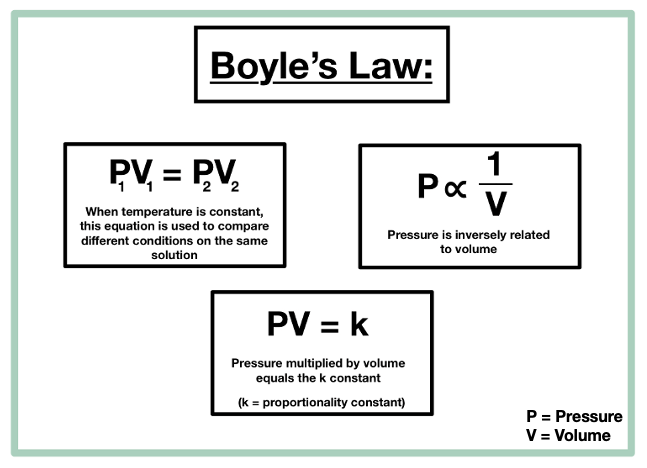
Image breaking down the different equations/relationships that is covered by Boyle's Law. At a constant temperature, P1V1=P2V2, pressure is inversely related to volume, and P x V = k (k= the proportionality constant)

Image source: Caroline Monahan

Example of Boyle's Law

Image showing an example of Boyle's Law where when temperature is constant P1V1=P2V2

Image source: Caroline Monahan

  • The example above shows how at a constant temperature P1V1P_{1}V_{1}=P2V2P_{2}V_{2}.

  • The example above also shows the inversely proportional relationship between volume and pressure. In the first beaker, the pressure is at 400 mm Hg while the volume is at 50 milliliters. When the pressure decreased to 200 mm Hg, the volume increased to 100 milliliters.

Boyle's Law Practice Problem Walkthrough!

In one chamber, the pressure is 100 mm Hg, with a volume of 80 mL. If the volume decreases to 20 mL, what is the new pressure of the chamber? Assume the temperature is constant.

Solving this problem is simple, just plug the numbers into the Boyle's Law equation, and solve for the missing variable.

1. (100 mm Hg)(80 mL)\text{(100 mm Hg)(80 mL)} = P2P_{2} (20 mL)\text{(20 mL)}

2. (100 mm Hg)(80 mL)(20 mL)\frac{\text{(100 mm Hg)(80 mL)} }{\text{(20 mL)} } = P2P_{2}

3. P2P_{2} = 400 mm Hg

The new pressure is 400 mm Hg when the volume is decreased to 20 mL!

Now try a practice problem!

In a chamber, the pressure is 1500 atm, and the volume is 5 liters. If the pressure is decreased to 500 atm, what is the new volume? Assume the temperature is constant.

Choose one answer

Read · 2 min

What is Boyle's Law?

It is a law used to describe the behaviors of gases. This law was determined from laboratory experiments. The law states:

A gas in a closed container (with constant temperature and mass) will have a pressure inversely proportional to the volume.

Mathematically this is expressed as:

PV = kPV\ =\ k or P∝1VP\propto\frac{1}{V}

  • PP= pressure
  • VV=volume
  • kk=constant.

When comparing the changing pressure or volume change within one container the relationship can be expressed as:

P1V1 = P2V2P_1 V_1\ =\ P_2 V_2

Importance of Boyle's Law

In a closed container with a constant amount of gas, the number of molecules remains the same. What happens if we manipulate the system by decreasing the container's volume? The pressure will increase. Why? The decrease in volume causes the gas molecules to move closer together. So, they collide more frequently and push more against their container. If the space the gas molecules occupy is increased, then the pressure will decrease. Why? The molecules have more room to move. We are observing that gases are expandable and compressible.

An example is to think of a balloon filled with air. If you twist part of the balloon forcing the gas into a smaller space, the pressure in the balloon will increase. If the balloon is untwisted, the pressure returns to its original state.

The Other Gas Laws

Boyle's law is also related to the other gas laws. All of them assume that we are working with an ideal gas. Why? When the gas laws were discovered, our technology was limited. We couldn't produce high temperatures or pressure. So, all the gases behaved ideally. We didn't observe any deviations from Van der Waal's forces or electrostatic interactions. With the gas laws, various chemists began to build a theoretical framework. They wanted to conceptually explain how gases behave and why the gas laws worked. What was the result? The kinetic molecular theory. Eventually, we applied the framework to chemical reactions. That's how we developed collision theory. This was the earliest form of theoretical chemistry.

Do you want to learn more about the other gas laws? We have explanations for each of them! Just click on the links below!

Video

(Video) Chemistry: Boyle's Law (Gas Laws) with 2 examples | Homework Tutor

by Socratica

Boyle's law describes the relationship between pressure and volume. The formula is often written as P1V1=P2V2P_1V_1 = P_2V_2. If you want to use this formula, temperature and the number of moles must be constant.

In this video, you will get a chance to practice two problems using Boyle's law. You will also find out when to use this law instead of other gas laws.

Type a concept, like “slope” or “photosynthesis”.

↑ ↓ to choose · Enter to openSearch explanations and problems