As we have studied the phases of matter, we've looked at the properties of solids, liquids, and gases. But, we have a lot to learn about gases. Scientists have studied them for hundreds of years. Robert Boyle developed the first gas law in 1662! Over one hundred years after Boyle, Jaques Charles began to study gases. He determined the relationship between volume and temperature. Unfortunately, he died before he could publish his work. Joseph Gay-Lussac discovered Charles' work and attributed it to him.
Charles' law relates a gas's volume and temperature. Charles developed his law by filling five balloons with different gases. Each balloon had the same volume. Next, he heated each balloon. He discovered that each of their volumes increased by the same amount. He realized that a gas's volume was a physical property, not a chemical property. Of course, today, we know that the gas has to be ideal. Real gases experience Van der Waal's forces. So, the electrostatic attractions affect their properties.
Charles' Law Formulas
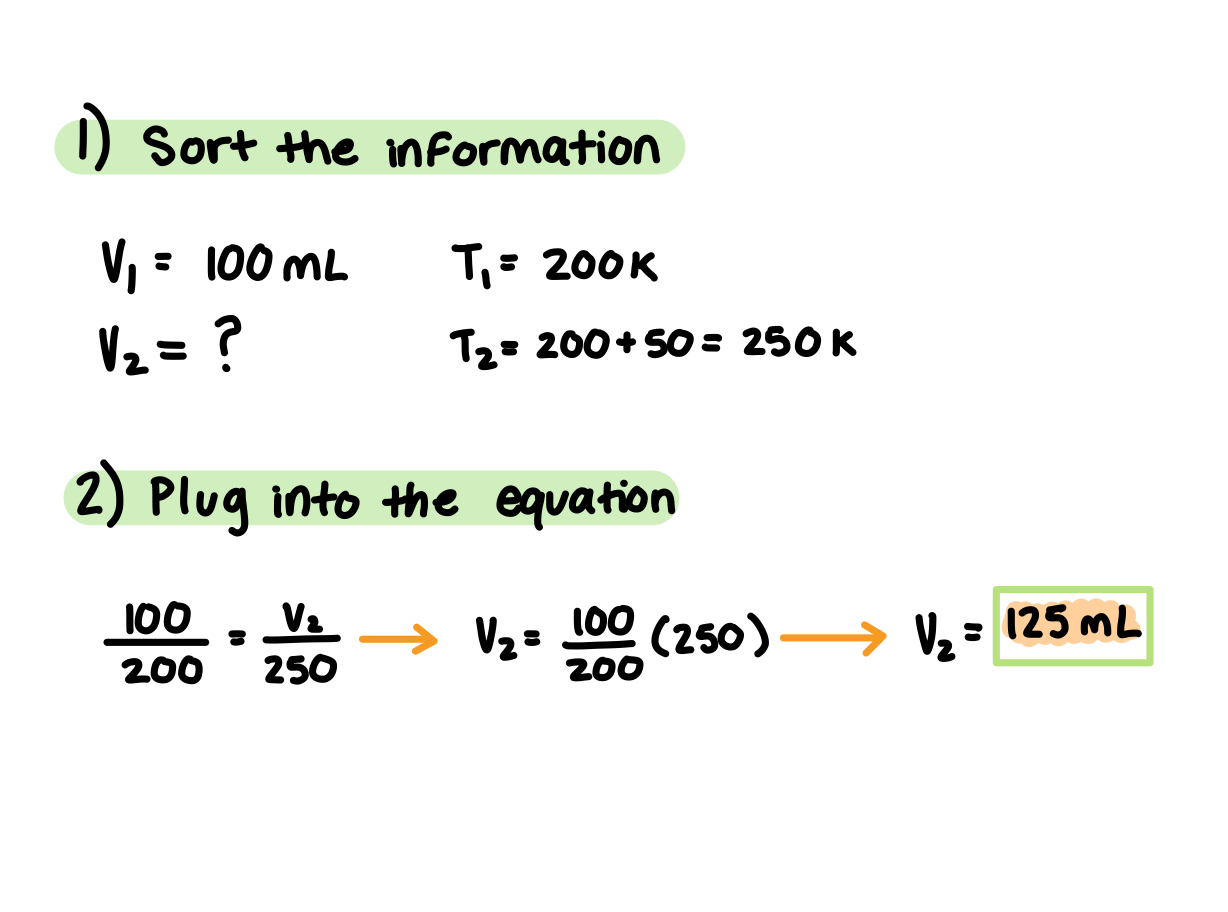
We can write Charles Law in three ways. Also, the temperature is always in kelvin. Let's explore each one.
The first way to write Charles' law is as a proportionality. It tells us that volume and temperature are directly related. So, if the volume increased, the temperature did too. If the temperature drops, the volume declines too.
The second way to write Charles' law is as a ratio. The ratio of volume and temperature is a fixed value. We denote the constant with the letter "k." Let's consider an increase in volume. The temperature is in the denominator. So, to keep the ratio the same, the temperature had to increase. The same is true for the numerator. If the temperature increases, the volume has to as well.
- T1V1=T2V2
The final form relates the initial and final states. We just learned that the ratio is constant. So, even if we change the conditions, the proportion stays the same. Let's start with an initial temperature and volume. For ease, let's say their ratio is 1. Now we'll increase the temperature. We know the volume also rises. But, the new volume divided by the new temperature is still 1. So, if we know three of the terms, we can solve for the fourth.
Charles' Law and Kinetic Molecular Theory
Kinetic molecular theory can help us understand Charles Law. As the temperature increases, the molecules' kinetic energies increase. They are moving faster. So, they collide more often with the walls of the container. In a rigid container, the pressure would increase because of the Gay-Lussac law. But, if we have an expandable canister, it will offset the pressure by raising the volume. Of course, that's Boyle's Law.
We are seeing the interconnectedness of the gas laws. The interconnection is what led to the development of the ideal gas law. We can deduce any of the relationships from the ideal gas law.
Charles' Law and Absolute Zero
What would happen if the temperature reached absolute zero? Let's look at the second form of Charles' law. We can't divide by zero. So, let's multiply both sides by the temperature. We get V=kT. Now we can see that at absolute zero, the volume would be zero. But, that's not possible! At absolute zero, we know that, theoretically, all movement would stop. But, the gas molecules still have a volume. Simply by being matter, they must have a volume. So, Charles' law only works at normal temperatures.
As a side note, quantum mechanics teaches us that absolute zero is impossible. If we reached absolute zero, a particle would be at rest. So, we would know both its position and momentum. But, according to the uncertainty principle, that's impossible! So, absolute zero is only theoretical.
Who was Jacques Charles?
Charles' interest in gas behavior wasn't just scientific curiosity. He wanted to fly! He is the first person to launch hydrogen sourced hot air balloons. He believed hydrogen would be a good source based on his study of Boyles law. He and his partners created hydrogen gas by mixing sulfuric acid with iron. The reaction is Fe(s)+H2SO4(aq)→FeSO4(aq)+H2(g). It is a single replacement reaction.
He launched the first hydrogen balloon in 1783 from the Champ de Mars in Paris. Almost 100 years later, the Champ de Mars became the home of the Eifel tower! A lead pipe fed the gas into the balloon. But, the sulfuric acid and iron reaction is exothermic. So the gas was hot. As the gas entered the balloon, it cooled. Charles' law tells us that as the gas's temperature cools, the volume decreases. They had a difficult time filling the balloon. Eventually, they filled it enough to launch. But, it could not lift a person. They followed it on horseback. The balloon traveled about 20 kilometers (13 miles). But, it got too far ahead. When it landed, terrified local farmers attacked it with pitchforks.
Three months later, Charles' was ready to fly. We estimate that he and his copilot reached a height of 1800 meters (1.10 miles). They traveled a distance of 36 kilometers (22.3 miles). He would never fly again. But, his experience with balloons led him to try and understand gas behavior. Before his death, we would formulate Charles' law. Unfortunately, he was unable to publish his work.