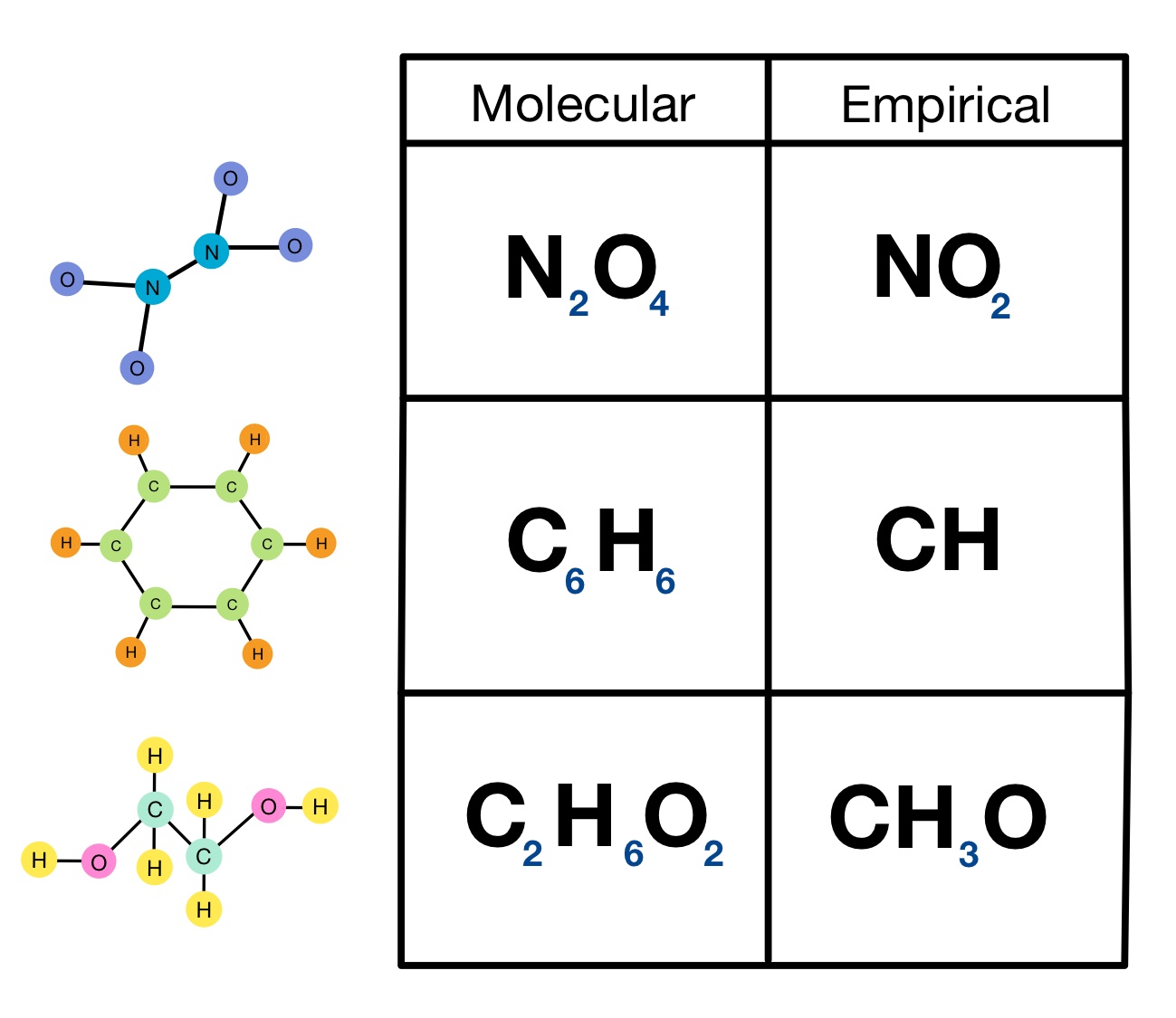
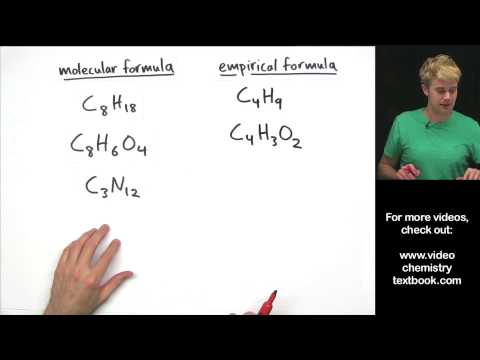
We've been studying chemical formulas. We started with molecular formulas. They tell us a molecule's elements and the number of each element in a molecule. We've also encountered empirical formulas. They give us the simplest ratio of a molecule's elements. But when do we use empirical formulas? They seem useless. Why don't we always use molecular formulas? Let's find out!
Where do Empirical Formulas Come From?
At its heart, chemistry is an experimental science. Sometimes, chemists get carried away with major theories like quantum mechanics. But very few of us are theoretical chemists. Most chemists perform experiments. More specifically, many chemists are analytical chemists. They analyze a sample to determine its components. What does this have to do with empirical formulas? Many different experiments help us determine the empirical formula. Once a chemist has the empirical formula, they can perform other experiments. By combining their data, they can determine the molecular formula.
Mass Percent Calculations
Many common analytical techniques will give you a percent mass. The percent mass is the ratio each element contributes to the sample's total mass. Thankfully, we can use mass percentages to find the empirical formula.
The steps to solve a mass percent problem are as follows.
-
Assume you have a 100.0-gram sample. That means the mass percent equals the mass in grams.
-
Use the molar masses of each element to convert to moles.
-
Divide the number of moles by the smallest number from step two. This gives you the mole ratios. Round any numbers to the nearest whole number.
-
Use the mole ratios to write the empirical formula.
Example Problem
Let's imagine that we have an organic compound containing carbon, hydrogen, and oxygen. The mass percentages are 40.00% carbon, 6.67% hydrogen, and 53.33% oxygen. Find the empirical formula.
Assume a 100.00-gram sample. This gives us the masses for each element.
Carbon=40.00 g
Hydrogen = 6.67 g
Oxygen = 53.33 g
Convert the mass to moles.
Carbon: 40.00g×12.01g1mol=3.33mols
Hydrogen: 6.67g×1.01g1mol=6.60mols
Oxygen: 53.33g×16.00g1mol=3.33mols
Divide the number of moles by the smallest number to find the mole ratio.
Carbon: 3.333.33mols=1
Hydrogen: 3.336.60=1.98→2.00
Oxygen: 3.333.33mols=1
We round hydrogen to the nearest whole number ratio. Any discrepancies are caused by experimental uncertainty.
Write the empirical formula.
CH2O.
Without the molar mass of the compound, we can't determine the molecular formula.
Combustion Analysis
One of the main techniques that analytical chemists use is combustion analysis. It takes advantage of the oxidation of carbon and hydrogen. A hydrocarbon is a compound composed of carbon and hydrogen. In a combustion analyzer, a hydrocarbon gets placed in a chamber. The oxygen source is typically copper(II) oxide. A furnace begins to heat the compartment. At a very high temperature, the hydrocarbon combusts. The products are carbon dioxide gas and water vapor.
The products from the combustion reaction pass into a series of secondary chambers. The first partition captures the water vapor. We commonly use an ionic compound to absorb the water. For example, a standard material is calcium chloride. When it absorbs the water, it creates a hydrate. We can weigh the sample before and after. So, we know the mass of water absorbed. The carbon dioxide passes through into another chamber. There, a strong base captures the carbon dioxide. Again, the differences in the masses tell us the amount of carbon absorbed.
How do we solve combustion analysis problems? We are given the mass of carbon dioxide and water. Our goal is to find the moles of carbon and hydrogen. Then, like a mass percent problem, we can use the mole ratio to find the empirical formula.
Let's look at the steps for solving a combustion analysis problem.
-
Convert the grams of carbon dioxide and water to grams of carbon and hydrogen. We'll need to use unit analysis.
-
Next, we convert the mass of carbon and hydrogen to moles.
-
Divide the moles by the smallest number from step two. This step gives us the mole ratios. Remember to round to the nearest whole number. Any discrepancies are caused by experimental errors.
-
Finally, we can convert the mole ratios to the empirical formula.
Example Problem
Let's say we did a combustion analysis of a hydrocarbon. The reaction produced 0.660 grams of carbon dioxide and 0.336 grams of water. Find the empirical formula.
First, we need to find the grams of carbon and water.
gC=0.660gCO2×44.0gCO21molCO2×1molCO21molC×1molC12.0gC=0.180g
gH=0.336gH2O×18.0gH2O1molH2O×1molH2O2molH×1molH1.01gH=0.038g
Now we need to find the moles of carbon and hydrogen.
molC=0.180g×12.0g1mol=0.015mols
molesH=0.038g×1.01g1mol=0.0373mols
Now we find the mole ratio.
0.0150.015=1
0.0150.0373=2.5
This question has a small trick to it! The ratio gave us a half value, but we need whole numbers. What do we do? We can multiply both values by two!
1×2=2
2.5×2=5
So, our empirical formula is C2H5.