Молекулярні формули

Video · + 1 min read

Like the secret Krabby Patty formula in Spongebob, a molecular formula is a kind of recipe that tells you the ratios of different ingredients, or elements, in a molecule.

There are a few types of molecular formulas. An empirical formula describes the simplified ratio of elements in a molecule, regardless of how many atoms are actually found in that molecule. A structural formula shows the bond connections, instances of multiple bonds, and lone pairs of electrons. They are also called Lewis dot structures. The most common type of molecular formula, and what people usually mean when they say "molecular formula," just lists the exact number of atoms of each element present in a molecule.

For example, C6H12O6C_{6}H_{12}O_{6} is the molecular formula for glucose or sugar. It tells us what elements are in this substance and how many atoms per molecule. CH2OCH_{2}O is the empirical formula for the same molecule. It still tells us the elements' ratio but doesn't tell us how big a molecule is.

Sometimes, the molecular and empirical formulas are the same. A great example is water (H2OH_{2}O). Water has two hydrogens and one oxygen. So, the formula is already irreducible. The same is true for any molecule with a 1:2 ratio. So, another example is carbon dioxide (CO2CO_{2}). It is also common in organic chemistry. An example is methane (CH4CH_{4}) gas. It's the gas that is commonly used to heat homes. Sometimes it's called natural gas.

There are also compounds that have 1:1 ratios. For example, soon we'll learn about acids and bases. Many strong acids have 1:1 ratios. For example, halogen-based acids, like hydrochloric acid (HClHCl), all have 1:1 ratios. So, they all have one proton to donate when they dissolve in solution.
Video · + 1 min read

(Video) Molecular Formula

By The Science Classroom

Molecular formulas tell us the elements and the number of elements in compounds. It is a type of chemical formula.

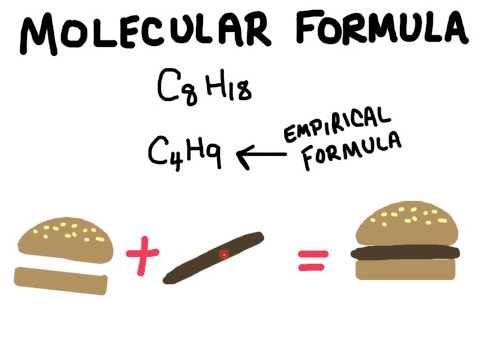
Octane has the molecular formula C8H18C_8H_{18}, which means there are eight carbons and eighteen hydrogens. The empirical formula describes the lowest ratio of elements in a compound. For octane, the empirical formula is C4H9C_4H_9. Empirical formulas can be used to determine the molecular formula since it is all based on ratios.

A simple ratio example can be described with a burger. A burger is made up of one bun to one patty. The ratio is 1:1. If a triple-sized burger were made it would consist of three buns to three patties. This has a ratio of 3:3. A way to write this as a molecular formula would be B3P3B_3P_3 where the empirical formula is B1P1B_1P_1.

Common chemistry problems will give you an empirical formula and either the molecular weight (amu) or the molar mass (grams/mole). Given these two pieces of information, you can determine the molecular formula. The steps to solve a molecular formula include:

  1. Find the empirical formula.
  2. Determine the empirical formula's molar mass.
  3. Divide the compound's molar mass by the empirical formula's molar mass.
  4. Multiply the empirical formula subscripts by the nearest whole number from step 3.

In the given example the empirical formula is CH2OCH_2O and the compound molar mass is 180 g/mol. The empirical molar mass is 30 g/mol. Dividing the molar mass by the empirical molar mass gives a value of 6. If we multiply our subscripts by six we get C6H12O6C_6H_{12}O_6. This is the molecular formula and corresponds to the compound of glucose, a sugar.

Type a concept, like “slope” or “photosynthesis”.

↑ ↓ to choose · Enter to openSearch explanations and problems