Обернені тригонометричні функції

Before this, knowВикористання одинчного кола у тригонометричних рівняннях

Read · 1 min

Try to remember what an inverse function is! We've seen before that an inverse function is when we reflect the function over the line y=xy=x.

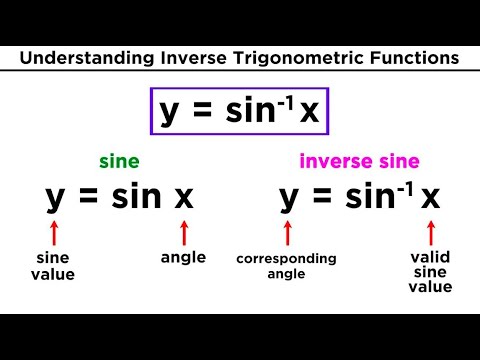
Let's think about what happens if we had f(x)=sin⁡(x)f(x) = \sin(x). We can define sin⁡−1(x)\sin^{-1}(x) as the inverse of our function. Essentially, since sin⁡(x)\sin(x) takes in an angle measure and returns a ratio of sides, the inverse function will take in a ratio of sides and return an angle! So since sin⁡π6=12\sin{\frac{\pi}{6}} = \frac{1}{2}, we have sin⁡−112=π6\sin^{-1}{\frac{1}{2}} = \frac{\pi}{6}.

We can define the inverse functions of cos⁡(x)\cos(x) and tan⁡(x)\tan(x) similarly.

However, simply defining the inverse trigonometric functions like this is not enough. For example, think about whether sin⁡−112\sin^{-1}{\frac{1}{2}} equals π6\frac{\pi}{6} or 5π6\frac{5\pi}{6}. We must, therefore, define the inverse function such that it returns only one value (and thus is a function).

We know that on the unit circle, the values of sin⁡(x)\sin(x) are all different along the interval [−π2,π2][ -\frac{\pi}{2},\frac{\pi}{2}]. Therefore, we can define the inverse function there, since then there is a one-to-one correspondence between an angle and a ratio of sides. By this definition, sin⁡−112\sin^{-1}{\frac{1}{2}} would equal π6\frac{\pi}{6} rather than 5π6\frac{5\pi}{6}.

Similarly, we can define cos⁡−1(x)\cos^{-1}(x) along the interval [0,π][0,\pi], and tan⁡−1(x)\tan^{-1}(x) along the interval [−π2,π2][ -\frac{\pi}{2},\frac{\pi}{2}].

Illustrated · 1 min

Trigonometric Inverses

Now that we understand the basic trig functions, we can move forward to inverses of trig functions.

Trig Inverses
sin^-1(x) --> arcsin(x)
cos^-1(x) --> arccos(x)
tan^-1(x) --> arctan(x)

Image source: by Anusha Rahman

If we are given the sides of a triangle, and we need to find the degree of the angle, we can use the inverse trigonometric functions to evaluate! You can use these skills to solve trig equations.

The inverse of the sine function is arcsine. The inverse of the cosine function is arcsine. The inverse of the tangent function is arctangent.

Video

Inverse Trig Functions

by Professor Dave Explains

In this video by Professor Dave Explains, you will learn about inverse trig functions.

Summary

Professor Dave introduces the concept of inverse trig functions: arcsine, arccosine, and arctangent. These are used to find an angle when given a trig ratio. Because sine, cosine, and tangent are not one-to-one over their entire domains, we restrict their domains so the inverse is a proper function.

For example, arcsin(x)\text{arcsin}(x) is defined on [−1,1][−1,1] and returns angles in [−π/2,π/2][−π/2,π/2], while arccos(x)\text{arccos(x)} returns values in [0,π][0,π], and arctan(x)\text{arctan}(x) returns values in (−π/2,π/2)(−π/2,π/2).

Type a concept, like “slope” or “photosynthesis”.

↑ ↓ to choose · Enter to openSearch explanations and problems