Illustrated · 2 min

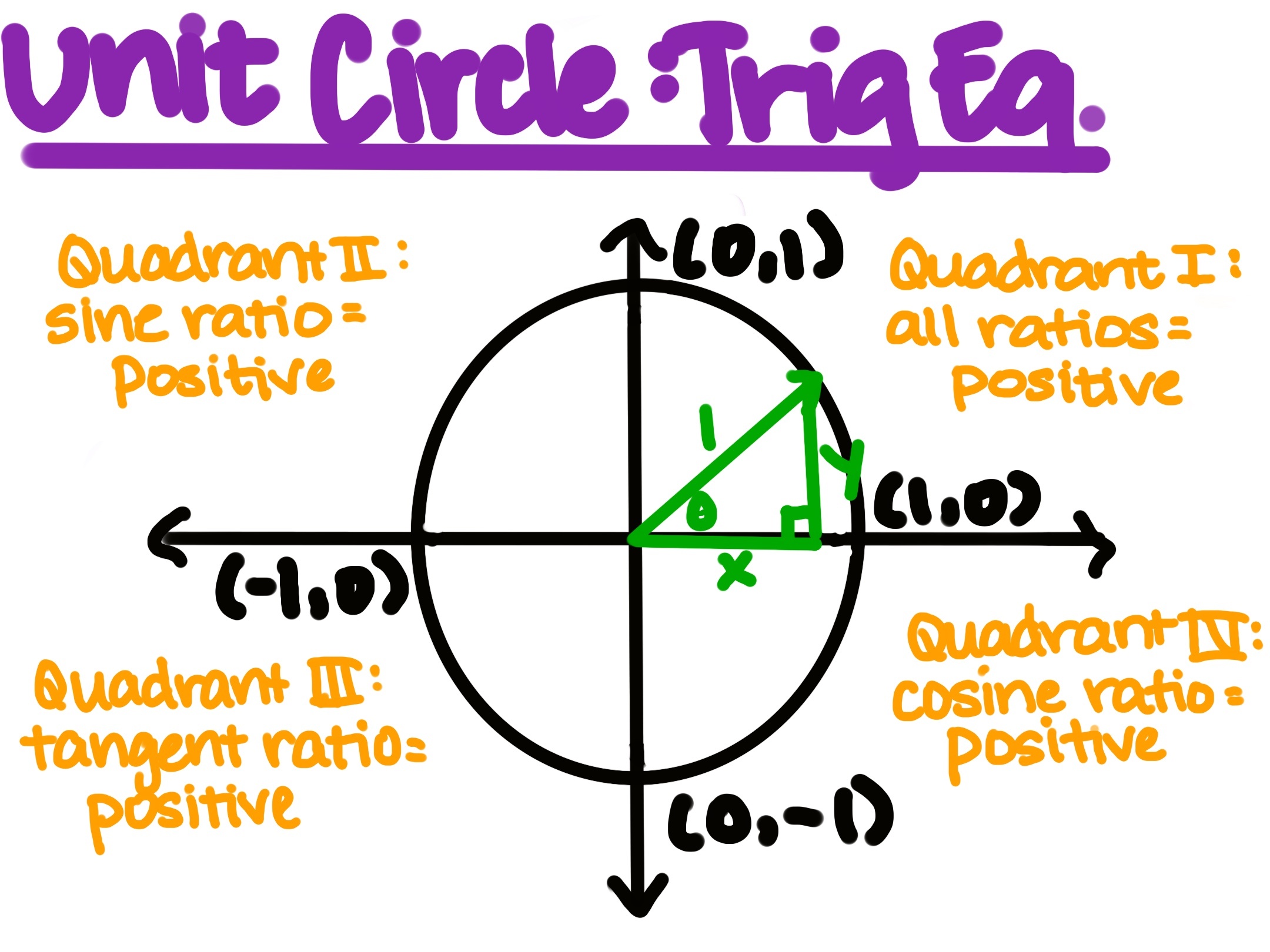
One way we can solve trigonometric functions is to plug in the equation into a calculator, but oftentimes, it's easier to use the unit circle!

By Gustavb via Wikimedia Commons
But before we dive into how to use the unit circle, let's first talk about trigonometric equations. A trigonometric equation is an equation where there are trig values within the equation. For example,
We could solve for , but we need to be mindful of the cosine. A lot of the same techniques you used previously when solving algebraic equations, you will use here, including combining like terms and PEMDAS. That part is pretty straightforward, but the more complicated part comes in when trying to get rid of the cosine! Here is where we can use the unit circle.
Here are some tips for solving trigonometric equations:
-
Use your trig identities! Negative angle identities, co-function identities, angle sum and difference identities, double angle identities, and half-angle identities. These will help you to simplify and solve the equations.
-
Combine like terms! Combine everything that you can, reducing the number of terms you have to work with.
-
Use your factoring skills and the zero product property to solve for variables, just like with algebraic equations.
-
Watch whether you need to give your answer in degrees or radians.
Example
We want to solve the following equation for in radians.
Our first step should be to move all terms to the same side, so we can rewrite the equation as:
You may notice that each of the two terms has in it, so we can factor that out from both terms.
The zero-product property tells us that at least one of the terms has to equal zero, so we can set them both equal to zero to solve for . Let's start with . Going back to our unit circle, we are looking for the radian angle where the coordinate is zero. We can see that that angles are and . For our second factor, we can say that .
On our unit circle, we are looking for the angle where the -coordinate is , and that is at the radian angles of and .
Looking Further
In the next lesson, you will learn about trig inverses. Once you have mastered that, you will tackle using inverses to solve trig equations. You'll end this section with trig identities and trig word problems.