Графічний калькулятор: Обернені до синуса та тангенса

Before this, knowОбернені тригонометричні функції

Read · 1 min

A couple of lessons back, we learned how to solve trigonometric equations using the unit circle. In this lesson, we will learn how to use trigonometric inverses to solve equations.

Using inverses to solve equations allows us to solve our equation without using the values within the unit circle. An important note, however, is that taking the inverse of a trig function will only yield one answer. Typically, solving sine, cosine, and tangent will provide multiple solutions, but taking the inverse will not do that.

Let's walk through an example.

Example

2sin⁡x−1=02\sin{x} -1 = 0

Our objective is to solve for xx. To do that, we need to first isolate the trigonometric term.

2sin⁡x=12\sin{x}=1

Next, we will divide both sides by 22.

sin⁡x=12\sin{x} = \frac12

Previously, we would have looked at the unit circle to determine what the xx value would be. For this lesson, we will be using inverses. So, now that we've isolated the trig term, we want to use inverses to get rid of the sine. To do that, we will take the arcsine of both sides.

arcsin⁡(sin⁡x)=arcsin⁡12\arcsin{(\sin{x})} = \arcsin {\frac12}

We will now simplify.

x=arcsin⁡12x = \arcsin {\frac12}

Solve!

x=π6x = \frac{\pi}{6}

Video

Solving Trig Functions Using Inverses

by Alison Dickinson

In this lesson, Alison Dickinson walks through how to solve trigonometric equations using inverses.

Summary

To solve a trig equation like sin(θ)=a\text{sin}(\theta) = a, cos(θ)=b\text{cos}(\theta) = b, or tan(θ)=c\text{tan}(\theta) = c, we can use inverse trig functions. These will give the principal value, but because trig functions are periodic, there are often multiple solutions.

Illustrated · 1 min

Solve Trig Equations Using Inverses

In this lesson, we are going to learn how to solve trigonometric equations using inverse trig functions.

Solve Trig Equations Using Inverses
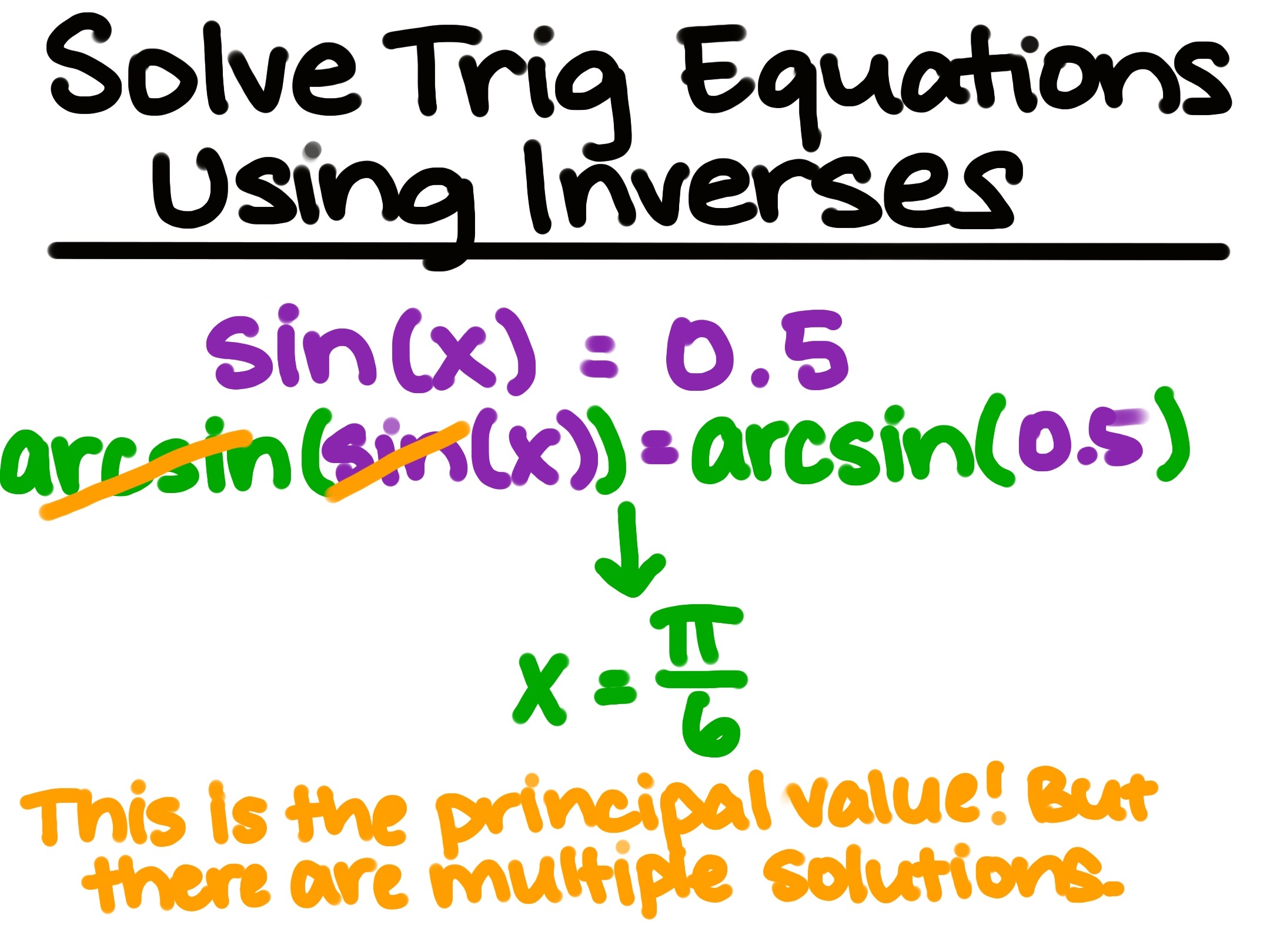
sin(x)=0.5
arcsin(sin(x)=arcsin(0.5)
x=pi/6
This is the principal value! But there are multiple solutions.

Image source: by Anusha Rahman

Let's say we know that sin(x)=0.5\text{sin}(x)=0.5. To find the angle xx, we use the inverse sine function, written as arcsin(0.5)\text{arcsin}(0.5) or sin1(0.5)\text{sin}^{1}(0.5).

When we do that, we get π6\frac{\pi}{6}.

But we know that these types of trig functions have more than one solution. That's because sine is positive in both the first and second quadrants. Arcsine only gives us one answer, called the principal value. arcsin(0.5)\text{arcsin}(0.5) not only returns π6\frac{\pi}{6}, but other solutions like 5π6\frac{5\pi}{6}.

The same thing happens with arccosine and arctangent (inverse cosine and inverse tangent). They only give one answer in a specific range.

In Summary

When you solve trig equations using inverse functions, you're finding the main solution, not all possible ones. To find the others, you can use the unit circle and the symmetry of the trig functions.

Looking Further

In the next lessons, you will learn about trig identities and trig word problems.

Type a concept, like “slope” or “photosynthesis”.

↑ ↓ to choose · Enter to openSearch explanations and problems