Earnst Rutherford performed his gold foil experiment in 1908. Suddenly, we understood that atoms have a positively charged nucleus. So, we developed the nuclear model. It was a monumental achievement. But, he furthered his research in 1919 by discovering the proton. So, we knew what made up atomic nuclei. But, that left us with a lingering question. How can protons stay together in an atom's nucleus? Based on electrostatic interactions, they should repel. It would take a long time to discover the nature of the strong nuclear force. Today, particle physics teaches us that particles generate forces.
Mesons mediate the strong nuclear force between protons and neutrons. But, it only interacts over very minute lengths. The approximate range is about the diameter of two nucleons or about 2.5 femtometers. How does this affect nuclear stability? There are two competing forces. For nuclei with less mass, the strong nuclear force holds everything together. But what happens as the atomic nuclei get more expansive? The repulsion between protons becomes more significant. Electrostatic interactions are not distance limited. So, each proton repels every other proton. But, each nucleon only feels the strong nuclear force from its neighbor. So, eventually, the repulsion overcomes the strong nuclear force.
Nuclear Stability and Binding Energy
So, as we get more protons, we expect less stability. But, how do we measure it? And where does the change occur? It turns out we use the binding energy. Do you remember what that is? It's the minimum energy required to dismantle a nucleus. The inflection point occurs at the transition metal, iron. Between hydrogen and iron, the strong nuclear force is the prominent influence. After iron, the nuclear binding energy decreases. It becomes easier to remove nucleons. So, the electrostatic repulsion becomes more significant. Eventually, we reach the radioactive elements. The actinides and lanthanides have such large nuclei they readily fall apart. Some radioactive elements have comparably lengthy half-lives. And some are unbelievably short. For example, technetium's half-life is 4.6×10⁷ years. But, the most stable isotope of lawrencium has a half-life of 4 hours.
Reading The Chart of Nuclides
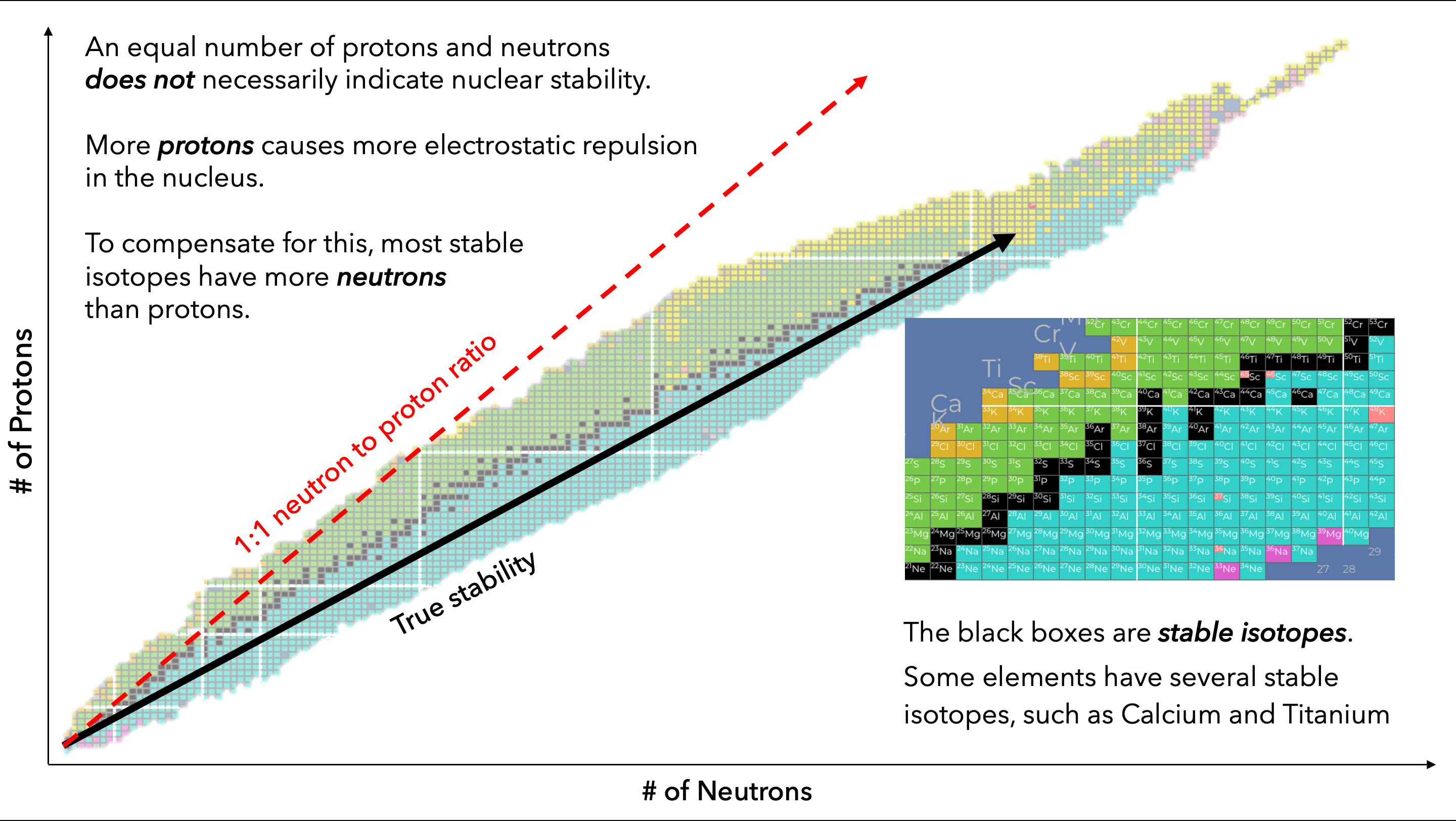
We have one other tool for studying nuclear stability. In our image explanation, you can see the chart of nuclides. A nuclide is a generic term for any atom that we have classified by its atomic number and neutrons. What does the chart show? It displays every isotope of every atom. On the chart's x-axis is the number of neutrons. On the y-axis is the atomic number. So, we'd find an atom's isotopes next to one another. The chart is color-coded. Black indicates stable elements. How do we define stability? The isotope's half-life is at least ten times the earth's age. That's 46 billion years! The colors continue red, yellow, green, and blue. The line of black isotopes is the band of stability. The further an isotope is from the stability band, the more radioactive it is.
We can make a few observations from the chart of nuclides.
- Larger elements require more neutrons to counterbalance the electrostatic repulsion.
-
There are no stable nuclei above lead. So, any element with an atomic number greater than 82 is radioactive.
-
Some combinations of nucleons are extra stable. We call these magic numbers. They are 2, 8, 20, 28, 50, 82, and 126. Magic numbers occur because nucleons have energy levels. It is similar to electrons. Just like electrons fill orbitals in spin pairs, so do nucleons. But, protons and neutrons have their own unique shells. A magic number occurs when a nuclear shell completely fills.
- Some isotopes have a magic number of either protons or neutrons.
- A few isotopes have a magic number of protons and neutrons. We call these isotopes doubly magic.