In chemistry, we mostly care about electrons. An atom's nucleus is unique. But it doesn't really do anything. But electrons do everything! That's because we want to know about chemical bonds. To cause a chemical reaction, we need to break and reform bonds. We've spent so much time describing and classifying what happens! But, there is one branch of chemistry that focuses on the nucleus. We creatively call it nuclear chemistry. Today, we'll answer why the nucleus holds together. The in-depth description requires some complicated physics. So, I'll write a generic answer first. If you want the complex explanation, you can read the second section. But, even the second section is a basic summary at best.
The Basics
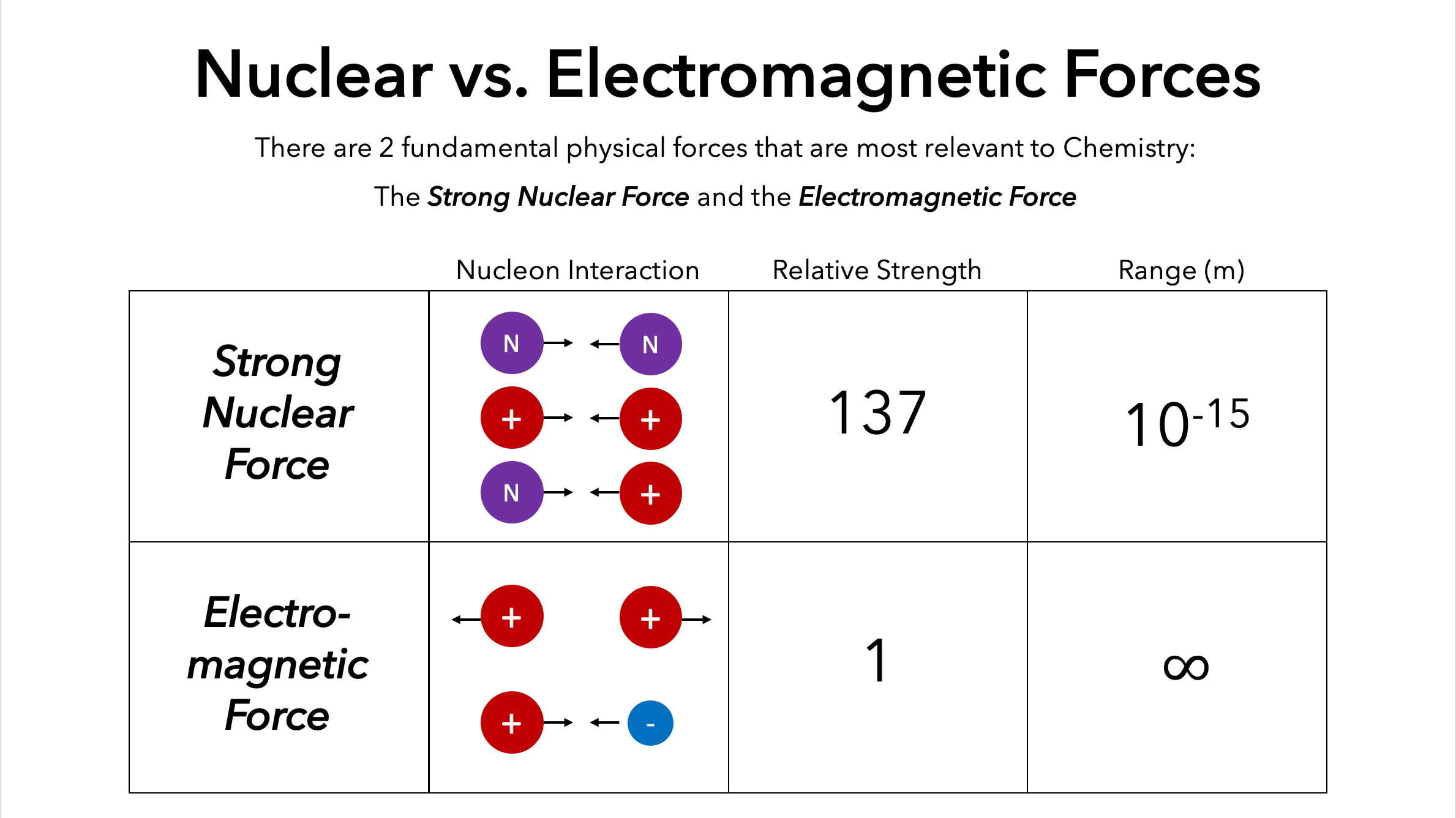
We know a nucleus consists of protons and neutrons. They are packed together at the center of an atom. But, according to electrostatic interactions, the protons should repel. That's a lot of positive charges crammed together. So, there must be a force that counteracts the repulsion. We creatively call it the strong nuclear force.
Here's what you need to know:
- The strong nuclear force is way more powerful than all the other fundamental forces. For example, it's approximately 130 times stronger than the electromagnetic force.
-
The strong nuclear force is a property of quarks. Remember, quarks are the building blocks of protons and neutrons. It holds the quarks within the nucleons. It also keeps the nucleus together.
-
The strong nuclear force only acts over a range of about 2.5×10⁻¹⁵ meters. That's femtometers! That is about twice the diameter of a proton or neutron. So, within the nucleus, only neighboring nucleons feel the strong force.
- That's why we start to see radioactive decay. In the lanthanides and actinides, there are so many protons. Every proton feels repulsion from all the other protons. But, the strong nuclear force only acts between neighbors.
The Basic Summary of the Complex Answer
So, we know the strong nuclear force holds a nucleus together. But what really generates it? That's a great question! Unfortunately, it requires some pretty complicated physics and math. The math is completely beyond me. Also, I'm not great at physic. But I'll do my best to explain the big picture.
Do you remember when we talked about internal energy? I made a big deal about how we store energy in fields. For example, let's say I lift my pen above my head. I've moved it through the gravitational field created by the earth. So, it has more potential energy. When I drop the pen, it falls. The potential energy from lifting got transferred to kinetic energy. In reality, that is an approximation. Fields don't exist! More advanced quantum mechanics gave us a new explanation.
So what is happening? Let's consider two electrons. We know they each have a negative charge. So, they repel. But, what causes the repulsion? It turns out that the electrons emit photons. What happens when a photon collides with an electron? It changes the electron's momentum. But remember, momentum is a vector quantity. So, it has a direction. The result is that the electrons repel.
But wait, when we think of photons, we think of light! And light doesn't have mass. We know that momentum equals mass times velocity squared. So how can they have momentum? It turns out that momentum and mass relate only in classical mechanics. Classical mechanics is the domain of large objects moving very slowly. At the quantum scale, we have minuscule particles moving insanely fast! So, even massless particles have momentum.
But, how can a photon cause like charges to attract? Great question! Do you remember the wave-particle duality? We can think of any particle as a wave. That means, in the quantum mechanical model, it has a wavefunction. We can also think of a photon as a wave with a wavefunction. Remember, a wavefunction defines a probability. So, when the photon collides with the charge, it changes the momentum wavefunction. It turns out that the momentum is toward an opposite charge and away from a like charge. How? Because of the constructive and destructive interference of the wavefunctions. So, why do electrons orbit the nucleus? Because there is an exchange of photons between the protons and electrons.
But what does this have to do with the strong nuclear force? What makes up protons and neutrons? Quarks! Well, they are very tiny particles. And they move at almost the speed of light. So, why don't protons and neutrons fly apart? Because there is a particle that's creating an attraction between the quarks. We call it a gluon. The gluon-quark interaction holds the quarks within the nucleon. But what keeps protons and neutrons together in the nucleus? We have another particle called a meson. The meson interactions bind nucleons together.
But, what causes the fromation of gluons and mesons? We might think it's electrostatic interactions. That's what we saw with electrons. Also, we know protons have a positive charge. That's because it has two up quarks and one down quark. But, the neutron is neutral. So, how is the nucleus holding together? Also, I said that quarks travel near the speed of light. Are electrostatic interactions strong enough to keep them together? No, they're not!
But wait, there are more problems! Do you remember quantum numbers? We said all subatomic particles have to obey the Pauli-exclusion principle. It turns out that's not entirely accurate. In chemistry, it's true! But, in physics, it's not truly correct. For example, gluons do not follow it. But quarks do. As a refresher, let's consider electron spin. When we fill orbitals, each electron pair has a positive and negative half-spin. What was the problem with nucleons? Quarks seemed to disobey the Pauli-exclusion principle! A proton has two up quarks and a down quark. But, there are only two spin options. So, at least two quarks will have the same spin. The same is true for neutrons.
So, physicists realized that they needed a new interaction. Physicists are much more creative than chemists. So, they named the novel relationship color. Quarks are not actually colorful. It's just a metaphor! Instead, color is a new type of quantum state. There are three color options: red, green, and blue. Every proton and neutron consists of three quarks. To obey the Pauli exclusion principle, each of the three quarks must be a different color. So, they each have a unique quantum state. When a nucleon has a red, blue, and green quark, we call it color neutral or white. Every nucleon is color neutral. Do you notice the metaphor? The three colors are the primary colors of visible light. Remember, this is different from art class! What happens when we combine red, blue, and green light. It produces white!
What does color have to do with the strong nuclear force? It's like electrostatic interaction. Charged particles produce an electromagnetic force. What mediates it? A photon. For quarks, there is a color force. The particles that mediate it are gluons and mesons. So, when two quarks approach each other, one will discharge a gluon. It turns out that releasing a gluon changes its color. Also, receiving a gluon changes the color. So, the two quarks swap colors. For example, let's consider a red and blue quark interaction. The red quark releases a gluon. So, it becomes a blue quark. The original blue quark receives the gluon. So it becomes a red quark. So, the whole nucleon remains color neutral. But, the quarks are constantly changing color. That's what keeps everything together.
But, how is that a force? Remember, color isn't visible light. It's a quantum state. So gluons and mesons are causing changes to the quantum state. How do we cause change? We apply a force. It turns out that the force is attractive and holds everything together.
How did physicists come up with all of this? First, they considered the nucleus. Do you remember Earnst Rutherford? His gold foil experiment paved the way for the nuclear model. So, we knew the nucleus has a lot of positive charges. But, it didn't fly apart like electrostatic interaction predicted. So, we knew there must be a force holding the nucleus together. By the 1960s, scientists were developing particle accelerators. A particle accelerator accelerates nucleons to near the speed of light. Then, when they're going crazy fast, they smash them into one another. The force is so large that the nucleon breaks apart. And they observed quarks. But, they still needed to explain the behavior of quarks. So then, there was a lot of complicated math involved. It turns out that the math could explain the experiment results! They started with quantum electrodynamics. That's the interaction of charges, like two electrons. Suddenly, we had a quantum explanation for atomic spectra, blackbody radiation, and orbital energies. And, even better, the math was very accurate and precise! But, that didn't work for the nucleus. So, they developed quantum chromodynamics. Color forces explained the strong nuclear force!