
根据介值定理求根

Before this, know图形计算器:多项式 x-截距

Illustrated · 2 min

The Intermediate Value Theorem

By definition, polynomial functions are continuous functions, meaning that you can draw the entire function without lifting your pencil from your paper. By extension, we can say that between any two points on the function, there will be an infinite number of points. If we have the points (a,f(a))(a, f(a)) and (b,f(b))(b, f(b)) on a function, we know that between [a,b][a,b], there can be an infinite number of points also on the function, including some point, (c,f(c))(c, f(c)). So, cc lies between [a,b][a,b] on the function (on a closed interval).

Consider the function y=x3y=x^3,

Graph of y=x^3 with labeled points (0,0) and (1,0)

Made using Desmos

This is a graph of a continuous function. I labeled two random points on the graph, but you could pick any two points. If you pick up your pencil and trace this function from the point (0,0)(0,0) to the point (1,1)(1,1), then it must pass through any yy-value, f(x)f(x).

This makes sense! This Theorem is just a fancy way of saying that there are points that exist between two points on a function.

But -- think about what would happen if we were to extend this concept to consider how we can determine zeroes of a function.

Finding Zeroes with the Intermediate Value Theorem

If we think about it, there can be a point between two points on a function that lies on the xx-axis, which would make that point the xx-intercept, or the zero of the function. This would only be the case, however, if the two points were on either side of the xx-axis (i.e., one positive yy-value and one negative yy-value).

Formally, in order to use the Intermediate Value Theorem to find the zeroes of a function, we must first find a point, (a,f(a))(a, f(a)), that is above the xx-axis. Then, we must have a second point, (b,f(b))(b, f(b)), that lies below the xx-axis. According to the Intermediate Value Theorem, there must exist a point, (c,f(c))(c, f(c)), that is between (a,f(a))(a, f(a)) and (b,f(b))(b, f(b)) on the function that then crosses the xx-axis. We could set f(c)=0f(c)=0, which would make this point cross the xx-axis.

Let's look again at the function y=x3y=x^3.

Graph of y=x^3 with labeled points (1,1) and (-1,-1)

Made using Desmos

The Intermediate Value Theorem won't help us determine the xx-intercept, but it does tell us that the xx-intercept lies on the function between these two points. This may seem intuitive, but math needs to be proved!

Video · + 1 min read

The Intermediate Value Theorem

by Brian McLogan

In this video by Brian McLogan, you will learn how to see which zero exists using the Intermediate Value Theorem.

Summary

Intermediate Value Theorem

"Let ff be a polynomial function. If aa and bb are real numbers and ff is continuous on the interval [a,b][a,b], then ff takes on every value between f(a)f(a) and f(b)f(b). Meaning if cc is within [a,b][a,b], then f(c)f(c) must exist.

For zeros: If f(a)f(a) and f(b)f(b) have opposite signs, then there must exist at least one value cc where f(c)=0f(c)=0."

Basically, as long as we have a function that is continuous, there will always be a value present between two given endpoints. With this Theorem, we are really focusing on continuous functions.

The second part says that if we have two points, one is negative and one is positive, then there must be a point in-between that sits on the xx-axis, because the function is continuous. Think about it - for us to go from a negative value to a positive value on a continuous function, that function must cross the xx-axis.

Example

He then walks through an example. Try it, then watch what he does!

Illustrated · 1 min

The Intermediate Value Theorem

The rational root theorem helps identify possible rational zeros of a polynomial. In this lesson, we are going to learn about the Intermediate Value Theorem (IVT), which is another way to identify roots.

Intermediate Value Theorem
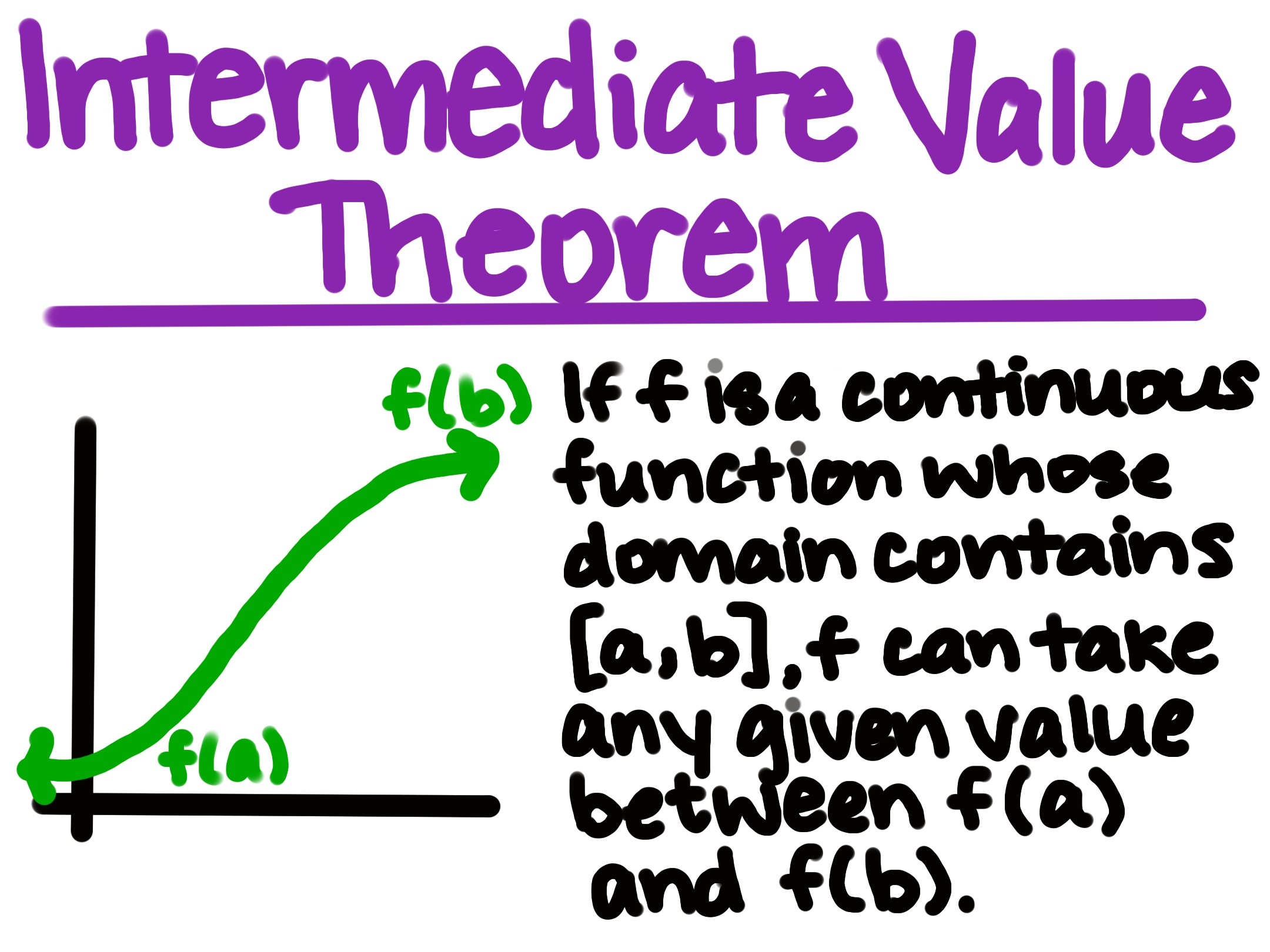
If f is a continuous function whose domain contains [a,b], f can take any given value between f(a) and f(b).

Image source: by Anusha Rahman

Let’s say you’re hiking up a hill. At the bottom, you're at 100 feet. At the top, you’re at 300 feet. The IVT says that if you walk up smoothly without jumping or teleporting, you must pass through every height between 100 and 300 feet. That includes 150 feet, 200 feet, and even 278.5 feet!

We can extend this idea to math, specifically continuous functions. Continuous functions) are the functions you can draw without lifting your pencil. The IVT says: If ff is a continuous function whose domain contains [a,b][a,b], ff can take any given value between f(a)f(a) and f(b)f(b).

In more basic terms: If a function is continuous, and it goes from one value to another, it has to hit every value in between. This helps us know that some equations must have solutions, even if we can't find them exactly. It’s like knowing there’s a treasure on the path, even if we don’t know the exact spot yet.

Once the zeros are known, you can write a polynomial in terms of its roots.

Type a concept, like “slope” or “photosynthesis”.

↑ ↓ to choose · Enter to openSearch explanations and problems