Summary
To understand what the Rational Root Theorem is, we need to understand what each aspect of the theorem means. From the word "Rational", we can think that the process will include ratios. From the word "Root" we know that we will be looking for solutions, which are the points where the function crosses the x-axis.
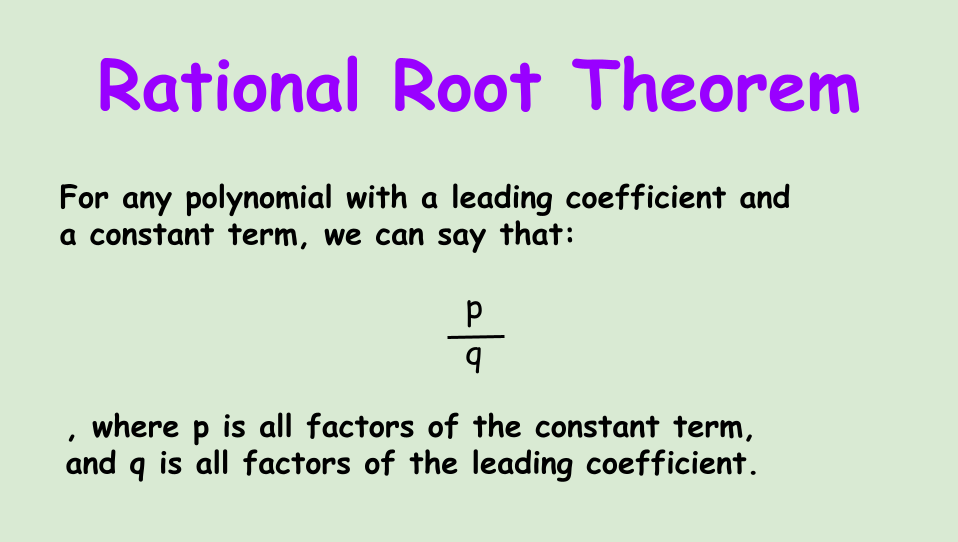
To use the Rational Root Theorem, we are looking for,
qp,
where p is all of the factors of the constant term, and q is all of the factors of the leading coefficient.
Looking at an example,
f(x)=2x3−12x2+22x−12
All of the factors of −12 are: ±1,±2,±3,±4,±6,±12
All of the factors of 2 are: ±1,±2
So, we can say that:
±1,±2±1,±2,±3,±4,±6,±12
Remember, this is a ratio, so we can simplify this further to all possible roots.
21,1,23,2,3,4,6,12
To test these roots, we use synthetic division, looking for roots that have a remainder of 0. After trying each one, we find that x−1 is a factor, +1 is a root.
(x+1)(2x2−10x+12)
We have a quadratic, which we are very familiar with! We can either factor or use the quadratic formula to find the rest of the zeroes.
Factoring out the common factor from the quadratic,
2(x2−5x+6)
Which we can then simplify to,
2(x−3)(x−2)
So, our zeroes are: 1,2,3.
In factored form,
2x3−12x2+22x−12=(2)(x−3)(x−2)(x−1)