乘法统计原理

Interactive · 2 questions

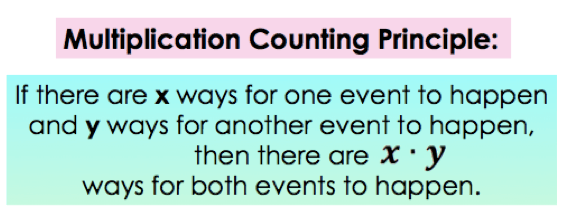
The multiplication counting principle states that the number of ways a sequence of events can occur is the product of the number of ways each individual event can occur.

Example 1:

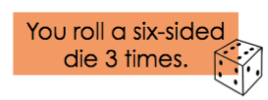
Jack, Mary, and Tom each roll two dice. What is the number of ways in which Jack can get a total of 6,6, Mary can get a total of 4,4, and Tom can get a total of 3?3?

First we must look at the individual events — let's start with Jack. Jack must get a total of 66 from two dice. Let the possible combinations be in the form (a,b)(a, b) where aa is the number the first dice lands on and bb is the number the second dice lands on. The possible combinations are (5,1)(5, 1), (2,4)(2, 4), (3,3)(3, 3), (4,2)(4, 2) and (1,5)(1, 5) so there are 55 ways Jack can get a total of 6.6.

Similarly, the possible combinations for Mary are (1,3)(1, 3), (2,2)(2, 2), (3,1)(3, 1) →\rightarrow 33 ways. The possible combinations for Tom are (1,2)(1, 2) and (2,1)(2, 1) →\rightarrow 22 ways.

The number of ways in which Jack can get a total of 66, Mary can get a total 44, and Tom can get a total of 33 is 5×3×2=30.5\times 3\times 2 = 30.

Example 2:

You are planning your schedule for next year; there are 33 Math courses, 22 English courses and 44 Science courses that you are eligible to enroll in. You want to take 11 course in each subject, how many combinations of 33 courses (11 from each subject) do you have to choose from?

Number the courses in each subject from 11 to the number courses you are eligible to enroll in for that subject.
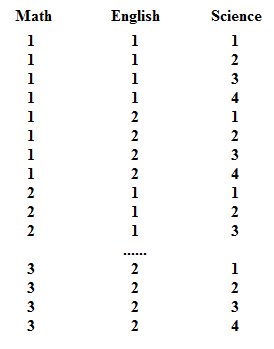
Table of ways to take different numbers of each kind of class.

There are 4 different science classes you can take with each English class and there are 2 different English classes you can take with 3 possible Math classes. If you follow the pattern above you will get 24 combinations. Note that since there are 3, 2 and 4 Math, English and Science classes you can take (respectively) you get...

3×2×4=243 \times 2\times 4 = 24

Test Yourself!

How many numbers in the range 100100 - 999999 do not have any repeated digits?

Choose one answer

Interactive · 4 questions

What is the multiplication counting principle?

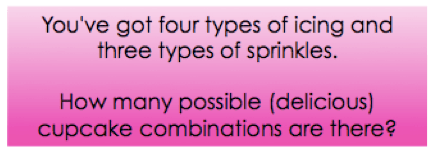
Imagine that you're making cupcakes. You've got four types of icing and three types of sprinkles. How many possible (delicious) cupcake combinations are there?

Obviously, since cupcakes are involved, this is a critical question. How can we figure this out?

An array of chocolate cupcakes in rainbow wrappers with a maple icing and bacon crumbles. Yum!

Image by Free-Photos via Pixabay (CC0)

The multiplication counting principle allows us to calculate the number of possible outcomes of multiple events happening at the same time. In our case, the first "event" is the icing and the second "event" is the sprinkles.

Multiplication Counting Principle: If there are x ways for one event to happen and y ways for another event to happen, then there are x * y ways for both events to happen

Let's come back to our cupcake problem.

You've got four types of icing and three types of sprinkles. How many possible (delicious) cupcake combinations are there?

How many different cupcake combinations (icing + sprinkles) are possible?

Choose one answer

Video

(Video) The Counting Principle, Permutations, and Combinations

by Jack Walker

Jack Walker has a great video on the multiplication counting principle, permutations, and combinations.

How many ways are there to arrange the letters in the word "SARAH?"

Choose one answer

Interactive · 3 questions

Counting Sizes of Cartesian Products

One particular instance of the Multiplication Counting Principle is in finding the sizes of Cartesian products of sets. If AA and BB are sets, the Cartesian product of sets AA and B,B, denoted A×B,A \times B, is the set of all ordered pairs where the first coordinate is an element of AA and the second coordinate is an element of B.B.

Example: If A={1,2,3}A = \{1, 2, 3\} and B={4,5},B = \{4, 5\}, then

A×B={(1,4),(1,5),(2,4),(2,5),(3,4),(3,5)}.A \times B = \{(1, 4), (1, 5), (2, 4), (2, 5), (3, 4), (3, 5)\}.

At the same time, we can flip the positions of AA and BB and see that

B×A={(4,1),(4,2),(4,3),(5,1),(5,2),(5,3)}.B \times A = \{(4, 1), (4, 2), (4, 3), (5, 1), (5, 2), (5, 3)\}.

In general, A×BA \times B and B×AB \times A have the same number of elements (where each element is an ordered pair), but the elements are not the same. Like in the example above, (4,1)(4, 1) is NOT the same as (1,4).(1, 4).

For the next series of questions we use X={0,1,2,3,4}X = \{0, 1, 2, 3, 4\} and Y={−3,5}.Y = \{-3, 5\}.

How many elements are in X?X?

Choose one answer

Type a concept, like “slope” or “photosynthesis”.

↑ ↓ to choose · Enter to openSearch explanations and problems