不连续点

Before this, know有理函数的定义域和值域

Read · 1 min

##How to find points of discontinuity

Points of discontinuity, also known as holes, are points on a rational function that are undefined. We can find the points of discontinuity by factoring the numerator and denominator of a rational function and canceling any common factors. These common factors can then tell us the xx and yy values of the hole. Keep in mind - there can be multiple holes if multiple factors cancel!

Let's look at an example rational function:

y=x2+7x+12x3+3x2−6x−18y = \frac{x^2 +7x +12}{x^3 +3x^2 - 6x -18}

If we factor...

y=(x+3)(x+4)(x+3)(x2−6)y = \frac{(x+3)(x+4)}{(x+3)(x^2 -6)}

We can see that (x+3)(x+3) is a common factor in both the numerator and denominator, so we can cancel them.

y=(x+3)(x+4)(x+3)(x2−6)y = \frac{\cancel{(x+3)}(x+4)}{\cancel{(x+3)}(x^2 -6)}

To find the xx value of the hole, we can make x+3=0x+3 = 0 and solve. So, the xx value of the hole is −3-3.

To find the yy value of the hole, we can just plug the xx value into the new equation and solve.

y=((−3)+4)((−3)2−6)=13y = \frac{((-3)+4)}{((-3)^2 -6)} = \frac{1}{3}

Therefore, the coordinate of the hole is (−3,13)(-3, \frac{1}{3}).

As the hole is a point of discontinuity, the hole is not included in the domain or range.

Video · + 1 min read

(Video) Finding the Removable and Nonremovable Discontinuities of a Rational Function

by The Math Sorcerer

As we work toward learning how to graph rational functions, we have to learn how to find points of discontinuity and the types of discontinuity.

Check out this video by The Math Sorcerer to learn how to find removable and non-removable points of discontinuity.

Let's use the example rational function used in the video:

f(x)=(x+2)(x−1)(x−3)(x+2)f(x) = \frac{(x+2)(x-1)}{(x-3)(x+2)}

The first step is to simplify the function, so we can cancel out (x+2)(x+2) from both the numerator and the denominator. Our simplified function is:

f(x)=x−1x−3f(x)=\frac{x-1}{x-3}

A hole is when a factor in both the numerator and denominator can be canceled, meaning (x+2)(x+2) represents a hole. To find the xx-coordinate of the hole, we can set the cancelled factor, (x+2)(x+2), equal to zero, meaning x=−2x=-2. To find the yy-coordinate of the hole, we can plug the xx value into the simplified equation and solve for the yy-value. In this case, the yy value is 35\frac{3}{5}, so the coordinate of the hole is (−2,35)(-2, \frac{3}{5}),

Any hole in a rational function is removable.

Non-removable discontinuities include vertical and horizontal asymptotes, which we have covered previously. In this example, the vertical asymptote is x=3x=3.

Illustrated · 1 min

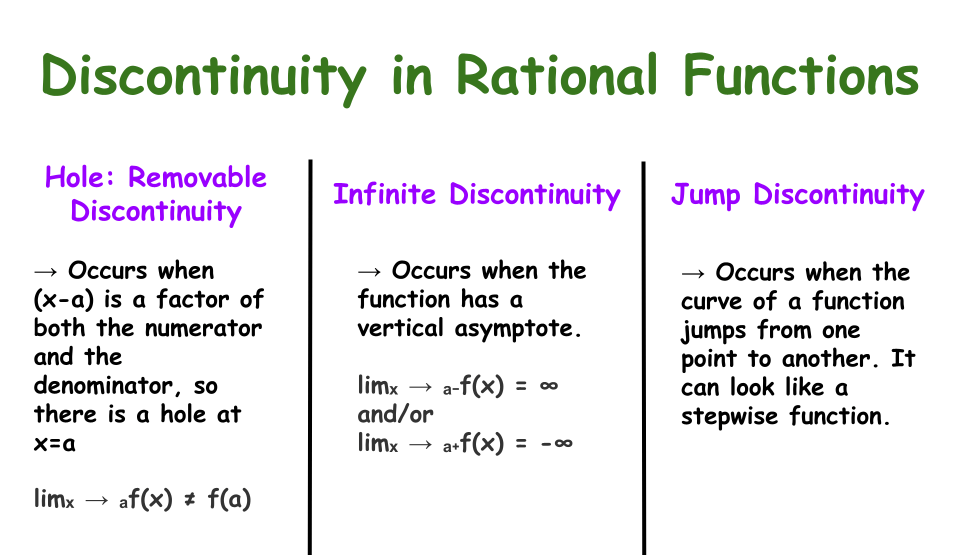
Discontinuity in Rational Functions

Sometimes, when we graph a rational function, the function isn't smooth all the way through. Discontinuity means that there's a "break" in a graph.

Discontinuity in Rational Functions

Hole: Removable Discontinuity

Infinite Discontinuity

Jump Discontinuity

→ Occurs when (x-a) is a factor of both the numerator and the denominator, so there is a hole at x=a

limₓ → ₐf(x) ≠ f(a)

→ Occurs when the function has a vertical asymptote.

limₓ → ₐ₋f(x) = ∞ and/or 
limₓ → ₐ₊f(x) = -∞

→ Occurs when the curve of a function jumps from one point to another. It can look like a stepwise function.

Image source: by Anusha Rahman

There are three main types: hole, infinite, and jump.

####Hole (Removable)

A hole happens when the same factor is in both the numerator and the denominator, like (x−a)(x-a).

f(x)=(x−a)(x−b)(x−a)f(x) = \frac{(x-a)(x-b)}{(x-a)}

This kind of discontinuity is called removable because the hole can be "fixed" by canceling the factor.

####Infinite Discontinuity

An infinite discontinuity happens when there's a vertical asymptote, which means that the graph shoots way up or way down. This usually happens when the denominator is zero, and the factor does not cancel out.

####Jump Discontinuity

A jump discontinuity looks like a sudden step in the graph, where the function "jumps" to a different value. You often see jumps in piecewise (or step) functions.

Type a concept, like “slope” or “photosynthesis”.

↑ ↓ to choose · Enter to openSearch explanations and problems