$f(x+c)$ vs $f(x)$

Before this, know变换:上下移动

Interactive · 1 question

Graphs of f(x+c)f(x+c)

Pretend you had some nasty function f(x)f(x) and you just finished figuring out how it works. But then the teacher tells everybody, "Graph f(x+3)f(x+3)!!!"

Oh no! Do we have to plug in x+3x+3 to every xx and expand everything out?

Hopefully not. Let's see if there is any pattern.

The blue functions are the original f(x)f(x)s, and the red functions are the changed f(x+3)f(x+3)s.

Graphs of x^2, (x + 3)^2, x/2, (x + 3)/2

Graph courtesy of Desmos

What is the x+3x+3 doing to the functions?

(Hint: Look at where they cross the x-axis)

Choose one answer

Illustrated · 1 min

When moving a function right or left, you change the xx coordinate. For example, take f(x)=x2f(x) = x^2 and move it to the left:

Graphs of x^2 and (x + 2)^2

Graph courtesy of Desmos

The only thing changing, is the xx coordinate, so in your equation, you only change the xx value. When the function moves to the right, you change xx to (x−a)(x - a), and when it moves to the left, you change xx to (x+a)(x + a).

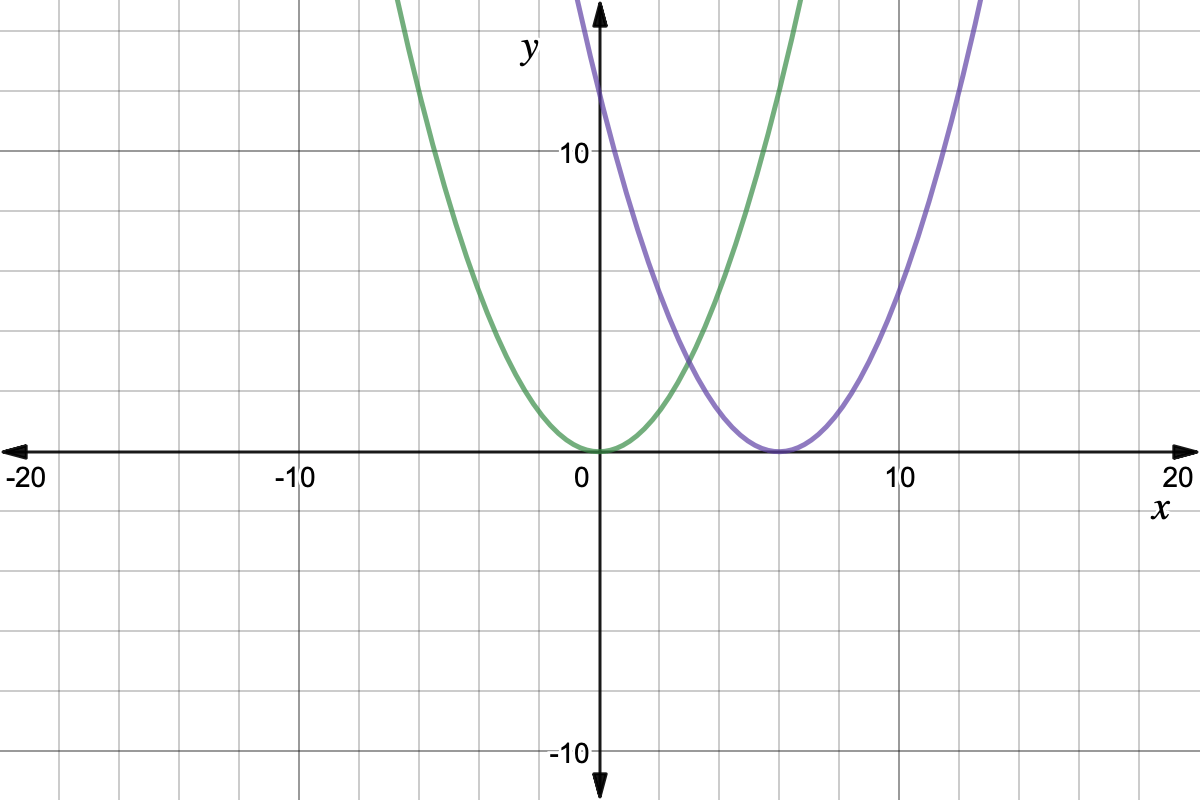
As an example: y(x)=x23y(x) = \frac{x^2}{3} is moved 6 to the right. What'll be the new formula?

ynew(x)=(x−6)23y_{new}(x) = \frac{(x-6)^2}{3}

ynew(x)=x2−12x+363=13x2−4x+12y_{new}(x) = \frac{x^2 -12x + 36}{3} = \frac{1}{3}x^2 - 4x + 12

Graphs of x^2/3 and (x - 6)^2/3

Graph courtesy of Desmos

Illustrated · 1 min

In Context

In this series of function transformations, we are starting off with vertical and horizontal translations. This lesson will consider the horizontal transformations.

Horizontal Translation

The next in our series of function transformations is the horizontal translation!

Horizontal translation: shifting a function left or right along the x-axis

Image source: by Anusha Rahman

A horizontal translation allows us to shift a function horizontally, or left and right, along the xx-axis.

Example

Let's start with the parent function of the quadratic function, y=x2y=x^2.

Graph of y=x^2

Made using Desmos

Let's say we want to shift this function over to the right by one unit. Our new graph would look like:

Graph of y=(x-1)^2

Made using Desmos

The equation for this new graph would need 11 added to xx, inside the parentheses. If we want to shift a function to the left, we add a constant. If we want to shift a function to the right, we subtract a constant.

Our new equation is: y=(x−1)2y=(x-1)^2

Video

(Video) Horizontal Function Transformations

by Anusha Rahman

In this lesson by Anusha Rahman, you will learn about shifting a function to the left or right.

Summary

A horizontal function transformation will move a function to the left or right. We can also call this type of transformation a horizontal translation. We are typically given the number of units we will be translating a function, and the size and shape of the function will stay the same.

g(x)=f(x−k)g(x) = f(x-k)

kk is the number of units that we will horizontally translate the function. If k>0k>0, the function will shift to the right by kk units. If k<0k<0, the function will shift to the left by kk units. Watch your signs!

Type a concept, like “slope” or “photosynthesis”.

↑ ↓ to choose · Enter to openSearch explanations and problems