
根据给出的图像,写出变换表达式

Before this, know$f(cx)$ vs $f(x)$$f(x+c)$ vs $f(x)$变换:镜面(关于y轴映射)

Illustrated · 2 min

In the previous lessons, we've talked about vertical translations, horizontal translations, vertical reflections, horizontal reflections, vertical dilations, and horizontal dilations.

This lesson will cover how to combine these transformations, dramatically changing a function from a parent function to a new, transformed function.

Order Matters:

Similar to solving functions and equations, there is an order in which we apply function transformations.

  1. Do the horizontal shift, within the parentheses.

  2. Do the stretch/compression, which is the constant multiplied by the parentheses.

  3. Do the reflection across the xx- or yy-axis.

  4. Lastly, do the vertical translation.

Basically, you're doing the operations from within the parentheses first, then moving to the constant sign multiplied by the parentheses, and then ending with the constant term added/subtracted from the parentheses.

Inside→Outside\text {Inside} \rightarrow \text {Outside}

One important note: the coefficient of xx has to be 11 in order to accurately transform functions.

Let's walk through an example together!

Example

f(x)=−2(x+4)2−4f(x)=-2(x+4)^2 -4

The parent function is: f(x)=x2f(x)=x^2

graph of y=x^2

Made using Desmos

Since we're working from inside →\rightarrow outside, we will start with the horizontal shift. The parent function is shifted 44 units to the left.

So far, we have: y=(x−4)2y=(x-4)^2

Graph of y=(x+4)^2

Made using Desmos

Our next step is to stretch or compress the function, if needed. The parentheses are multiplied by −2-2, but we should tackle the 22 before considering the negative sign. So, let's compress the function by a factor of 22.

So far, we have: y=2(x−4)2y=2(x-4)^2

Graph of y=2(x+4)^2

Made using Desmos

Next, we're going to apply that negative sign we ignored in the previous step. So, we will reflect the function over the xx-axis.

So far, we have: y=−2(x−4)2y=-2(x-4)^2

Graph of y=-2x(x+4)

Made using Desmos

Our last step is to do the vertical translation! We will translate our function down by 44 units.

Finally, we have our original function: y=−2(x−4)2−4y=-2(x-4)^2 -4
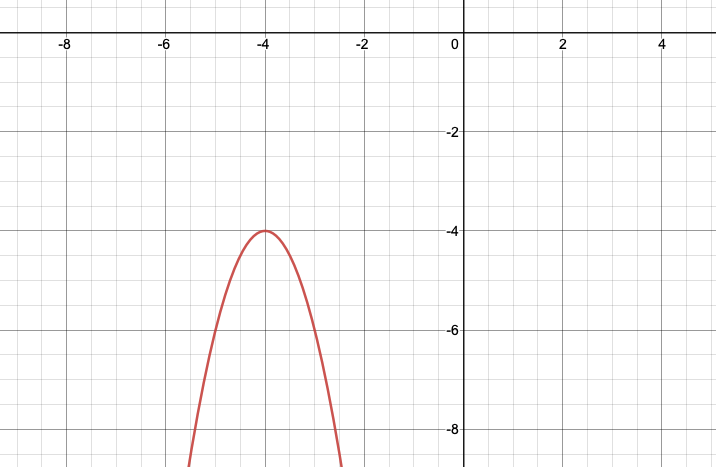
Graph of y=-2x(x+4)-4

Made using Desmos

Look how much we have changed and moved the graph, compared to the parent function! They look completely different.

In Summary

When doing multiple transformations, you can have a parent function that is stretched horizontally, stretched vertically, have vertical or horizontal translations, or is reflected. This can dramatically change the shape of the graph.

Video · + 1 min read

(Video) Quadratics with Multiple Transformations

by Brian McLogan

In this video, Brian McLogan teaches you how to graph a quadratic function in vertex form, with multiple function transformations.

Summary

We are going to graph y=−3(x+3)2+4y=-3(x+3)^2 +4.

Our first step is to graph the parent function, y=x2y=x^2.

Graph of y=x^2

Made using Desmos

Our next step is to look at how the vertex affects the graph. The vertex of the parent function is at the origin, (0,0)(0,0). The vertex for our transformed function is at (−3,4)(-3,4). That means we shift the function left by three units and up by four units.

We will also notice that the aa value on our parent function was positive, but the aa value on our transformed function is negative. That means the vertex for our transformed graph will be a maximum, not a minimum. Our graph will open downward!

Next, we will look for the intercepts! To find the yy-intercept, we need to find yy when x=0x=0. When we solve, we find that the yy-intercept is (0,−21)(0,-21). The yy-value seems a little big, but let's look at why. We know that when ∣a∣>1|a|>1, the function is compressed, so the graph will be skinnier.

Here is what the graph will look like:

Graph of y=-3(x+3)^2 +4

Made using Desmos

A good way to check your work is to plug in values from a table!

Illustrated · 1 min

Transform One Function Graph into Another

Now that we've learned the individual function transformations, we can combine transformations.

Transform One Graph into Another

Made using Desmos

When working with functions, you can transform them in different ways, like shifting, stretching, or flipping. These transformations can be combined to change the graph in more complex ways. Play around with the function transformations to see what interesting functions you can come up with!

Type a concept, like “slope” or “photosynthesis”.

↑ ↓ to choose · Enter to openSearch explanations and problems