函数的极限是什么?

Read · 1 min

Limits of Functions

Let ff be a function. We can say the limit of f(x)f(x) as xx approaches cc is LL if we can get f(x)f(x) values arbitrarily closer to LL by taking xx values sufficiently closer and closer to cc but never actually equal cc. We can write this as lim⁡x→cf(x)=L\lim_{x\rightarrow c}f(x) = L.

Note: f(x)f(x) does not have to be defined at some point cc in order to find the limit as xx approaches cc.

One-Sided Limits

Let ff be function on an interval (a,c)(a, c) where a<ca < c. Then we say the left hand limit of f(x)f(x) as xx approaches cc is LL if we can get values of f(x)f(x) from xx values that are close to c but never actually equal c and x < c. We write this as lim⁡x→c−f(x)=L\lim_{x\rightarrow c^-}f(x) = L.

Simlarily, we can write the right hand limit as lim⁡x→c+f(x)=L\lim_{x\rightarrow c^+}f(x) = L where x>cx > c.

Note: lim⁡x→cf(x)=L\lim_{x\rightarrow c}f(x) = L if and only if lim⁡x→c−f(x)=L\lim_{x\rightarrow c^-}f(x) = L and lim⁡x→c+f(x)=L\lim_{x\rightarrow c^+}f(x) = L.

Video · + 1 min read

(Video) Basic Description of Limits

by PatrickJMT

In this video by patrickJMT he explains the basic idea of limits.

A limit is a value that a function approaches as the input approaches a value.

He starts by looking at the example y=x−4y=x-4. So if we start putting in numbers close 5 (like 5.1, 5.01, 5.001, 4.9, 4.99, 4.999, etc.) we get out numbers close to 1. xf(x)4.90.94.990.994.9990.999515.0011.0015.011.015.11.1\begin{array}{c|c} x&f(x)\\ \hline 4.9&0.9\\ 4.99&0.99\\ 4.999&0.999\\ \color{red}{5}&\color{red}{1}\\ 5.001&1.001\\ 5.01&1.01\\ 5.1&1.1 \end{array} This is basically the fundamental idea of a limit. We put in numbers close to a specific number and we see what numbers we get out of our function.

We denote this as: lim⁡x→5x−4=1\lim_{x\rightarrow5}x-4=1 Read: The limit as xx approaches 55 of the function x−4x-4 approaches 11. The general way we write this is: lim⁡x→af(x)=L\lim_{x\rightarrow a}f(x)=L The number we get out is known as the limit of the function. So in the previous example, 11 would be the limit of the function.

There are different ways in which we deal with limits.

  1. xx approaches a finite number lim⁡x→af(x)=L\\ \lim_{x\rightarrow a}f(x)=L
  2. xx approaches positive or negative infinity lim⁡x→±∞f(x)=L\\ \lim_{x\rightarrow\pm\infty}f(x)=L This just means that we're putting in very very large numbers and seeing what we get out or putting in very very small numbers and seeing what we get out.

The basic idea on how you do a limit is plug and chug. You plug in values approaching a certain number and see what values come out, and what those values approach. In our last example we could easily plug in 5 and solve to get 1. Usually though, with limits, when we plug in the number we get outputs we can't solve like:

  1. 00\dfrac00
  2. NonzeroZero\dfrac{\text{Nonzero}}{\text{Zero}}

There are some good common tricks we can use to help us find the limit of a function:

  1. Factor
  2. Common Denominator
  3. Expand
  4. Multiply by Conjugate
  5. Others (problems that don't fit into the first 4)

Interactive · 4 questions

WHAT ARE LIMITS OF FUNCTIONS?

A function's limit is a value or set of values for which a function's output is undefined.

NOTE

lim⁡x→a=f(x)\lim_{x\to a}=f\left(x\right) where a is undefined by f(x)f\left(x\right)

WHAT ARE LIMITS FOR?

Limits are written when you want to find a function's value at a limit. Limits also represent when x reaches a number infinitely close to the limit.

HOW DO YOU FIND A FUNCTION'S VALUE AT A LIMIT?

BRUTE FORCE METHOD

The brute force method is used when you calculate variables which are close to limit a for predicting what x is.

EXAMPLE

f(x)=x2−9x+3f\left(x\right)=\frac{x^2-9}{x+3}, lim⁡x→3f(x)\lim_{x\to3}f\left(x\right)

f(2.9)=2.92−92.9−3=5.9f\left(2.9\right)=\frac{2.9^2-9}{2.9-3}=5.9, f(2.99)=2.992−92.99−3=5.99f\left(2.99\right)=\frac{2.99^2-9}{2.99-3}=5.99

lim⁡x→3f(x)=6\lim_{x\to3}f\left(x\right)=6

ALGEBRAIC MANIPULATION

Algebraic manipulation is used when you change or simplify a limited function to remove and solve the limit. If a limit doesn't really exist, then give the value for a=xa=x.

EXAMPLE

f(x)=x2−16x−4f\left(x\right)=\frac{x^2-16}{x-4}, lim⁡x→4f(x)\lim_{x\to4}f\left(x\right)

x2−16x−4=(x−4)(x+4)x−4=x+4=f(x)\frac{x^2-16}{x-4}=\frac{\left(x-4\right)\left(x+4\right)}{x-4}=x+4=f\left(x\right)

lim⁡x→4f(x)=8\lim_{x\to4}f\left(x\right)=8

PIECEWISE FUNCTIONS

Piecewise functions are functions which use different functions for different x values.

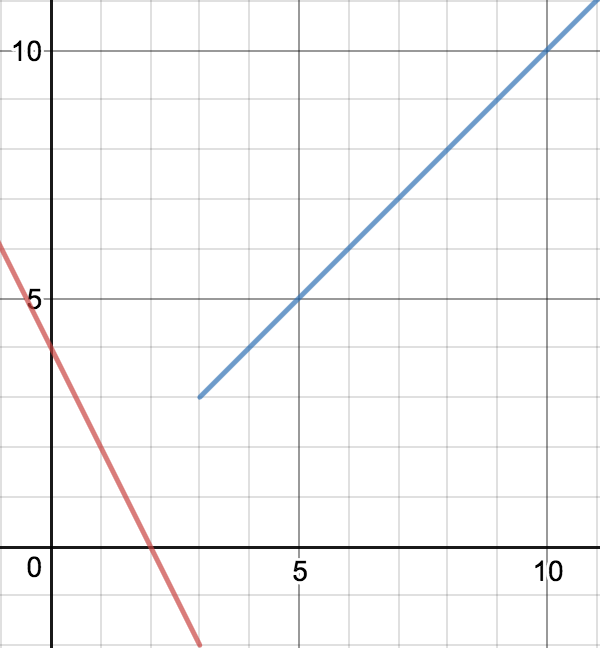
Piecewise Function

f(x)={x,x>3;−2x+4,x<3}f\left(x\right)=\left\{x,x>3;-2x+4,x<3\right\}

RIGHT HANDED LIMITS

Right handed limits are found when using brute force and going from high to low x value.

NOTES

lim⁡x→a+f(x)\lim_{x\to a^+}f\left(x\right) is the right handed limit

EXAMPLE

In the graph above, lim⁡x→3+f(x)=3\lim_{x\to3^+}f\left(x\right)=3

LEFT HANDED LIMITS

Left handed limits are found when using brute force and going from low to high x value.

NOTES

lim⁡x→a−f(x)\lim_{x\to a^-}f\left(x\right) is the left handed limit

EXAMPLE

In the graph above, lim⁡x→3−f(x)=−2\lim_{x\to3^-}f\left(x\right)=-2

LIMIT RULES

Limits only affect individual x values.

Left and right handed limits must be the same. Otherwise the limit is undefined.

lim⁡x→a−f(x)=0\lim_{x\to a^-}f\left(x\right)=0 & lim⁡x→a+f(x)=6\lim_{x\to a^+}f\left(x\right)=6. lim⁡x→af(x)=?\lim_{x\to a}f\left(x\right)=?

Choose one answer

Type a concept, like “slope” or “photosynthesis”.

↑ ↓ to choose · Enter to openSearch explanations and problems