Daerah Asal dan Jarak

Read · 1 min

##Find the domain and range of a radical function

Finding the domain and range of a radical function is very similar to finding the domain and range of other functions.

The domain of a radical function is restricted when the radicand is less then zero. In other words, we know we can't take the root of a negative number (ignoring imaginary numbers), so the domain would be restricted to only positive numbers.

Let's look at an example problem:

y=5x+1y = \sqrt{5x + 1}

Since the values inside the square root must be greater than or equal to zero, we can set the expression inside the square root equal to zero and solve.

5x+1=05x + 1 = 0 5x=−15x = -1 x=−15x = \frac{-1}{5}

Therefore, we know the domain in interval notation is [−15,∞)[\frac{-1}{5}, \infty)

Note! We used a closed bracket for −15\frac{-1}{5} because if we plug in −15\frac{-1}{5} into the equation, we get 0\sqrt{0}. As we can take the square root of 00, it is included in the domain.

Now let's find the range of a radical function. Since we know we cannot take the square root of a negative number, we know that any value we take the square root of will always be positive.

Therefore, the range of y=5x+1y = \sqrt{5x + 1} is [0,∞][0, \infty].

However, certain vertical shifts or reflection transformations can cause the range to be negative, so be careful!

Video · + 1 min read

(Video) Domain and Range of Square Root Functions

by drmikedcook

Here's a video by drmikedcook showing you how to graph the square root function and find its domain and range.

Summary

To find the domain and range of a square foot function, we are combining some concepts that we already know. First, we need to remember how to graph a square root function. Then, we also need to remember how to find the domain and range.

Let's walk through an example.

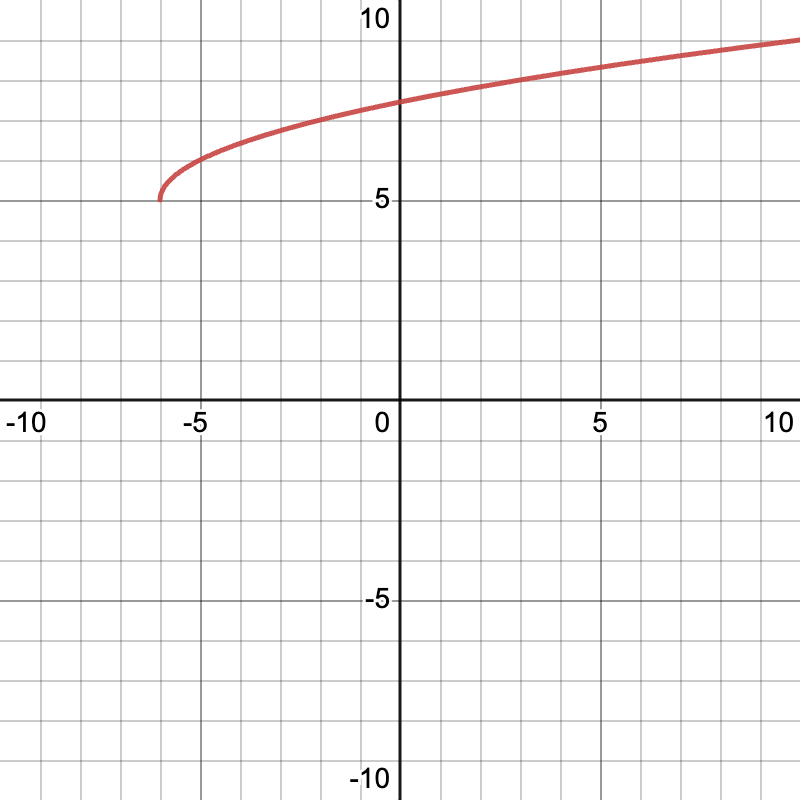
Example: Find the domain and range of y=x+6+5y=\sqrt{x+6} + 5

The first step is the graph the function. The starting point is always (h,k)(h,k), where the hh changes signs, but the kk does not. We then need to know whether the graph flips or not. Since aa is positive, the graph does not flip.

Our graph looks like:

Graph of y=sqrt(x+6) + 5

Image made by desmos

Alternatively, you could solve for points and plot those points!

Next, we will look at the domain. The domain is all values of xx. That means that the domain is x≥−6x \geq -6.

Last, we will look at the range. The range is all possible values of yy. The range is y≥5y \geq 5.

Illustrated · 1 min

Domain and Range of Radical Functions

This next set of lessons will dive deeper into graphing radical functions.

Domain & Range of Radical Functions
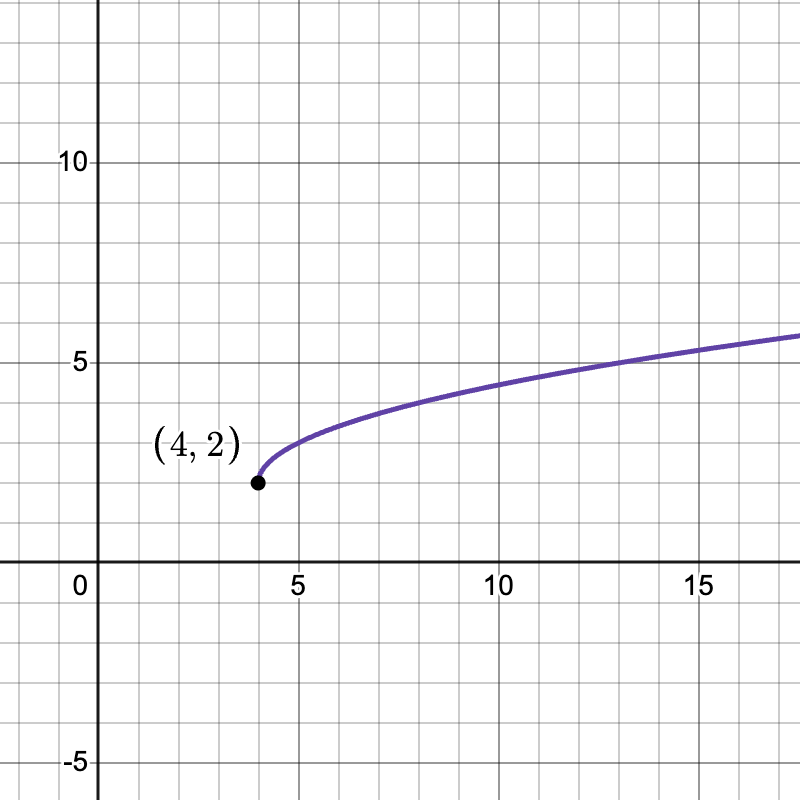
y=squareroot(x-4)+2
domain: x>=4 we can't take the square root of a negative number
range: x>=2 graph starts at (4,2) and curves up and right

Image source: by Anusha Rahman

Let's look at the radical function in the image above: y=x−4+2y=\sqrt{x-4}+2

Finding the Domain

There is a square root, so we must be careful about what xx-values we can use. We can't take the square root of a negative number, so x−4x-4 must be zero or greater. That means that xx must be 44 or more.

Therefore, the domain is x≥4x \geq 4.

Finding the Range

Now let's look at what happens to the yy-values, which is called the range. As xx gets bigger, the square root gets bigger too, so yy also increases. That means the range is y≥2y \geq 2.

Graphing

The graph starts at the point (4,2)(4,2) and never goes below y=2y=2. It never goes left of x=4x=4 and never goes below y=2y=2. So, from the graph below, we can clearly see that the domain and range match what we found!

Graph of the function

Made using Desmos

Radicals can be rewritten using fractional exponents, connecting to inverse power functions. Powers and roots are closely related through exponent rules.

In the next few lessons, we will cover the cube root graph, the fourth root graph, and translations, both vertically, and horizontally. We will end with radical inequalities.

Type a concept, like “slope” or “photosynthesis”.

↑ ↓ to choose · Enter to openSearch explanations and problems